
Columbus, Ohio USA
Return to Homepage www.shortnorth.com
Elizabeth Ann James
Art Column Archive 1999-2003
LIZ JAMES ART COLUMNS
Visit Art Columns 2004-2005
Visit Art Columns 2006
Visit Art Columns 2007
Visit Art Columns 2008
December 2003
Thomas R. Riley Galleries has continued to supercede its own excellence
Hiroshi Yamano creates glass masterpieces; he's a contemporary master. His current work, in this case a series employing fish as a motif, is somewhat realistic and detailed. On the other hand, it's dreamy, ethereal, provokes speculation of the artist's intent.
Yamano's glass sculptures will remain on view at Thomas R. Riley Galleries, 642 N. High Street, thru December 15, 2003. Riley is correct in saying that Yamano's consummate skill has "elevated glass beyond decor and function into art," meaning fine art, sculpture.
The exhibit consists of 18 blown worked-glass sculptures with titles that begin "From East To West." In halting but correct English, Yamano explained that "blown, worked - they're the same, glass blowing."
In fact, Yamano is familiar with traditional Japanese metalwork - even the art of sword making!
He can also plate the surface of a vessel with hot-sculpted and cold-worked glass elements. He can "roll thickly blown hot glass over silver leaf to fuse it, scratching figures into the surface; he can plate the surface with copper." Thus, the silver-sided ultra-gleaming fish!
The fish: These fish range from around 6 inches to 11 inches long. They droop, curl, hang, suspend. They gleam.
"They're frozen in time," Riley explained. There is a sameness to the many curved and drooping creatures and their enclosed aquatic environments, but there is an engaging individuality among them as well. Tinges of color on tails and fins vary. The fish and their environments are breathtaking.
The containers: With special drills "similar to dental instruments," Yamano can etch the surfaces of his fish-containers with images. In many cases he etches mini fish, tiny line-drawings which embellish the outer surfaces of his containers and baskets with all-over designs.
A statement from the Trevor Gallery in Seattle reinforces the concept of motif: "Yamano's trademarks are fish, oceans, and mountains." The fish speak of his wanderlust; the mountains refer to his stays in the U.S. His oceans and lakes (that the fish swim in) symbolize Japan.
Fish Catcher Bag Type #66 - Outside: This glass catcher bag, a mottled bronze in tone, is at least 19 inches tall. It does not appear to be entirely glass but it is. It seems to have an outer surface that is painted wood or clay. On the tan surface, Yamano, with that special drill, has etched tiny fish swimming with pale open mouths. They have teeth. They grimace.
Inside: As do most of Yamano's fish containers and catchers, this one has a clear glass port hole, a long oval in front thru which, toward the top, two, sometimes three, long fish are visible. In front, the silver fish has a faintly magenta tail hanging over the top. In back a second silver-sided fish curves a silver tail.
Immersed in glass, swimming or suspended, hanging within depths of a cloudy blue which settles into a faded yellow green toward the bottom - one can gaze upon Fish Catcher Bag Type #66 and continue to notice more details. Yamano's realistic fish have wide mouth lips, fins, and gills. Their glass eyes contain pupils. They are marvelous fish. They seem to escape Fish Catcher Bag Type #66 and to multiply. There are five of them on the Fish Hanger #25!
From East To West Fish Hanger #25: This sculpture/construction, one of the hangers, consists partly of a black frame. #25 is a two-section hanger with a top and a bottom. A yellow sea tone prevails in the glass here, with clear overlays. Yet Yamano's fish remain obstinately silver. On top, the catcher bag holds two fish with tails hanging over the lid. The lower section reveals two smaller fish curling over the sides of an etched yellow bowl.
Hiroshi Yamano, born in 1956 in Fukuoka, Japan, earned his MFA from the Rochester Institute of Technology. He has shown in many fine galleries and lectured in Sweden, Ireland, Australia, Mexico, and, of course, in the States and Japan. After counting 30 solo exhibitions,
I stopped. In 1994, he entered the Japan Modern Glass Art Exhibition and won the Notojima Town Prize. His list of exhibits and educational accolades is superlative.
Of his recent youth and his ongoing fish motifs, Yamana says, "Some fish, like the tuna or the salmon, have to move, to keep moving or they die. I thought about that. I like to live like that. I'd move somewhere and I'd stay a couple years and make friends, connect, and then I'd move again and do the same thing".
At the opening, artist Xan Palay referred to Yamano's work as transformative. I'd say beautiful, precisely rendered, evoking layers of meaning.
As to the fish, although they've caught the light of gleaming moons and phosphorescent coral, they are sleek, thoroughly modern fish hooked by a contemporary master.
One more Piscean delight: three marvelously detailed women, nearly shoulder high, ceramic sculptures by Mel Rea. One sculpture is definitely a Mermaid; the other two seem to have emerged from the sea in intricately patterned ceramic apparel.
Get in the swim. See for yourself.
Mac Worthington, Genius In Aluminum
The artist grinds, polishes, cuts, spins and welds aluminum, and he does it with finesse and exactitude
Aluminum sculpture by the artist Mac Worthington continues to dance with a unique and upbeat light. It continues to sell too!
The artist grinds, polishes, cuts, spins and welds aluminum, and he does it with finesse and exactitude. - That's not easy. Any welder or metal worker knows that the welding and incising of aluminum is an intricate process. You have to be fast! Mac is very good at that; he's able to combine art and technology in a fabulous way.
What's Mac's newest thing? The Shadow Boxes,"flat aluminum paintings under glass."
One of them is Self Portrait in a black 20" x 24" frame. As a portrait, this one is highly abstract to say the least! Mac has used his unabashed love of color in arranging bright geometric shapes that touch each other but do not merge or blend.
"Deep pink, red, teal, yellow - I like primary colors. Vivid color! That's why this is me," he laughed, pointing to a big yellow circle with a bright red circle inside it, "and everything's aluminum!"
Seven, a horse flying without wings, is delicately carved, pointy maned and strong hooved. He's a gleaming aluminum wall sculpture named after Mac's own favorite horse in Colorado. He's 48 inches tall and around 39 inches wide.
Seven - he's Pegasus for the information age! Look up and there he is, flying in profile. Lucky Seven can race indoors and out.
The tables. Aluminum is soft, light, hard, and lasts forever. A Mac can be displayed, or used, indoors or out. Mac's polished (brushed) aluminum-and-glass tables are fabulous, one of a kind. They are indeed, "Art you can eat off of" as he has been known to say. At the time of this writing the Gallery contained five low-slung and gorgeous coffee tables and one full-sized dining table for four.
Aluminum supports, and armatures show thru the glass and make swirls, minimalist patterns which gleam under the glass. These subtle designs are wonderful, and you can see all of the tables, including the large "Peel" table at his Web site macworthington.com
My dream evening: at Mac Worthington's Sculpture & Design Studio, 749 N High, I sit with a spiced coffee at one of Mac's tables while Pro Musica plays something dreamy, and I see, or imagine I can see, the skaters downtown, the scrolled patterns under their blades, ice ferns. Trees by a frozen lake under my cup and saucer.
Or maybe I'd be having a cool drink. Mac has a large metal Margarita on the wall; it's garnished with a big cherry in his signature automotive red. The aluminum Martini is luscious too, with a big green olive.
Mac loves to support emerging artists, painters and photographers. In November, he showed photos by the amazing yet visually impaired photographer Traci Parks. On December 9, strong artists will celebrate the holiday season at Mac's!
Appreciation is due to Jessie Bohman and Chris Schamburg for being informed and gracious gallery hosts.
In conclusion: Mac's work sells. His art glimmers at the Columbus Metropolitan Public Library, Charles Penzone Salons, and the Sheraton Hotel in New York City. At many corporate and private venues at home and abroad, in Germany, and on the Worthington Green. To paraphrase the slogan about the Stars and Stripes: Mac's colors do not run! His sculpture is beautiful; it's unique, appealing, and lasts forever!
Hours: Wednesday-Thursday, Noon to 5; Friday-Saturday, 11-7; Sunday, Noon&endash;5. Call 294-7790 for more information or click on www.macworthington.com to see more shining examples of his work.
Chihuly at the Conservatory:
On a recent afternoon, a branch of the National League of American Pen Women met to see Dale Chihuly's glass artwork at the Franklin Park Conservatory.
Already familiar with the Great One's dramatic glass creations, I expected to view the Franklin Park exhibit with a mixture of shock and delicious awe. My expectations were fulfilled. Chihuly has demonstrated not only an exceptional aptitude for creating glass art, but a sheer genius for placing it in specific public spaces.
New sculptures were not created for the Franklin Park exhibit. Instead, Chihuly and his apprentices, as in Sorcerer's Apprentices, visited the Conservatory. They observed; they took photographs. Next, the Sorcerer, using his eagle eye, chose pieces from hundreds of existing sculptures. The show exemplifies not only fine glass sculptures, but the Master's genius at placing each of these in precisely the correct surroundings.
Colors meld and/or stand out from their specific environments, be it a miniature rain forest, a prairie, mountains, or a bonzai garden. Chihuly's glass works reflect shapes from the natural world, from what is organic.
Think of it: Patterns on the land echo patterns in the sea, in ourselves. Reeds, serpents, anemones, cacti. Cells, sinews, veins. Appendages. Venetian chandeliers. Torchieres. Orbs, spindles, globes. Chihuly knows. A few shapes are subtly dotted and striped. Some wind like serpents. Some spread their petal shapes into blossoms. Some extend like reeds. Many of them gleam in bright oranges, yellows, reds, greens, lavenders.
The Conservatory is more than a hundred years old and spacious. Although Chihuly's art is color-full the scene is uncrowded, and a lovely air of tranquility prevails. Walk over bridges and beside waterfalls. Visit the Himalayas. Listen to the tropical birds. Listen to the docent. Behold: the desert is rich with succulents, and some of them have been blown into huge blossoms and jellyfish and tall glass spikes and reeds!
Deborah Anderson, fabric artist, happened to be standing near some tall plants that resemble dotted mums: "Look," she laughed, "Chihuly painted those plants!" Maybe he had sculpted the entire garden and we were actually standing inside his imagination.
Franklin Park Conservatory is located at 1777 E. Broad Street. Call 645-8733. The Chihuly at the Conservatory runs through March 21, 2004. Chihuly's paintings, designs for sculptures, are also on view.
Retrosparks
To my readers: Matisse sat in meditation at the Rosary Cathedral in Vence, France, not in Venice, as a typo in last month's Cameo Gallery epiphany article stated.
Upper Arlington's Concourse Gallery hosted a truly stellar exhibit for TAO VII during November: Betty Collings' "For Spacious Skies," an inflated, twisted red, white and blue loop, acrylic on blackout cloth, wowed everybody. It should quickly find space in somebody's corporate head-quarters or a public site.
Thomas MacAulay had constructed a great walk-thru sized Broken Colonnade of white cardboard boxes. Ann Dewald's Neon Plastic constructions, each labeled NFS, gleamed In Memory. And Ron Kroutel has a strange flat way of painting scapes from Athens, Ohio - yes, they're darn good!
Most unforgettable: Jeanne Fryer Kohles' abstract expressionist oil paint-ings, The Table is Set and Scattering the Ashes. Fryer-Kohles' subtle on-the-edge colors, her deceptively casual use of shapes in composition, make her one of only a few actual, bedrock, abstract expressionist painters in America. Under-line expressionist. Underline actual.
Michael Jones, Marty J. Kalb, Rick Mayer, Anna Christoforidis, John Davies, William Ramage bolstered the merits of this solid multi-faceted show.
It's Worth The Trip: The Art of Romare Bearden
"The Art of Romare Bearden" will show at The National Gallery of Art in Washington D.C. thru January 4, 2004.
Bearden is a significant and recent figure (1914 - 1988) in American art. The show is titled "The Art of. . ." because, although Bearden was an accomplished and sought after painter, the majority of "paintings" in the show are collages.
The artist is famous for them. And he is admired for the vast range of his career which included, at various times, works verging on social realism, cubism, abstraction, and, last not least, the mind blowing collages which are a combination of all three!
Bearden was always original, created from his own emotions and observations. He was sophisticated. Cute and casual were not terms applied to his style or to his technique. He was profoundly exact at cutting, affixing, and arranging his collages.
He was engaged emotionally and socially. He grew up in the Harlem Renaissance; he out lived rock and roll, Pop Art and the sixties Civil Rights movement. He knew jazz and blues men, small country churches, lush Caribbean scenes, honky tonks, university halls and elite dinner clubs. He continued to make art. He became an American master.
A Holiday Card from Romare Bearden
Ritual Tidings, collage. Various papers, graphite.
1964. This biblical event, likely the Annunication, takes place in a rural village, probably North Carolina. Could be Kansas, Georgia, Idaho. Each color and shape in the "painting" is sharply defined and tightly conjoined. Two figures stand against a gray slat-walled house. One figure is soft, round, gray, and human. Her plump oval face contains gentle, pasted-on eyes. Her gentle head is wrapped in a bandanna. Her wide gown is floral and striped, perhaps cut from feed sacks.
One arm, stiffly angled, holds a crysanthemum from which dangles a stiff pink checked ribbon. The second figure, is dark, dark. --He, or she, is taller than the madonna figure. His, or her, stiff angelic arm has been cut from two black and white photos. The eyes are fierce; the mouth is open, annunciating. The garb is striped; a thin sharp triangle emerges from this tall figure's shoulder. Behind the two figures we see not only the slat walled house, but behind that, two favorite Bearden motifs, a small white church and a locomotive, and above it all, two white doves and two black doves against a vibrant pink sky. note: The collage Ritual Tidings is almost exactly similar to and a version of his The Visitor.
Romare Bearden once said, "All painting is a kind of talking about life. The true artist feels that there is only one art--and that belongs to all mankind."
The National Gallery of Art is located on the National Mall between 3rd & 9th
St. www.NGA.GOV. 202-737-4215.

(From the Nov. '03 issue)
By Light
Enthralled: epiphany
Cameo Gallery presents "A
Splash of Glass"
November brings epiphany to Cameo Gallery llc., at 772 N. High Street. The term epiphany suggests an aha! experience, a flash of insight. This November and December show, "A Splash of Glass," provides an experience in glass from the epiphany glass studio in Pontiac, Michigan.
Epiphany's state-of-the-art glass studio consists of 3000 square feet; the equipment therein was built by SpiralArts who have provided equipment for Chihuly, Lino Tagliapietra, Steuben, and the Corning Museum.
April Wagner and Jason Ruff are epiphany, and they have described their 10 year collaboration, and recent marriage, as "insight into the essence of an object and or material - epiphany." The two glass artists met when they were students at their alma mater, the Center for Creative Studies, College of Art and Design, in Detroit, Michigan.
Erin Nelson, co-owner and manager at Cameo, describes the epiphany free forms and other epiphany sculptures as "large and colorful, free form in aspect."
As quite simply described by them-selves, the process used by epiphany, is that of "blowing the glass in a free form manner." The resulting glass is sculptural, not intended as functional.
The Cameo show will include splash free form bowls that resemble large uneven blossoms with flat centers. Many of the "blossoms" are of one hue. Their single colors are pure and clear; they appear to glow. Lavender, soft purple, red, green. Violet. And, yes, some "blossoms" are striped; they ripple inside with their own colors, via the painstaking method of folding fluid cane-ribbons between molten glass layers. The completed free form "blossoms," - wavy, striped and unstriped, - have been bordered, some of them in gold, dull silver, or gray.
The show will also include wall sculptures and various large sculptural pieces. Epiphany's promotional brochure reveals appealing and complex glass sculptures such as those commissioned by General Motors Headquarters and Strategic Staffing Solutions in Detroit. Jason and April have glass in the White House Collection in Washington, D.C. Their show at Cameo should be a state-of-the-art glass experience.
I can sit in Cameo, and the light, from indoor overheads and outdoor sun, plays upon and shines thru glass objects, and I can feel, just slightly, as though I'm sitting in a chapel, the way Matisse did at Venice. Again, Cameo Gallery shows lovely art glass, and a variety of epiphany glass will be shown there thru December.
Cameo exhibits work by top glass artists year round.
The jewelry and the small object glass, much of it wearable, is splendid! Lawrence Tuber, outstanding contempo-rary glass artist from LT Glass in the Arena District, is well represented. Tuber will serve as a juror during the Columbus 2004 Arts Festival. In October, his gold-stone bowls were on view, along with his designer collaborations with Kelsey Murphy, Cameo's founder and owner.
Tuber, a Victorian Village resident, now offers beginning glass blowing thru his studio.
Kevin Pettelle, internationally known bronze sculptor, was slated for a Cameo appearance at the October Hop. His nearly life-sized woman, Salutation, makes viewers catch their breath.
Available only at Cameo: "Cameo Depictions made in heaven," fine note cards presenting color-brite scenes of the Short North, are the best anywhere.
Sparks, Sparks & Retro Sparks!
"Be strong, eat up. The fires of art burn fiercely."
-Auguste Rodin, sculptor, to student Malvina HoffmanDead leaves and live sparks fly over Ohio, and, from the Short North outward, the fires of art, indeed, burn fiercely. Walk up and down High Street. You'll find an abundance of art that is hot, terrific for the buying.
Splice Dance & Mad Dr. Frangst
News from the Ohio Art League:
In November Heather Mims, choreo-grapher, will present her art via the miracle of Chris Kaczmarek's video installation, at the League's gallery, 952 N. High Street. Described as "a slice, a cut, a joining; a memory joined with the present, juxtaposing the real, the remembered, and what remains," SPLICE will run thru November 29.
The dance and its accompanying sound will incorporate, relate to, the physical space in the OAL Gallery. Kaczmarek, working closely with Mims, will use ropes, stairs, projectors and projections in creating the dance environment. The work was excitingly in progress during October. Mims had not yet chosen the costumes, "not definitely, but they'll likely be white, so they will be luminous, pick up the light; perhaps we'll use the ones from Trios, a previous collaboration with Chris."
Mims, an MFA candidate in OSU's dance department, will not dance in SPLICE. The gifted OSU dancers splicing time, will be Ruth Anselm, Karen Ganin Pintot, and Tiffany Rhynard. Thru Kaczmarek's ability, you may sometimes be able to see thru them!
Mims' choreography is informed by strong interests in art, art history, and literature, "the past and the present and how we relate to people we have lost."
While choreographing SPLICE, Mims thought of her beloved grandmother whom she lost over a year ago: "I relate to her although she's not here, and to my mother but she is still here, and that difference."
(According to Jung, mom, grandmother, daughter, form a "trio" that insures human connection thru memory and attachment.)
Mim's Becoming a Woman and Other Awkward Subjects will be presented November 13-15 at OSU's Sullivant Hall Theater with Kaczmarek's sound score and projections.
Kaczmarek is a sculptor with a BFA from Appalachian University in North Carolina and is on staff in the OSU art department. In the past year he has expanded into digital video, using that medium to document performances and to create short films which have been shown in various festivals and exhibitions in Ohio and New York. Thru his expertise, SPLICE becomes choreography that's transcendent in more ways than one.
If Heather has any free time, she practices yoga and reads yoganic literature. If Chris has a moment, he plays basketball or reads. But mostly, Heather says, "We spend all of our time working, and if we have leisure time we go to galleries and dance concerts and watch other people work!"
Here Comes the Doctor
A surprise at OAL in September. An ingenious persona is dwelling among us, breaking aesthetic barriers and bestowing a hagiographic legacy of botanic and visual artifacts upon everyone.
"The Close-up World of Dr. Frangst" (aka Francis Schanberger) combined literature, science, and art in a deliciously informative manner. From a secret lab somewhere in Columbus, the esteemed doctor, a naturalist, provided, for all to peruse, an exhibit of large blue Cyanotypes complemented by mind-bending pages from his work journal.
Cyanotypes, loosely defined as early photography invented in 1841, employ sunlight and water to produce images. Frangst's large floating Cyanotypes, a strong chalky blue, are minimalist and appealing. One of them is of a tall blue shirt or smock. We hope more work by the unflappable ponderer is in the wings.
"Blue," Frangst reminds us, "is not easily found in nature ... I would like to return to a pre-Copernican view of nature." This show was both informative and enchanting.
And don't miss the Ohio Art League Annual Fall Juried Show at Fort Hayes, November 7 thru December 12, 2003. Helen Molesworth curates the show.
More Sparks
From Studios on High - and a career as an artist/teacher - Denise Romecki has been juried into the international ceramics show "21st Century Ceramics in the United States and Canada," held thru December 7 at the CCAD's Canzani Center downtown. Romecki's sculptures celebrate an ecological concern, in this case, the plight of endangered animals.
At JungHaus, belated congratulations to curator Claire Hagan who is now Claire Hagan Bauza. October brought Shirley Engleman and Viki Blinn to JungHaus Gallery, and these women are longtime winners. A group show is up for November and December with such notables as Don and Karen Jones, Elizabeth Fergus Jean, Kim Elliott, and the dynamic duo of Michael Bauza and Claire Hagan Bauza with Eric Weinberg, photographer.
"Provence is a love of life culture!" The sun of southern France glows upon the OSU Faculty Club thru paintings by on-site Provencal travelers Christiane Curry, Anita Miller, and Carol Schar with their "Three Views of Provence" thru Dec. 18.
It's a gem (and a well-kept secret): Northwood ARTSpace Gallery in the OSU office building at the corner of High and Northwood. The "My Turn" show there, coincidentally, included a lovely farewell to autumn thru art with such titles as Nasturtiums, Pine Cone and Birch, Milkweed, Lantern Dancers, Ice House. Haiku included autumn plants.
(From the Oct. '03 issue)
Living Structures at Elements of Art
Tyler Bohm: A painter rising
He's an artist armed with strong and unusual new paintings. A relative newcomer to the exhibition scene, Tyler Bohm will present "Living Structures" at Elements of Art throughout October, 2003. There will be about 18 large acrylic paintings in the show, which is the artist's first major exhibition. The opening is set to be an outstanding event, a tribute by curator Roman Czech to a young man with a promising career.
"Living Structures" is a series of large paintings that, although highly abstracted and geometric, are imbued, or inspired by, the concept of cities, actual cities and their individual structural personae.
The artist has lived in most of them - the paintings and the cities! - and has been able to capture thru his cubist-like depictions, the specific personalities of various sites, even when, at first glance, the finished work seems highly abstracted.
The artist could have easily convinced me that he had solely painted in acrylics for this project; his work appears to be underpainted, layered, varnished. Shiny, textural. And, indeed, in some cases this is so. Yet he has also used an unusual mixture of aquarelle crayons, oil stick, pens, pencils and highlighters.
The work can be divided into two categories: there are the paintings in which pure geometrics, a kind of jigsaw puzzle design, is uppermost, and there are others in which actual skylines and structures are more evident.
Short North, 36" x 60", like most of the "Living Structures," dances with strong forms, solid colors and outlines. Abstracted buildings have definite, if wavy, shapes. Behind the Short North, the tall buildings of the Columbus skyline tilt toward and away from each other.
According to my notes, the Convention Center is the blonde building; the dome of the Greek Orthodox Church is green. High Street resembles a gray snake. Perspective shifts: we look down at blue-gray curves, curves that Bohm explains suggest construction work in progress. Overall the colors are vivid, yellow with sunlight, even though we don't see the sun. Although there are no people, these structures are inhabited with motion, i.e, they are living structures.
There are dusky tan colors in Odessa, they congeal in pan-shaped squares. Like a smeared-out poem. Bohn says that Odessa, a beautiful city, has become tarnished, is decaying, but remains beautiful, with dull oranges and browns. This painting has fewer sharp corners than the others.
Vertigo, 48" x 60" is one of Bohm's "puzzle shape paintings" - my description, intended as positive and meant to convey a graphic image for readers who have not seen the painting.
Vertigo was painted, yes, drawn, upon a silver background and contains many lines, shapes, and faint color smears. It is map-like; but it is not a map. It's a fantastical architectural design as seen from above, Bohm's viewpoint.
In the lower right are two purple balls with a red ball between them. Three grey rings conjoined by the same faded purple loop form, a violet-arched logo below the upper three balls. "It's a logo, kind of, a mark," Bohm explained. "The city is a complex concept. Alive, changing growing."
Somewhere between and within the many lines and boundaries, dim and name-less objects take shape. Tiny squares, a non-pointed star. Bullet-shaped towers, puzzle pieces, intersect with each other. Vaulting lines, representing skyscrapers shoot out at us. Perspective is flat yet dizzying. Vertigo, a mixed media on canvas, is vintage Tyler Bohm.
Bohm's colleagues sometimes compare his work to Cubism. I agree with him that both the abstracted work and the more representative, appear Cubistic, emphasize the geometric, yet are not actually Cubist. Bohm tends not to "cube" objects, extra-polate from them. Instead, he employs a modus that either invents objects and symbols, as it does in Vertigo, or he transforms an actual landscape into a kind of stage design, a stylized backdrop. Short North, Odessa, Warsaw, German Village, Chicago, Edinburgh.
Bohm paints every day, spends hours at that work, and he paints looking down, with the canvas below him. This method gives his paintings a map-like-aspect. Flat and intriguing.
Born in Columbus in 1976, the artist describes himself as self-taught. He grew up in a home where artistic pursuits were fostered, however. His mother is an artist and his father is an established architect.
Bohm has lived abroad for the last few years and recently returned to Columbus.
He has an engaging interest in other cultures, languages, history, and art.
He received a BA from Kenyon College in 1999 and shortly thereafter went to live in Moscow, Russia, and later Oxford, UK, where he received a Master's of Philosophy from Oxford University in 2002. While in Russia, he worked for an American NGO and pursued his interest in Russian art and architecture. In the UK, Bohm worked for the London-based theatre company Fat Beast Productions where he designed the theater's printed materials.
He has previously shown his work at 2Co's in the Short North and at the Arcana Gallery in Oxford.
Bohm's paintings will likely be much sought after because they are attractive, original and of substance. Their emphasis is on design. They are well-painted and can capture a wall or a room from a distance, and that's an admirable quality in itself.
An Opening Reception will be held at Elements of Art from 6-9 pm on Friday, October 3. The Gallery is located at 501 N. High Street in the Hampton Inn building. Call owner Roman Czech at 451-0767 or 324-9030 for more information.
"Living Structures," a collection of large-scale cityscapes and structural arrangements in mixed media by Bohm will remain on view October 1 &endash; 31, 2003 at Elements of Art, 501 N. High Street. Hours are Tues-Sat 11-3 or by appt. Call 614-324-9030.
(From the October 2003 Issue)
Gorgeous:
Paintings by Marti Steffy
An American Contemporary at Bexley's Art Access Gallery
Color is my
focus ... its use, to create an atmosphere or a mood
of a special place or a memory. - Marti Steffy
Art Access Gallery in Bexley will show "New Work" by Marti Steffy thru October 11, 2003. There are 35 oil paintings on view. The artist's previous successful efforts have included a color-dance of bright landscapes, somewhat abstracted, based on her sojourns thru Italy, France, and Spain. The painter is also known for dreamlike representational work in which gentle personages, simply rendered, converse, if silently. Marti Steffy understands what Jung called "the shadow side."
One such painting is Conversation in the Garden. It's a 4' x 4' painting. In it two women, their faces painted without detail, are shown in full-length profiles. They wear long, simple dresses. The brushwork is flat and deceptively naive.
The woman in dull brownish red sits under an unabashedly green tree, on a lounge glider that is sky blue and might even represent a lake! Her hair is black; her skin is dark. She is the figure who signifies Steffy's shadow side, the hidden dark. She is also the observer.
The second woman's frock is forest green; this woman, the one standing, has orange hair. Her face is bathed in sunrise or sunset. In one hand, she grasps a small but iconic notebook. It resembles a gray clutch purse and that is how she holds it.
The two women seem to reach toward each other without speaking. They inhabit most of the space in the painting, standing slightly off center. The background is sketchy yet potent. The garden, or park, glows with yellow, yellow greens, several greens. The mood is one of immanence, possibility. Something is happening, we don't know what. The artist has managed to infuse an ordinary moment with lyricism and mystery.
Believing that artists should not always continue on one aesthetic path but should "try other ways," Steffy has created a series of abstractions, many of them pure abstractions. Again, there are 35 paintings in the show and they are all oil paintings.
New Abstractions
One of the many exceptional qualities in Steffy's work is that, whether representational or abstract, it is highly feminine, emotional - yet, it is never syrupy or trite.
She has declared herself an intuitional painter. Her dancing, well-balanced color-segments although sometimes hot are rarely brash or jangling; instead they are blossomy and vivid. They dance together; this is especially evident in the new "Pond" series which are lyrical and bold.
Ascending Ripples of Walden I is a galaxy of colors and shapes, loosely defined objects, that rise to the surface of Thoreau's ice-cold, ever-pure Walden Pond. (July 4, 1847, is the day Henry Thoreau began Walden.) Again, the painting is a galaxy, a current of soft-edged geometric shapes. Toward the top we see violet and magenta fronds, burnt orange crosshatches, all as delicate as fern hair. The sunlight comes from underneath.
To the left a pinkish coil shape; below that, quavering ovals, seed shapes, all suggesting elements of the natural world. Less than halfway down to the right, a smudgy black square stands out. Bottom left, a second smudgy black square.
The pink coil is balanced by magenta brushstrokes. Burnt orange leaf-patterns appear. A sketchy magenta plant grows from the dark square at the bottom. Look closely - at finely drawn cattail shapes, at small dusk-rose coils. Toward the top, purple pebble shapes as vivid as grape shot.
It is hard to get an academic "fix" on Steffy's compositional intent in the Walden paintings, but it is alive and well. The color-active sections reflect and play against each other; the painting "works" compositionally; it has flow.
The pond's indefinite center is illumined with violet, with livid cobalt blue, with crashes of ice blue and white, with at least one ice white rectangle, and that is where I apprehended Steffy's concept of pond, of a Walden pure and cold, sources unknown- in 1847.
Ascending Ripples of Walden I is echoed by Ascending Ripples of Walden II. They are a pair, similar in aspect, and effective separately and as a diptych. The more effusive Sunrise, Walden, echoes the duo with a personality of its own.
Ice-crystal waters suggest Thoreau's uncompromising integrity (my interpreta-tion). Walden's clarity enabled the water to reflect sky and earth, all living things.
I found this same ethos in Steffy's effervescent abstract paintings.
Steffy is also a miracle worker when it comes to the use of magenta-cobalt-violet-multiple blues and purples. She is able to suggest thru dramatic colors and thru brush-stroked shapes and not many identifiable objects, an actual space that exists somewhere in nature.
Anyone who can resist the large abstract Carolina Marshes, 6' x 5', a high octane rush of fuchsia strikes and wild iris strokes, doesn't recognize superb painting.
In my opinion Marti Steffy is fast on her way to becoming an important contemporary American artist.
Steffy holds a bachelor of arts from The Ohio State University. She has more than once won first place awards at the Zanesville Art Center, and in 2001 she was a finalist for the Greater Columbus Arts Council Business Arts Partnership. She
has received Awards of Excellence from the Art Extravaganza in Chattanooga, Tennessee, as juried by Miriam Shapiro.
Her paintings may be found, currently, in more than 25 corporate collections and in over 90 personal collections.
Again, Steffy's "New Work" will show thru October 11, 2003. Gail Burkart and Barb Unverferth direct Art Access Gallery 540 S. Drexel Avenue in Bexley. Gallery hours are Tuesday thru Friday, 11 - 5 pm; Saturday 11 - 4 pm. Other times by appointment. 614-338-8325 or click on www . artaccessgallery. com
(From the September 2003 Issue)
Sharon Weiss Gallery
Hani Hara's August Show Glows with Affection and Imagination
Salon Show starts September; Daniel Ferlan opens October
Sharon Weiss Gallery showed paintings and sculpture by Hani Hara during August. Hara's work is available on an ongoing basis thru the gallery. His acrylic paintings dance. They glow without hi-tech colors. They glow with affection and imagination. Those qualities are somewhat rare in cubist-like works in which colors, lines, and geometric patterns seem intentionally plotted and counter-balanced.
Hara works with, often begins with, line drawings. In Couple at the Loft, 18 x 24 inches, the scène d'action is definitely a loft in an upscale high-rise. We see lines, sections of color. We note angles, squares, curves that likely represent glass bricks, steel-and-glass furniture, and Danish cabinets. Furnishings we assume would be present.
We assume that cool neutral colors would reside there. Yet, the loft apartment dances with deliciously warm colors. Because this is a delicious scene: The Lovers. They sit up front, just off center. They gaze at us. One of his arms enfolds her while the other arm rests on the sofa. She's on his lap. The duo seem to have lightly entwined after a deeper twining. Her breasts, circles, echo many patterns and remain exposed despite her figured shirt. His left shoulder and head reside in segments of yellow light. The yellows touch orange shards. The Lovers possess Hani Hara faces; their "profile" lines are soft, calm, genteel.
The room with its geometric panoply of colors and objects recedes behind the Couple thru a narrow rectangle, a window displaying other windows in other buildings. Windows as patterns. Light green-blue patches move about the room. Hara's signature hues of magenta and purple are not absent. Color divides and connects the lines. An orange sun shines rigid painted rays against blue green.
Hara loves dreams; his art reveals their complexity. The artist himself suggests that "the red curve, in the center above them, yes, it sets off the painting. Well, in a way, that could suggest a universal meaning. And that pink streak could be a fuse. Yet, this painting is about love."
Hara showed 17 paintings during August, and each tends to be as dream-like and complex as The Loft. Jerusalem/Columbus speaks boldly thru a red-and-black structure-scape, an abstract of a spiritual habitat. It is likely his largest painting. Columbus, a large cityscape, has been much commented upon. Native is gorgeous. In it a dark face in vibrant tribal robes peers thru rainforest greens (and magentas.) Chuck, a Hara-esque portrait in yellows and browns, wears a recognizable Hani-talisman, a wide-brimmed hat. Two paintings of sketchy anguished faces, Tragedy and Vanished, are September 11 tributes.
Hara's painted log sculptures-on-turn-tables "work" well with his paintings or independently. Wood blocks, many of them railroad ties, serve as rectangular surfaces that hold paintings: faces and objects against color-full backgrounds. A story unfolds when the block turns. The knots and fissures in the natural grain have become part of the paintings.
Life Ride (woodblock) shows the faces of ordinary Iraqi people fleeing bombs. Turn, and under a red sky exploding with lizards, fish, birds, a man drives a horse cart "as life goes on."
Reservation at Eight is delightful. Turn, and colors and faces evolve from night to day (or vice versa). There are around seven block sculptures. Complementing them is Modern Totem. This tall hanging plank painted with ascending modern-day faces has proved to be "a hit" and understandably so.
Hara's paintings and sculpture, their complexity and balance, are quite appealing. They manage to be derivative yet original and should prove a sound investment. Well-executed and spontaneous, they blur, successfully, the lines between decor and high art. - That's good!
Daniel Ferlan will show in October. Weiss describes him as "very different, cutting-edge, youthful."
Ferlan graduated from the Art Institute of Pittsburgh in 1996. He has shown at the notable Barth Gallery and such Short North venues as ACME, Basso Bean, and the Coffee Table. His October show will include non-traditional portraits in oil.
"It's one thing to paint your fiancé, your Dad, your friends, people you know. I wanted something else. For months I went to Goodale Park and made sketches of interesting people. I'd often see the same people. I either sketched them or took a Polaroid, and I painted them as different personalities. Some of them are cartoon-like, but it's rather hard to label my work. Yes, in a sense they are abstracts.
"My colors are warm, vibrant but not loud. You'll see some earth tones. I'm a fanatic about mixing my oil paint colors. I use a lot of paint and these portraits are very textual."
Wonderful antiques and vintage objects remain available at Sharon Weiss Gallery, formerly Antiques & Art on Poplar. There, fine art is running strong. Congratulations are due to the entire salon and to the gracious gallery director and owner, Sharon Weiss. The Gallery is at 20 East Lincoln. Hours are Thurs.- Fri. 12 noon to 4 pm. Sat.12-5 p.m. Sun. 1-4 p.m. Call 291-5683.
(From the August 2003 Issue)
ROY G BIV
Hot Times are Cool at ROY G BIV
It's almost too much for one writer to handle! I'm referring to the exciting eruption of events at ROY G BIV Gallery, 997 N. High, over the next three months.
Tara Espinoza and Nate Larson opened at the July Hop and will close August 9, 2003, so you may be able to catch them. Rachel Dove and Whitney Lee will show August 13 thru 30. A non-traditional ceramics exhibit by Ohio University instructors Brad Schweiger and Chuck McWeeny, who have been awarded Ohio Arts Council fellowships and are now creating work thru a Maine residency, will remain September 6 thru October 11. (Look for Schweiger in the upcoming CCAD ceramic extravaganza in October.)
"River Rat" with Thom Lessner and Pat O'Neill closed at ROY on June 28, and you may read about their show in my "Sparks & Retro Sparks."
Tara and Nate and Supernormal
"Supernormal," works by Nate Larson and Tara Espinoza will remain at ROY thru August 9, 2003, with a closing reception scheduled during the Hop on August 2. The two artists know technique and have control over their mediums. Larson is a photographer. Espinoza draws, paints, collages, and is a printmaker. Both artists manage to present work that is highly original yet understated.
Tara Espinoza draws small cartoon-like presentations of animals. The aardvark and the armadillo are her heroes. In many of her mixed media prints, these creatures wear televisions on their heads. (Don't we all?) Her works have weird titles, for example, blah, blah, blah in lithograph, silkscreen, and colored pencil. In blah, blah, blah - obviously I like the title - bats and kangaroos use tin cup phones! It's a miscommunication gambit.
In light blue, pink, brown with white, my favorite Espinoza, the armadillos have become a flying squadron of small etched cutouts. And they, the armadillos, or aardvarks, wear bubble helmets, and fly with delicacy through this "etching, painting, beeswax." It's an all-over pattern of flying whimsical Espinozian varks.
Espinoza often clear-tapes a creature or two on the prints, and the effect is charming, suggesting kids art. The background, an interplanetary milieu is light blue, pink, brown with white. Her creatures always prance against minimal soft-hued backgrounds.
In you know it's bad when pigeons have to defend themselves, a bubble-helmeted fox holds up a butterfly net. A squadron of white pigeons with yellow halos hold up toy guns. Their taped-on leader wears a helmet, and, well, you know it's bad when pigeons have to defend themselves.
In the conversationalist and his listener, a creature, dragon or lizard (yes, wearing a TV on its head), speaks via cartoon blurb to a frog-type creature.
Creature: "That's the last time I let Wanna Rider (Winona Ryder) borrow my helmet."
Frog: (answering from a flower pot) "Same here!"
The artist is interested in communication, its misfires and quirks, and in the thinking process; her work expresses this. She is aware of the quickness of media culture, and her use of clear tape has to do with "a deliberate disjunction of the print tradition."
The flash of Espinoza's ideas, when combined with her light masterful touch, creates an unusual and pleasing aesthetic. Her alma mater, Columbus College of Art and Design, can be proud of her.
Many Manifestations of Larson
This meld, of a daring concept to a careful understated execution, is also the hallmark of Nate Larson's black-and-white photographs. They, too, are supernormal, or perhaps, more accurately, supranormal, beyond or above normal.
Nate Larson received an MFA in photography from The Ohio State University. His medium-sized black-and-white photographs "explore the line between belief and skepticism." His cloud-scape Doorway to Heaven, a polaroid print, presages his "Manifestation" series.
In Christic Manifestation: Cloud, a pigment print, Larson has "seen" a Jesus figure in white clouds; the lithe faceless image wears a belt around his robe;
he stands among fuming clouds, is part of them. How the belt streak was "manifested" is a (technical) mystery.
The Manifestations seem to have been photographed in a windy sky. There is no earth, plane, or bird. The clouds beckon - thin, fibrous, cold and white, against the dark firmament, i.e., space. Yet, contrast is not high, but celestial. Look closely, angels manifest themselves.
Maybe someday Nate will make a wall-sized field or cloudscape, but the current skies manage to be dramatic in traditional sizes.
Larson is a "mail order" minister, interested in the fusion of the secular and the sacred. His sense of humor is light-hearted not scathing, and he understands whimsy. His appreciation of the world around him is "manifested" thru scenes of parks, fields and the clouds above them.
Anthony and Elizabeth, shows a bride and groom, yes, with Sunday suit and white veiling, getting married outdoors, and includes comments by their pastor, Nate Larson.
Larson also photographed and married David and Lisa outdoors. He likes to place one or two people against vast back-grounds where they feel at home despite the space. The aspect produces a calm wonder.
Grandmother's Dove: Heart-Shaped Wound, 12" x 16" pigment print, is a realist's photograph. We see lines and wrinkles in the woman's large hands and arms. It is a higher contrast, less ethereal photo than most of Larsons' work. Grandmother is his actual grandmother, "just as all of my photographs are real people, who I say they are."
Grandmother's real alive spotted dove, clutched in her big hands, is about to leap off the photo paper. You want to see Granny chopping steak and sweeping off the porch. Her lap is more than ample. You can't see her face; her torso fills the frame.
Larson himself appears in the luminous yet minimal Shadow Person Sight-ings, and in the Three Dowsing for Water. The image of one ordinary man against wide space, whether that space is under a stadium or in the midst of a green field, is both haunting and inviting. Spiritual yet secular, like Nate Larson.
His low-key photographs appeal thru single works and thru sequences. Note: His show also includes a rambunctious goat and the infamous Two-Headed Kitty!
Rachel and Whitney
Rachel Dove, a recent CCAD gradute, will show latchwork-derived art with Whitney Lee at ROY, August 13 &endash; 30, 2003. Edmund Gaisie, president of the board, is enthusiastic about Dove's work, describing it as "unusual, yet dealing with the feminine." It could be considered tradi-tional, including the perceived notion of women's art - flowers, sewing.
"When Rachel paints, the paint is used in a way similar to a thread passing thru the grid. Rachel tends toward warm colors: reds, burgundy, pinks. She works in oils, intaglio printing, and mixed media. I co-curated this exhibit, and I thought the two women's art with their latch-hook themes would prove to be a wonderful combina-tion. They're both terrific. Lee's work goes a bit farther in implying a feminist message. Both artists are strong."
Whitney Lee recently won Best of Show for her "Cyber Girl" series at the "Art on View" regional juried show at the Dairy Barn in Athens, Ohio.
The artist loved to latch hook when she was a child, remembers latching a big red heart. Now she has combined her digital photography with the latch-grid concept, and in so doing she has created and re-created images of women.
Playboy "girls" morphed into head and shoulder portraits of women, are presented in latch-grid mode with actual latch-kit colors, digitally derived. Using terms such as "pixels," "knots," and "grids," Lee tried to explain how she programs grids and yarn colors into her computer. (Explaining to a Luddite like me isn't easy!)
Whitney says her Playboy women, originally intended for the male gaze, reverse the sexist aesthetic when they are photographed, re-imaged, their faces cropped, from the neck up. Then, they appear to be more assertive, to look straight at the viewer.
Melody and Her Mission
Ohio University alumna Melody Worsley is director of ROY G BIV gallery which is, "first and foremost, intended to show emerging artists." Recalling her wonderful performance art days in college, Worsley stressed this mission repeatedly in her interview. In general, "emerging" describes artists who are talented but unestablished, and "for whatever reason have not been able to show widely."
Exhibitors receive educational feedback and constructive criticism from jurors, the public, peers, and often, the press. The artist's work is offered for sale with a commission much lower than that of a commercial gallery.
Beginning with a mere $25, there are several membership categories available. Membership makes one eligible for the annual members show. Non-artists are welcome to become supporting members.
ROY G BIV was founded in 1989 and receives funds from the Ohio Arts Council, The Columbus Foundation, and the Greater Columbus Arts Council.
(From the August 2003 Issue)
Spectacular Beads: The Ohio Craft Museum
"Bead International 2003" and "Beadwork III: The Beaded Cloth" will run at The Ohio Craft Museum 1665 West Fifth Avenue thru August 24. Out of a possible five stars this show deserves a seven.
"Bead International 2003" was organized by The Dairy Barn Southeastern Ohio Cultural Arts Center in Athens, Ohio. This show encompasses all sides of bead art ranging from embroidery, braiding, jewelry and sculpture. It includes work that appears quite contemporary in aspect, and there is a wide range of subject and style. You are bound to find at least several bead art objects to adore and love.
"Beadwork III: The Beaded Cloth" was organized and circulated by Bead maga-zine, and consists of over 40 beading projects with beads affixed or sewn to cloth. Much of the bead art is traditional, or, rather, reminiscent of the past, and is quite beautiful. (Much of it is modern too!)
Chris Forsythe's Geoffrey, 26" x 24," is a pelican walking sideways in the close-fit teeny tiny beads of himself. He is a no-nonsense pelican, proud and alive, almost filling his simple black background. He glistens, of course, with various rainbowy pastelly beads, with "fiber trim crimpline and black stitch techniques."
His, or her, cocky head gleams with a gold comb, a red crown. A touch of purple. His rear and tail feathers bear wispy tufts. He is a Geoffrey of now, but he could have pranced in from the last century. His wall neighbor is the 13" x 15" That's How My Garden Grows, beaded by Deb Menz. The intricate, luscious flowers are a delight for anytime, and reminded me somewhat of children's book illustrations by Fern Bissell Peate.
Laura Willits of Seattle, Washington wowed everyone with her gorgeous bead-scenes, as part of "International." These "landscapes", finely, finely, executed in loom-woven glass seed beads and neutral colors, manage to be precise yet lyrical. The classical has fused with the contemporary. Willits' City North of Home won "Best of Show."
Bopping us on the head with his bold colors is a 3-D canine driving a keen black and yellow rocket-mobile. He's On the Prowl - rhymes with growl. The sporty mutt wears bright red goggles and a bright red scarf. He's a silver (white) and black mutt who commemorates Konyak, the artist's Siberian Husky. He's a statue of sorts, in seed beads, peyote stitch, right angle weave. Valerie Harlow won a juror's award for him.
On July 11, at a gala opening for both bead shows, Dr. Rita Yokoi presented a marvelous lecture on Santo Domingo Pueblo beading. She was introduced by Joyce Griffiths of Byzantium. It was a great evening during which authentic Pueblo jewelry could be seen and purchased. Dr. Yokoi is the world's premiere expert in heishi beads and Pueblo Santo Domingo jewelry, its craft and history. She is the founder and director of The Museum of Native American Jewelry.
"Sophisticated Figures: Nontraditional Dolls by Contemporary Artists" will show at the Craft Museum September 4 thru November 2. Catherine Butler sculpture and jewelry and Fiberart Forum will accompany the doll show.
The Ohio Craft Museum, 1665 W Fifth Avenue, is open from 1 to 4 pm Sunday and 10 am to 5 pm Monday through Friday. Parking is free. For information, call 486-4402.
Sparks & Retro Sparks
Don't miss it! "Behling, Behling, & Behling" will show at Civilization 2837 Festival Lane in Dublin thru October 30, 2003. Artwork by John H. Behling and his two grown sons Matthew C. and Paul F. are bound to please and astound. This is real painting with the fine traditions of contemporary masters behind it.
The trim youthful Behling studied art in Mexico in 1953 when the great ones were still around. He knows how to paint and knows how to teach. His paintings of Bright Optimism continue to sell like an unstoppable underground river. He taught his sons to paint and they've done it well, each with his own volcanic creative spirit.
Cathy Babbit, pianist and entrepreneur, owned Civilization in Clintonville and now curates the space in Dublin. The Behling show is in The Piano Gallery in Festival Center at Civilization Art Gallery, "the discovery of Art, Culture and Atmosphere among friends." Call 793-8444.
Showing The Colors
Allen Zak, veteran photographer of the Selma March and the sixties, showed photographs from the last ten years at MPX Gallery, 3313 N High, during June. Ohio's Bicentennial outreach needs these color-full photos, many of them showing the colors, Old Glory, the flag.
We Ohioans - Columbus and Clintonville dwellers - could recognize ourselves in this show. Images are clear, lively, and strong. Many photos were shot at the Ohio State Fair. We see Fair Ladies and Moment with the Giant Chicken. We see an Elvis Sighting and Valentines Day at Big Bear! We see Fourth and Spring and the Broad Street Bridge. We see a solitary old guy in a wheel chair, looking out the window in a Veteran's Home.
Showing the Flag, inspiration for the show's title, was shot near Zak's West Como Avenue home when a neighbor agreed to help raise an actual veteran's tattered flag against a tree ablaze with autumn colors. The neighbor held up a blue service star flag (the kind you put in a window) and "wore" the newer taken-down flag draped over his shoulder.
In order to see these images contact Allen Zak at 262-4098 or email azak@columbus.rr.com. Long may they wave!
"RiverRat" with Thom Lessner, skateboard veteran, acclaimed street artist with Columbus roots, was a blast at ROY G BIV in June. Lessner's work has become more sophisticated; his new cool paint colors and the new Philadelphia posters blew me away. Pat O Dell travels and skateboards with Lessner. O Dell's shots - celebs, groupies, board parties - danced off the walls.
&endash; Elizabeth Ann James
(From the July 2003 Issue)
Columbus Museum of Art
Discover Someone You Love:
American
Expressionism
"American Expressionism: Art and Social Change 1920s - 1950s" will remain at the Columbus Museum of Art thru August 24. The exhibit consists of 78 paintings by famous and not-so-famous artists. Be warned: You may encounter an old love there - Ben Shahn, perhaps, whose social expressionism I would label "poetic."
Two African-Americans on his Willis Avenue Bridge, a tempera on paper executed in 1940, are eloquently but simply depicted as they sit on their bench, packages and all. It's night; white stockings, a petticoat and pajama bottoms gleam in the darkness. The young man has deliberately turned his face away from the elderly woman swaddled in dark clothes and a prim hat. His tall yellow crutches stand out like a religious talisman, and the red bridge girders suggest cathedral beams.
In George Tooker's Entertainers painted in 1960, the three youthful singers, curvaceous and scantily garbed in red, hold tambourines that are as white as paper plates. These kids are hot! They're the princesses of Round, and fill up the space from the waist up. The middle one is singing straight at us.
Charles White's three poster-like paintings, exacting and heart wrenching, depict the dignity and anguish of the black laboring man and the lowly foot soldier in WW II.
So, look out! As in "some enchanted evening you may see a stranger across a crowded room" and fall in love. I did, and you'll see later with whom.
Who Were They?
The Expressionists were skilled painters who could paint what they observed realistically. They could paint cows so real you could hear the cud being chewed just looking at their canvas. But they were imaginative painters who might decide to paint green cows with wings!
The Expressionists used vivid colors and strange angles too. They employed distortion and exaggeration in order to express how they felt about what they actually saw. In general, they were engaged politically and emotionally. They cared about the problems they saw around them.
The Expressionist movement began in Germany in 1905. The heyday was over by 1920, but the tidal waves continued to roll over European art, buffeting the New World, where, of course, Yankee artists expressed them-selves in their own individualistic and uproarious ways.
The historic period "1920 - 1950s" covered by the current Art Museum show includes many disastrous events: Jim Crow, lynchings, the Great Depression, the rise of fascism, World War II, McCarthyism. Note: A few of the paintings in the show were actually painted in the 1960s.
Mental Geography
O. Louis Guglielmi, 1905-1956, the son of Italian immigrants, grew up in the shadow of the Brooklyn Bridge. During his brief life he was horrified by the Spanish Civil War and the rise of fascism in Europe.
Orwell and Hemingway shared that horror also, and it was during this period that Picasso painted Guernica. The title referred to a Basque town bombed by Spanish fascists/falangists in 1937. Anton Refregier also painted a Guernica and that painting, a chilling surrealist oil on panel, is in the show. In 1938, O. Louis Guglielmi painted a fantastical depiction of the Brooklyn Bridge. He then entitled this work, a rather large oil on masonite (35 3/4 x 24 inches), Mental Geography and wrote a brief manifesto in which he explained his title. In so many words, he mocked the indifference and naiveté of his fellow Americans in the face of tragic European events.
He wondered how his neighbors would feel if they were to experience war. How would Brooklynites imagine their bridge being bombed? Would they continue with their "mental geography?"
To my mind Mental Geography is one of the weirdest paintings in a show of many unusual paintings. Yet, it does not scream for attention from across the room; its mysterious shapes and outlines draw one close.
Employing an old European master's quiet palette Guglielmi has portrayed a bombed Brooklyn Bridge, the sky, and the river.
Arched and shadowy, soft orange in sunset, the bridge looms tall and gigantic. Spindly and unstrung it has been painstakingly rendered. Steel girders and tubes have dropped. This painting is murky, in color tone as well as content.
Our eyes go to a disturbingly blue sky: dark, not robins egg, painted carefully, suggesting neoclassicism thru wisps of magenta.
Composition has been carefully yet unobtrusively worked out. Part of the bridge is gone. The concrete guard rails reflect the dusky yet aqua tints of the upper sky. The only brightness comes from the sun on the top of the bridge.
With a realist's precision, Guglielmi has presented tiny human figures on the bridge. The woman is wearing a neat blue dress and her hair is neatly arranged in a bun; calmly, she straddles the side of the damaged bridge. Her back is toward us as she stares at a hole in the arches. She is about as tall as my little finger.
Two halves of a canister bomb protrude from her back. To her right, farther up, a man sits strumming a concert harp; as I recall the harp has no strings. Miniscule buildings are visible near the bridge and teeny tiny humans may be seen upon it.
Guglielmi has used a realist's finesse in order to present a horrific yet subtle dreamscape. The result is Mental Geography.
Greenwich Village, 1945
"I do know that great art can only be created out of love and that no greater lover has ever held a brush." - James Baldwin on Beauford Delaney.
Beauford Delaney's Greenwich Village made me fall in love with him and his paintings. His work was unknown to me before, as on "some enchanted evening," his painting Greenwich Village, 1945, was the "stranger" I saw "from across the room." It was love at first sight.
Love at first sight cannot be explained totally, of course, but a certain spirit, a joie de vivre, perhaps, attracted me. The scene, of course, is Greenwich Village 1945, shortly before Beauford Delaney moved to Paris.
This painting (oil on board 26 x 38 inches) is a panoply of green-and-blue brush strokes, and ah, that orange! The scene dances, yet the composition is well-balanced. The thickly applied colors dance with rhythmic texture, a homage, perhaps, to another expres-sionist whose initials are V.V.G. You see that rhythm up close. From a distance the painting opens up to a more defined presentation. A good painter can do that.
The sky is composed of dark blues and purples. A dull yellow moon, as though a child has drawn it, languishes dead center, almost touching roofs.
Everything has been carefully, mathe-matically laid out. But the affect is one of spontaneity! The moon glow is echoed by a triangle of lampposts; one is closer to us, and the moon glow is reflected by globes on the street lamps. The three green manhole covers lead us to an orange traffic box. The light falls to the right of the painting. The modest brick buildings seem made of melted crayon strokes.
Amazing Grace: A Life of Beauford Delaney by David Adams Leeming reinforced my affection for this artist who had many "important" shows in the U.S. in the thirties. But things were rough for him, financially and otherwise. As a gay black man of wonderful but humble origins, Delaney moved to Paris in the mid forties. His close friends were James Baldwin and Henry Miller and others in the intellectual and ex-patriot community.
Always sincerely engaged in love and art, Delaney eventually suffered from paranoid hallucinations which he endured with "Amazing Grace" until his death. He had many successful shows in France, including shows at the Gallery Lambert and the American Cultural Center. Illustrations of his paintings increased my affection and admiration. There are poignant and realistic watercolor scenes, and powerful, expressive portraits of Henry Miller and Jean Genet.
There is always something deliberately childlike and unashamedly sensitive about a Delaney. In one painting, Rosa Parks is naively yet skillfully depicted as dressed for a garden party, in a hat and knee-length dress. She has posed in Delaney's imagination, on a park bench; it appears to be snowing in that almost empty park in 1971, but the painter has given us a snow storm of blossoms. Some of Delaney's pale abstractions are like that.
Yet, his Marian Anderson Poster in Greenwich Village, 1951, is an amazing, nearly cubist piece and is highly sophisticated in its bold colors and design. Like all great artists, Beauford Delaney experimented and worked consistently.
Delaney's grandmother had been a slave. His father was a preacher. His mother Delia had sometimes taken in washing and cleaned houses for white people. His memories were rich and his career estimable. His loving and vibrant paintings kept his own torturous voices at bay almost to the end. He died in France in St Anne's Hospital for the Insane in Paris, 1979. He had once told James Baldwin that there was never any reason to return home since he "had never really left."
David Leeming was correct in saying "he lives on in his paintings."
Again, be warned: The Columbus Museum of Art is a dangerous place. You too may fall in love with one or more of the American Expressionists.
Danger! George Bellow's portrait of his mother broke my heart. George Wesley Bellows (1882-1925) can't be beat. I'm in love with him too! He's an old flame. His unsurpassed oil portraits, many of them life-sized, radiate with affection and dignity.
His paintings of shipyards and boxers are exemplary. And, by the way, like many of the Expressionists, he had deep social concerns. He even contributed to The Masses, (1911-1917) an arts magazine promoting racial equality and labor reform.
Bellows remains one of the great American artists. He was born and educated in Columbus where, as he said, blithely, "I rose up surrounded by Methodists and Republicans."
"By George! Columbus Celebrates American Master George Bellows" will show at the Museum thru July 27.
The Columbus Museum of Art, 480 East Broad Street, is open Tuesday thru Sunday from 10:00 am to 5:30 pm, and until 8:30 pm every Thursday. Free admission Thursdays 5:30 - 8:30 pm 614-221-4848.
Summer Salon at Gallery V
Nine Ohio Artists in a Salon Style Show Honor Ohio's
Bicentennial
Thru August 2, Lynne Muskoff, director at Gallery V, will honor Ohio's Bicentennial with the works of nine Ohio artists showing at her High Street gallery. Those exhibiting are highly esteemed artists currently living and working in Ohio.
"Summer Salon" is a new-works exhibit which includes painting and sculpture, ceramics, photography, and mixed media. Muskoff is correct in saying that the exhibit is being presented "in honor of Ohio's extensive and accomplished contemporary art scene."
Barbara Vogel and Marjorie Bender, veteran artists of Columbus art venues, are new on the Gallery V scene and will have works in the bicentennial show.
Barbara Vogel, thru mixed media, based upon photography and painting, will exhibit an inventive new series. "Couples" originated when the artist decided to photograph her married friends, 30 couples, in black and white! Included in the photo shoot were her husband and the family dog, her own parents, and Ursula Lanning (of former Lanning Gallery) with Nellie the cat!
Vogel's method consists of coating canvas with a liquid emulsion, printing, then painting them. She notes that her work previously has dealt mostly with the past and that her current series focuses mainly on her everyday life. "These are all people I have interacted with, snippets of the now, little slices of life," she says.
"Perhaps I am living more in the present after I had open heart surgery a few years ago. I see in each of these a start, a recollection, recognition, a letting go, and an insight."
Marjorie Bender, who spends time available painting while she cares for her ailing mother, left her own art narrative up to Vogel: "In this show Marge will feature some new collages which are layered with family memorabilia, prints, and pigment. Her new collages are really layered. The surfaces are rich. The tone of Marge's collages tend to be either very light, including images of Shirley Temple or old movie stars, or they are full of power and angst, like her own self-portrait."
Vogel, and especially Bender, are risk takers with firm groundings in technique. Both have strong fine arts backgrounds in painting and drawing. Barbara Vogel is also an experienced photographer; Marjorie Bender is a skilled ceramicist.
In a recent conversation Vogel referred to their art as "highly personal responses to the world around us."
Barbara Gibbon, a 2002 graduate, will have one work in the show. Gibbon's SCAB a large abstract oil on canvas, 43 x 72 inches, is painted in "deep, deep blues and purples with unusual underlayers." Candice Madey, gallery assistant, continued her description of Gibbon's work as "really unusual, attractive, one of a series, "Introspection."
Presenting in the Gallery V show are: Marjorie Bender, drawings and ceramics; Ed Corle, ceramics; Kelly Dietrick, abstract paintings: thread and acrylic on canvas. Barbara Gibbon, a large-scale abstract painting. Alan Gough, small-scale paintings of southern Ohio land-scapes; John Kortlander, abstract paintings; William Kortlander, southern Ohio landscapes in acrylic; Julie Taggart, photo-realistic oil paintings of contemporary urban scenes; Barbara Vogel, multimedia.
"Summer Salon" is certain to provide evidence of Columbus' new status as a cultural leader among cities. According to a recent article in the Columbus Dispatch, Columbus ranks 12th in a list of the 25 best art destinations in the United States. The survey from AmericanStyle magazine shows Pitts-burgh and Cleveland ranked lower than Columbus. And Chicago has edged out New York City as No. 1!
An Artist's Reception will be held on Friday July 11 from 5:30 to 7:30. Gallery V is located at 694 N. High Street. Hours are Tuesday thru Saturday, 11 am to 5 pm and by appointment. Call 614-228-8955. p
(From the June '03 issue)
Wexner/COSI Collaboration, National Gallery of Art, Washington
Dazzle: The Art and Science of Light
Frederic Remington's "The Color of Night" will show at the National Gallery of Art in Washington, D.C., through July 13. Meanwhile, Hiro Yamagata's Supernova, an installation presented by the Wexner Center for the Arts and COSI Columbus, will show at COSI, 333 W. Broad Street, through September 1.
These two disparate shows are about light. Throw the word into the air and powerful associations bounce back: Light! Truth, sun, word, refraction, prism, spec-trum, particles, speed of, sheet lightning, rainbow pigment, aurora borealis.
The young Rembrandt noticed light as it filtered through a spinning rat cage throwing shadows. Frederic Remington picked up a brush and painted with his own two hands, and manages even today to dazzle us with light. Hiro Yamagata combines techno wizardry with physics in order to dazzle us with glittering cubes and kinetic constellations.
Hiro Yamagata's installation/environ-ment Supernova includes "hundreds of mirrored cubes lit from within and suspended from the ceiling, ranging in size from 2 ft to 8 ft square. Some of the cubes have motion sensors that activate the cubes as visitors approach; by affecting the movement of the cubes, the viewer becomes part of the work." Glittering and flowing effects are constantly changing. A glorious trip! It's correctly described as a "total-immersion experience"!
Entering what seemed to be a black velvet corridor, I stepped gingerly when I reached the brilliance. There, everything sparkled and flowed around me. Fluorescent hues blinked and darted. The illusion was that of standing on a bridge connecting outer (and inner) space. I felt I could fall off. Of course, I couldn't but that was my sensation.
I thought of Dante's bridge between heaven and hell. But this was nicer. And, of course, the Milky Way isn't made of cubes, but that's how I felt. You'll describe things differently, but you'll love the experience, and you can take your time and go around again.
Another section of Supernova represents the constellations, drifting and changing across the black velvet ceiling. They require time. They're a symphony of soft yet warm hues. They reminded me of my mother's colored scarves. She's out there now. And they'll remind you of something else. I'll brush up on my constellations before I go back.
Hiro Yamagata is a laser artist, a Renaissance man of technology and science. He was born in Japan in 1948 and, after studying in Paris, settled in Los
Angeles in 1978. His father was a scientist and worked in the aerospace field.
Buoyant, stalwart, in dark slacks, white tennis shoes and white shirt. Bespectacled with crew-cut, Yamagata personifies a steady flow of energy. Neutrons and protons one might say.
At the May 1st reception, he recalled that his father wanted him to be a "star gazer." But Hiro wanted to do other things and attended L'Ecole des Beaux Arts in Paris. Yet, he had a strong grounding in the sciences and decided that his calling was to combine the two disciplines. More than once during his brief talk, he mentioned his enjoyment of poetry. Afterward, he told me that he had always loved poetry. That he often writes poetry, but "mostly in one lines, for myself, not actual poetry."
He referred to Jack Kerouac's friend Gregory Corso as a best friend. Allen Ginsberg too. "I was friends with the Beat poets. Yes, I always loved poetry. I made The Source a documentary on them."
When asked if it's true that physicists often love poetry, he responded "Well, some might. But most of them I know are just interested in their own stuff - physics. I think people can enjoy facets of both
physics and art and that's my goal when I work."
When I queried him about his childhood, He said, again, "My father wanted me to be a stargazer." And added, "but you know, I wanted to watch Our Gang and Alfalfa." p
Wexner Center and COSI present Supernova, a dazzling high-tech exhibition by Hiro Yamagata, featuring lasers, lights, and mirrors in fusion of art and science. It remains on view thru September 1, 2003. COSI is located at 333 W. Broad Street. Hours are 10 am to 5 pm Monday thru Saturday; Noon to 6 pm on Sunday. Tickets: Adults $12; Seniors $10; Age 2-12 $7
Call the Wexner Center at 292-3535 or COSI at 228-COSI (2674) for more information.
Frederic Remington: The Color of Night
A New Yorker, born to privilege, the artist Frederic Remington died prematurely at age 48 of appendec-tomy complications (as George Bellows died) in 1909.
He had gone to Yale, majored in art, and played football. His early businesses "went bust" (even the saloon didn't make a go of it). He bought a sheep ranch in Kansas, for which he was ill-suited and subsequently sold. But his western sojourns spawned a devotion for the mythic and actual West that remained with him until his death.
In a funk after his career losses, he sent some black-and-white sketches to Harpers; they sold, and he suddenly became a popular illustrator. His drawings and paintings made money. He worked hard. He wanted to be considered "a fine painter." He dined with artist pals at the Players Club twice a week. Childe Hassam, exquisite painter of mist, rain, and street lamps, was one of his best friends.
Remington believed, like Teddy Roosevelt, in the glory of "heroic combat," in the natural glory of the West, and in Manifest Destiny. He obtained a war correspondent's credentials and entered the
Spanish American War in 1898, intent upon experiencing the realities of armed conflict first-hand.
Afterward, he continued to paint but he was never the same. He had witnessed, yes, even "embedded behind the lines at San Juan Hill," more anguish than glory among the groaning wounded and the youthful dead. He contracted fever and endured a long convalescence. His war experiences haunted him. He may have remained what Jack London would have called with disdain "a club man," but he had become a club man with heart.
His nocturnes, 129 paintings executed by moonlight, actual and imagined, were painted in the months before his death. There is a new, emotional side to these canvasses. In each we see a precarious moment. A noise is heard in the sagebrush. Horses rare up for unknown reasons. Nothing is secure but everything is beautiful. The figures of the Native American Indians are heroic. In some cases, they brought tears to my eyes. (I'm not an ardent fan of Manifest Destiny.)
In the nocturnes painted detail, the illustrator's responsibility to narrative is gone. There is striking simplicity.
Noon, sunset, lightning, campfires, kerosene lamps. When I entered the gallery, I thought the oil paintings were illumined underneath by actual lighting. Not so. Under dim over-heads the paintings themselves glowed. I pondered and looked. Later, when I read about tonalism (those guys at the Players Club called themselves tonalists), I was proud I had figured out why the paintings glowed.
Within a studied yet unobtrusive composition, the painter had employed contrast. For example: fields of white (or light) paint lie dead-against dark grass-lands. Or, snow or sand flow into midnight sky. The horse's white muzzle and the whites of his eyes gleam in shadows, draw our eyes to places the artist wants us to look at. A visual trajectory, and by golly, it's the science of light!
Remington gave that a Master's touch. In the nocturnes, the artist's responsibility to narrative is gone. What remains is a striking simplicity, lots of space, i.e., sky, plains, water.
In Gossips, a warm dusk touches everything. The dark/light contrast is less obvious. Two braves are bathed in "gold" patches, reflections of sun on the marsh. A faint nearly regular line of tepees (or tied brush) is discernible toward the horizon. The focal point lies up front where two long-haired riders gesture in sign language. Again, the moment is precarious, muted. The pregnant spaces fill with awe.
Moonlight, Wolf was painted in 1909. The wolf cornered me; his tiny eyes gleamed from twenty paces. He was a wolf painted small yet standing tall beside a watering hole. The oil painting is not large, not over 24 inches long. Tiny splats, the stars, glitter above, and below in the shallow water which contains a shadow wolf. I put my face close; I feared the guard would run over! I found two miniscule silver strokes on the wolf's underbelly. I saw how the stars had been painted in dull gold, actual gold, and that the contrast, dull gold versus the darkness, had created the feel of "gleam, light." Soft, mysterious, moonlit nocturnes, the way Chopin played them.
Yamagata and Remington. You've got to see their work "in person." Long may they glow.
The National Gallery of Art is on Constitution Avenue between 3rd and 9th Street NW. Free, open every day. The "Color of Night" will show thru July 13. Call 202-737-4215 or visit www.nga.gov
Waldo's Walls Pop with George Kraemer's American Art
Meteoric Visions land at Gallery V
George Kraemer's Big Art oil paintings are hot! And they are very well-painted in that brash flat Pop Art kind of way. Five of them blared from the cool gray walls at Waldo's On High, 755 N. High Street, which is always a cool place to begin with. Kraemer will show May and June at Waldo's and at least two or three of the paintings named here will be present for both months.
In Elvis Loves Mustangs (44" x 58"), a youthful King sits at a bar, his hands clasped, his big blue eyes gazing pensively at us or into space, thru the superb legs of a high-heeled showgirl. Big jet fighters, red white and blue, of course, fly in formation close to the window. His bar companion is a red-bloused starlet who seems to be twirling a small crystal globe between her brightly manicured finger tips.
Kraemer knows how to paint show girls. He knows the panache veiling the collective American psyche. He knows movies, big fast cars and wide open spaces. In American Bam Bam, show girl Raquel Welch wears a Stars & Stripes bikini and tips a white Stetson. Her elbow length gloves are bright red. Joseph Stalin glares from a red poster. A white convertible races by. The sky is so blue you can stick your first thru it.
My favorite Kraemer is Andy Get Your Gun. I recognized a wistful and frightened Andy at once. And who is looking over Andy's shoulder, but a pistol packin' Duke. The expression on Andy Warhol's face is wonderful, vulnerable. It's Andy all right! In Yucca Flat, Nevada you can see a handsome Pablo Picasso, and a wistful armless woman in a pink dress is walking down the road.
C'mon. Jim Morrison is hanging out at Waldo's too. Kraemer is fantastic at what he does, and to my mind he has out-popped everybody else around! There's a nice positive esprit to a Kraemer.
Call Waldo's on High at 294-2887.
They're so good, they're luminous. "Cityscapes" by Parisian artist
Claude Bauret Allard and New Yorker Paul Ching-Bor at Gallery V thru June 21.
Bauret Allard is a rare creature. Since her first exhibit in Paris in 1955, she has steadily achieved a kind of aesthetic stardom thru her expertise in pastel work.
In general, she is considered an abstractionist. Her visual expressions of her beloved Paris are layered, dreamy, and non-site specific. They beckon us from a space that is beyond the sentimental. Yet, they are girded with a technique that is as grounded as the Arch of Triumph.
Born in China and a one-time resident of Australia, Ching-Bor is new to Gallery V and is apt to delight us with his large-scale watercolors. Academically practiced, he is the master of his lines, constructions, and (look closely) emerging figures. That fine line between exactitude and wash is a hard line for water colorists to tread.
Ching-Bor has a studio in Brooklyn where he is apt to paint the bridges nearby. One of these tough but elegant bridge paintings is taller than I am! Gallery V's Lynn Muskoff "discovered" Ching-Bor at The Butler. She is correct in using such descriptives as "mystery, formal acumen, intuition and sensitivity."
Congratulations to Gallery V on their press release which graciously concludes "We offer this exhibition as a peaceful, yet powerful statement in a time of tragedy and strained relationships among differing countries and cultures, in the hopes that art has the power to heal and bring peace to those open to its message."
Visit Gallery V at 694 North High Street. Hours: Tuesday thru Saturday from 11-5. Call 228-8955.
Art Darts! At ROY G BIV it looks like another knock-down drag-out show thru June 14. Talk about unique!
The announcement card is definitely from the Edge. Helma Groot appears to have hung a history-laden sea mobile, par excellence, and Jaiymie Kiggins bizarre and fierce metal dog (a pit bull?) seems ready to attack!
&endash; Elizabeth Ann James
(From the May '03 issue)
Art
Blossoms on the Wind: Celebrating Time and Talent - Past and
Present
Thank You, Rebecca
Ten Years in Columbus will show at Rebecca Ibel Gallery, 1055 North High St., through May 31. Denny Griffith, President of Columbus College of Art & Design, was correct in stating that "Rebecca has shown a level of personal
focus and professional commitment to contemporary art that is quite distinctive in this city. She has inoculated the community with work that is on the forefront of the national discourse. We're lucky she's here."
Curtis Fairman, Dion Johnson, Timothy Buckwalter, Charles LaBelle, Lynton Wells and the astonishing Yek, make up the first of three shows celebrating the gallery's decade.
LaBelle is a photographer. His haunting tempestuous black-and-white series of "Intervals and Intersections"- it includes Southern Palms, the title says it all - is luxuriant with motels, bar fronts, traffic, with palm trees and street lights tossing aureoles. LaBelle, based in Los Angeles, has photo-graphed Sunset Boulevard, "the high and low of American dreams." He has had recent shows in New York, Los Angeles, Chicago, and Berkeley.
Dion Johnson's Thank You, an acrylic on canvas 47 x 35 inches, is but one knock-out punch in this very contemporary show. In other words, Thank You, painted slickly and well, is an attention getter! Influenced
by commercial design and computer-generated images, Thank You's bright hues and line drawings grab you from across the room. Yet, the painting is not loud or in your face.
The upper half is a strong but subdued hi-tech blue with subtle purple markings. The bottom half is lemon yellow, grassy green, with fine markings, tulips and daffodils.
Clouds and marshmallowy shapes drift across a copy machine sky. There's a house. The roof holds what resembles a pink tile; the tile contains a drawing of a backpack and a hooded coat. An emblem from childhood. A design of cool times, but Mom, Dad, and caring are hiding behind Johnson's images.
The eyes have it! Curtis Fairman's wall sculptures grabbed me and knocked me down.
In polypropylene, stainless steel, and air brush, Fairman's Cirrus, is a three-D wall piece that is about the size of a hubcap. By golly, it's an eye, or an eye. And ditto for Fairman's Pylon in Polypropylene!
Reflecting at the Riffe
By chance, if you receive a copy of the Short North Gazette early, try to go down to the Riffe Gallery at 77 S. High Street. I am so sorry I misread the closing date of this show which will end on May 4. It is, indeed, "A Celebration of Ohio's Rich Artistic Heritage."
From itinerant portrait painters and European-influenced landscape artists, to and through impressionism and post impressionism into George Bellows' prize fight paintings, this is a very beautiful, carefully curated exhibit. Try to see it, and if you can't, seek out the March/June Timeline (like I did), a publication of the Ohio Historical Society.
With Mary Cassatt's spirit looking over her shoulder in 1911, Columbus' own Alice Schille painted Mother and Child in a Garden, France. This is a period painting in which watercolors dance with pointillist-like flecks along with lyrical but spare curves.
Tones of brown reverberate via the bent willow chair, the cropped head of the child, the loosely coiffed hair of the mother and the garden foliage. Mother and child wear white frocks, drawing the eye into sweet somnolent faces and out again to the dancing foliage of masterful quick brush strokes. The dying sun blesses all.
Although this particular piece did not make it into the exhibit, it is printed in Timeline along with a wonderful collec-tion of works that have been included in this magnificent show.
Acme Art Company is relocating to Clintonville at 2997 Indianola Avenue. They will be sharing the retail space, at the intersection of Weber Road, with American Importers. Their Grand Opening Celebration on Thursday, May 1 will begin at 9:00 pm. The Columbus Peace Project canvas, will still be available at 1129 N. High Street, for all to paint/draw/write their views during the May Hop from noon until 10:00 pm.
Meanwhile, New Yorker Norma Greenwood's "Moments in Time," medium-to-large oil on canvas paintings, infused sulky March with joy. It took a while to realize why these paintings, obviously direct "takes" from family photos, were so unique and appealing.
The skillful artist uses a delicate and warm palette and does not seem to rearrange or alter original groupings or scenes. Yet, her subjects seem spon-taneous, in the moment, and alive. She captures facial expressions with pinpoint accuracy. She manages the flow of light and shadow in her own special way, an impressionist for fast flash times! Norma, paint on. Continue to spread your creative wings and try out new spaces.
Eddie Fulcher's large assemblages and constructions are exciting yet under-stated. Meticulously wrought and assembled, a Fulcher provokes conversa-tion and thought. A couple of years back, at the Ohio Art League, I believe, Fulcher's mason jars glimmered with memory and speculation. The Vintage Useful met the Imaginative Now.
In March at Acme, Fulcher's Defined/ Strata seemed prophetic, by chance or intent suggested the gravitas of a national crisis. The interior of this construct, a walled room, austere and shadowy, contained nothing but four chairs, a built-table, and the light from one faint bulb. Tiny printed words on a multitude of uniformly folded paper cubes formed this space that resembled a bunker, possibly the bunkers of our minds; entrance walls also were layered with words. Words as an environment. A cautionary tale.
Fulcher enlivened his scene with a continuous voice collage, mainly adjectives: "fanatic, 19 years old, gay, male, eighteen, a soldier, all crazy, arrogant, selfish."
As the South Pacific song goes, "You've got to be properly taught."
We hope Defined/Strata is able to travel to other venues. p
(From the April 2003 issue)
Antiques and Art on Poplar
Craig Carlisle: A Magical Flight into Spring
Craig Carlisle's show "Monsters & Butterflies," presenting
20 new painting and drawings, flies into Columbus from Los Angeles on
Friday, April 4, remaining thru April 30 at Antiques and Art on
Poplar, 20 E. Lincoln Street in the Short North. An opening reception
with Craig Carlisle in attendance is scheduled from 6 &endash; 8 pm
on Friday,
April 4. Call 291-5683 for more details.
The newest Craig Carlisle show should provide an emotional life jacket amid the waves of angst swamping our nation.
Minimally rendered and upbeat, "Monsters & Butterflies" will be exhibited at Sharon Weiss's Antiques & Art on Poplar through Wednesday, April 30. The monsters, isolated and benign figures whose heads and faces send beatitudes upon their viewers, are Carlisle's hallmark, his prevailing motif.
Butterflies, also a motif in the new show, have long been a symbol of hope, of transformation, of creativity. Voila! "Monsters and Butterflies."
The Painter Paints
In his Los Angeles studio, Carlisle paints steadfastly, carefully, in acrylics. He makes pencil drawings too, and there are some graphite drawings in the new show. He says his brushwork has, progressively, become "more refined." And it has: more refined, more detailed and controlled. He practices. His education at Columbus College of Art and Design and his persistent journey into the art world have led him to a peculiar space of his own.
"I'm into interpretation," he said. "I may feel something and paint something, that's my interpretation. But then I want you to interpret what I've done, maybe even discuss it. Two birds, for example, one holding a branch, the other holding a sword. What does this mean? It's up to you; it's up to me."
The artist's admirations are many, a tribute to his joie de vivre. His favorite artists are those who interpreted their own exterior and interior realities, and, simul-taneously, left margins of interpretation open to the viewer.
"Rousseau, I love Rousseau, the jungle paintings, the imaginative animals. And Frida Kahlo, her images, I love her psychological drama and the Mexican surrealists in general."
Carlisle is also intrigued by the images and icons of California artist Mark Ryden, the colors contained in Japanese brush-work such as those of Takashi Murakami, as well as the intricate detail seen in erotic miniature paintings from India.
The stamp of surrealism and interpre-tation is evident in all Carlisle's art. After all, surrealism is in the Head! And this painter has a zest for Japanese pop culture, the games, toys, cartoons, so rich in the Los Angeles area.
In fact, kids stuff and the art of kids are an obvious influence in Carlisle's work: the simplicity, the sense of wonder and hope, the "truth behind each brushstroke" &endash; as he so aptly describes it. Behold the shiny playful flowers and toggle toy birds!
Yet, a meditative quality is Carlisle's coin of the realm. With that comes repetition and motif similar to that in a visual interpretation of a Celtic charm, or the inspirational affect of a Mexican retablo. You look at one and you feel better! You're inspired! You're probably happier. You look at it again.
Getting A Head
Carlisle's Heads, aka Monsters, have continued to evolve: Pink Monsters and Angel Heads have already visited Sharon Weiss' shop. These were preceded by Little Heads preceded by Big Heads, preceded by Large Heads. Each "Head" or "Monster" painting reveals a single human-like figure, either from the chest up or from the neck up.
I use the term human-like rather than humanoid because these monsters, or heads, are fully human in their vulner-ability and pathos. Carlisle says of his new Pink Monsters that their blurred and nubby edges suggest the rolling California landscape he loves. In general, the backgrounds are painted in a single color. Simplicity rules. In a typical Carlisle the subject is isolated, revealed without competing objects. Perspective is flat. One thinks of a coloring book page.
The April show will include about 20 paintings averaging 8 by 10 inches in size. Among the Monsters will be several paint-ings of flowers and birds. We need them.
"There are around four flower paintings and there is a lot of blue. I love flowers, I love blue, and I love birds too!" See, two fat birds dance like fishing tackle above a simple gray branch in a flat blue sky. These birds are as fat and round as billiard balls. But they're as happy as larks!
The Guy
Craig Carlisle graduated from CCAD in 1988 and will return to Columbus for his opening at Antiques and Art on Poplar from 6 to 8 pm on April 4.
Carlisle is represented by George Billis Gallery in New York City. His work is also showing in St. Louis at Elliot Smith Gallery and the Robert Kidd Gallery in Detroit. The Rebecca Bruce Gallery in Mill Valley has exhibited his work as well.
While attending CCAD, Carlisle spent summers as an intern at the Nimbus Gallery in Dallas where he was influenced by the large-scale oils of the Native American artist Fritz Scholder. "I liked the drama, the mystery, the passion in the brush strokes, the isolation of objects, and the size of his paintings."
The artist also considers his CCAD friend, the late Matt Harbert who died in the early '90s, to have been a major influence. "Matt and I shared a studio loft space at The Buggyworks Building in the late '80s," Carlisle said. "His death was a huge loss to the Columbus art community."
In person, Craig Carlisle exudes caring and warmth and is one of the most personable art guys around. He possesses equanimity, balance. His interests include a love of gardens, the natural world, and the ocean. "I love the ocean," he says. "It's important for me to go there and meditate."
He reads many inspirational books and enjoys art history and biographies of artists. One of his favorite books? The Art of Happiness by the Dalai Lama. He collects first edition books and vintage toys. He noted that many stuffed toys from the fifties and sixties "have their arms raised in celebration." He shares my own enthusiasm for the poetry and music of Leonard Cohen.
Carlisle's mythical and mysterious monsters have a following from California to New York and beyond.
Pink Monster
Pink Monster With Three Butterflies, an acrylic on panel, 10" x 8", is painted on a dark background, almost solidly black. This monster has a large grooved head shaped like a halved potato. His neck is skinnier than a "real" person's. One shoulder is lower, smaller, in the shadows. On this naked half torso, no collar bones or nipples are evident.
The monster's pink-toned fuzzy fur is blue-mottled, exquisitely painted and tightly detailed. One shoulder gleams white, the other is washed in blue shadow. The face is bathed in light; the browline is defined by light, and the apricot flesh tones of the face complement the hues of the mottled furry torso. The benign monster has a cookie slice smile. His hazel-blue-brown eyes gaze with friendliness.
Two peach-toned butterflies, as blithe as paper hearts, hover on one side of the hairless heads. A second butterfly floats near the invisible left ear.
This monster looks at us from other paintings. He reminds us of someone, an artist who now lives in Los Angeles and who once went to art school in Columbus. He's Craig Carlisle, the Mr. Rogers of the cool-art neighborhood. He's our loving vulnerable selves.
Carlisle's gambit is unique, and, as might be said of Andy Warhol, he has found a conceptual "schtick." A mark, a totem, a repetitive theme. He has rediscovered and recycled the concept of retablos. Symbolic, repetitive, meditational art, and yes, surreal. You can look at one of his paintings and feel better.
More power to him. His style manages to be creative and entrepreneurial at once, and that's a victory.
Sharon Weiss's popular Antiques and Art on Poplar is actually at 20 East Lincoln Street. Hours are Thursday and Friday: 12 to 4 pm, Saturday: 1 to 5 pm, and Sunday: 1 to 4 pm. Call 291-5683.
Beautiful Ohio, Beautiful Art
Mysterious Mandalas, Noble Barns, and Watery Colors
As curated by Columbus' Claire Hagan, with workshop facilitator Merry Gant Norris of Worthington, "Many Mandalas" will show through April 26 at the Jung Haus Gallery, 29 E. Russell Street in the Short North.
These art mandalas are solid in execution, and the show is attractively hung. The accompanying artists' state-ments (although some don't include media and material notes) are thought-provoking and fun! The ancient mandala has increasingly become a personal meditation gambit, and that's wonderful. A colorful album augments the show and provides glimpses of the Merry Nova Studio in Worthington.
Inspired by the time-honored practice of creating and gazing upon meditation circles and patterns, the Norris workshop has produced an exhibit by thirteen artists each of whom have at least one mandala - bright, neat, revelatory - in the show.
Juliet V. Miller has combined painting and collage to form her mandala against a shiny midnight blue background. Her orange circle contains sun colors within a
petal shaped outline. Six pine trees cut from scratched or brushed paper grow at even intervals on the circumference. A small purple metallic sun smiles, the nucleus at dead center. Rounded snow peaked mountains abide four square. Search, you'll find glass snowdrops!
Reliving the tranquility of a western sojourn Miller concludes: "Through the center of all canyons runs the river that seeks the level ground as it cuts through the vast ocean that is true home."
This show is not only a delight but should inspire conversation, and many mandalas! Jung Haus is open Tuesday thru Saturday, 11am - 2pm. The gallery is staffed by generous and busy volunteers, so it's best to call first: 621-8217
Richard Clem's oil painting show, "Barns are Noble," provided a beautiful, authentic tribute to rural Ohio at Image Optical, 846 N. High Street, during March. For this show, Clem painted 13 Ohio bicentennial logo barns and some other lovely barns with them. The Bicentennial Logo consists of Ohio's shape, name, and dates 1803-2003.
Clem paints strong, warm and wide. He uses "initial glazed layers to show through beside broken strokes of impasto." His mode enables his scenes to take on a rich perspective and a natural glow when viewed from a distance.
Clem has traveled widely in France and the U.S. He calls his exhibit a "tribute to the common man's architecture." He has developed "an impressionist expressive style" for dealing with landscapes. His large First Cut is a spare yet marvelous spin on the contemporary harvest.
Congratulations to the Central Ohio Watercolor Society (COWS) for presenting "Brush 2003" at the Columbus Cultural Arts Center during March. The show is open through April 6, so a visit may be possible.
Fran Mangino of Studios on High was a hit with Pushing Sand, one of her popular girl paintings. (Fran paints a "midlife" series of herself, her friends, and other women." In Pushing Sand, a pig-tailed girl-child is seen stretched tummy down in a shallow pool where she is reflected. Mangino has a fun-loving spirit, and her perky skillfully painted-from-photo heroines are much sought after.
Vivian Ripley's large delicate Great Mountain Lake captured the essence of watercolor, ever-fresh yet traditional. And her masterpiece was one of many!
Tightly juried and multifaceted "Brush 2003" contained a potpourri of styles and subjects and was wonderful! &endash; Ah, for more time and space. When it comes to art, leave it to the COWS! Contact the Cultural Arts Center at 645-7047.
Fran Mangino's Pushing Sand, 22" x 30" watercolor included in the Central Ohio Watercolor Society's exhibit "Brush 2003" at the Cultural Arts Center thru April 6.
(From the February '03 issue)
Rebecca Ibel Gallery
Power Paintings by Linda Gall and Christopher Herren
Throughout February, Rebecca Ibel will show the work of Atlanta-based Christopher Herren and Zanesville resident Linda Gall. These artists, although disparate in work mode and thematic choices, are similar in that each of them works skillfully and auda-ciously. And each of them possesses an impressive arsenal of technical tricks they can draw from. They innovate, and they're hot.
 Christopher Herren's Little
Shivers, 2002.
Christopher Herren's Little
Shivers, 2002.
Executed in mixed media on cutout panel with resin and acrylic, Homies (for RL&JB) stops short of being "decorative." It's well-executed and knocks you down! A duo, two small birds, actually more-than-life-sized small birds (one yellow, one brown), perch in the hollow of a huge, lyrically painted iris, possibly an orchid.
The iris drips orange; the birds perch on a large stamen that suggests a pine-cone. Everything is bright, a natural bright, not tech brite. Everything shines.
Tree barkish strokes form the bird's home inside the orchid. The iris (sorry, I can't tell an orchid from an iris) is a poetic meld of blue-and-lavender brush strokes. The dripping orange not only frames the cutout flower, but it creates tension. Herren has concerns for the environment. An incantation is a song, a prayer.
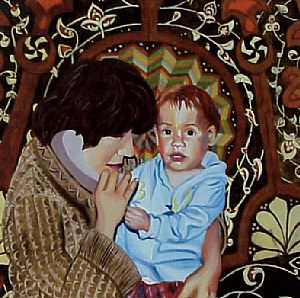
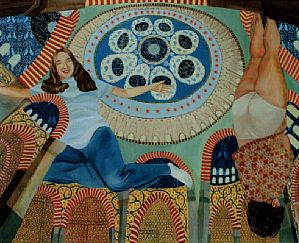
Left: Linda Gall's Memorial To A Much Lamented Son and
(right) Blind Drums,
oil on canvas. Both on view at Rebecca Ibel Gallery, 1055 N. High
St., thru February.
4625 is smaller than Homies, and less color-full. In resin and acrylic on canvas with mixed media, 4625 is Herren's tone poem, an unobtrusive seascape.
The hues, except for a light-hearted blue-green, reflect Winslow Homer's palette. In a classic manner, the canvas is halved: the horizon divides choppy water and sky, softly, evenly. The firmament is gray, dense with held rain; narrow indefinite shadows form a horizon.
The brief jagged shore is composed of dark rocky strokes. Simplicity. A haiku. Each haiku contains a surprise: Voila! Within the resin-shine, a lacy, circular arch informs the scene, as though the peripheries of a rose window have been imposed. A benediction.
Thus: paint, affix, aerosol, paint, aerosol, paint, shine. Herren states that his interests lie in graffiti, landscapes, turntablism and "a burgeoning need to have a political voice," elements that he believes "coexist peacefully" in his painting.
In Main Gallery at Rebecca's, Linda Gall breaks boundaries and does it in her own blockbusting realist-plus way! She paints big, dramatic, and with an original zest. These qualities are rare in somebody who can produce with nearly photographic realism.
She is influenced by photographs, and by the family. Not only her own family, but the international family. People. Connective histories. Her show title, "The Family: Emissaries, Seductors, Martyrs and Saints" is intended to reflect how the power or territorial struggle within families could be compared to countries.
Gall's work could be boring; instead it sizzles. She paints flat and with detail, but knows how to get our attention. In Memorial To A Much Lamented Son, a 54 x 66 inch oil on canvas, a grinning statuesque woman with long black hair is half flying, half lolling against Gall's talismanic arches.
The woman somewhat resembles Gall and doesn't seem to be lamenting! Levitating in the upper left of the painting she is white socked, blue jeaned, and her arms are spread. Below, to her right, a smaller persona floats upside down, back turned. This figure seems to be shedding, or pulling on, a croix-(cross)-patterned shirt. Gravity has been suspended.
Behind, above, every which way, patterned arches reign. Blue turtledoves, stripes, frosting dots, calligraphy. Here are regular, even, exacting mini patterns. How does she paint them? Obsessively? By stamp? Does she have to hire an apprentice like the old masters did?
These arches and patterns, Gall's "Multi Lobed Arches," a series, are the artist's current hallmark. They honor inscribed language, mosaic, traditional patterns. They praise universal connections. They are us.
In the Double Horseshoe Arcade, a 60 x 50 inch oil on canvas, a familiar regular-folks couple has traveled through time in two curved wicker sofas. Painted wicker sofas. - We all know them from somewhere, an old hotel, a forties album?
The man wears a flat pea green suit. His brown felt hat, like one my father wore, is folded neatly on a sofa arm. Her pleasant face is shadowed by a vintage hat, and her dress is a fiesta of griffons-in-circles. The painting nearly makes one dizzy; the sedate pair travel through time while, around them and all of us, red-and-white striped arches seem to whirl. With precision.
Power paintings by Linda Gall and Christopher Herren will show at Rebecca Ibel Gallery, 1055 N. High Street, through February. Hours are Wednesday through Saturday, 11 am to 5 pm and by appointment. Call 291-2555. Visit www rebeccaibel.com Note: The Main Gallery also includes 11 fine drawings by Linda Gall. p
February's Garden of Arts
Winners Bloom at Acme Art Company
Two outstanding exhibits will show at Acme Art Company, 1129 N. High Street, during February. Paintings by French artist Elisabeth Quenardel will bloom in Acme's Spot Gallery, and entries in the dialogue Magazine cover contest will show in their Main Gallery, along with Acme's "Presidents' Month Sale" of Columbus Artists' Small Works available for $50 or less!
In the Cover Contest, Darryl Baird of Michigan won 1st place and a spot as the March/April cover with Aqueous Humor #14. The jurors, the dialogue staff with representatives from the Columbus Museum of Art, Acme, and the Ohio Art League, awarded 2nd and 3rd prizes and honorable mentions. Acme should sizzle with the Cover Show!
Elisabeth Quenardel is just what Ohioans need for February's gray days. The largely self-taught artist began to paint because she "wanted to," and from her quiet suburb in France, she has sent us appealing and skillful oil canvases, many of them flowers in vases, à la the nineteenth century. Other paintings deal with colorful-but-quiet interiors and unobtrusive suburban homes. All of the paintings described here are in oil.
The artist confesses, joyfully, her homage to Manet in her artist's statement. Roses and Lilac Under Edouard Manet presents two large roses, a pale gold and a pale pink; their curved stems show through water in a wide glass vase with pedestals. Dark green leaves accentuate the two roses, allowing white lilac sprays to reach outward almost to the edge of the canvas.
Quenardel knows the importance of "framing" her still lifes with the edge, and she "fills up" the canvas in the correct compositional way. Dull blue and lavender strokes form a quiet background. A swatch of the table cloth is creamy white. Each large rose is rich, satiny, and has been captured in that lush state that exists a few hours before the petals fall.
Quenardel has sent us other flower paintings, and here they are, like pretty maids in a row: White Narcissus, White Lilac, Pink Iris, Yellow and Pink Begonias, Pink Carnations.
White Narcissus, Narcisses Blancs, is a large oil painting that is a bit more "loose" or "experimental" than the aforementioned Roses and Lilac. These narcissus seem to explode amid small orange mums on the left side, their white petals almost brash against a textured back-ground of cloudy blue and green. Mini flowers, that suggest dogwood, dance willy-nilly on slim branches.
PHOTO/GUS BRUNSMAN III
Pink Carnations after Edouard Manet, oil on canvas, by French artist Elisabeth Quenardel. Acme Art Company is honored and privileged to be exhibiting Quenardel's work in a gallery for the first time!
Is Columbus knee-deep in snow? No matter. Gaze upon May at Home, which, we presume, depicts Elisabeth's home. Two stalwart trees, green and leafy, nothing unusual about them, almost hide the modest dwelling with double doors. The curved drive is the color of sandbox sand. The irises rule the day. Marching in sedate rows under the baton of Quenardel's skillful brush, they manage to rivet our attention, although they are feathery and small.
Quenardel loves that indefinable Matisse blue. The World Behind Blue Curtains includes a table with blue cloth, vase and flowers. Soft orange and yellow strokes provide floorboards, and heavy blue curtains reveal mysterious sunlight. All these seem to be waiting for Eric Satie and his piano. In Quiet Evening on the Lake, Elisabeth breaks out of her garden series with shades of Stephen Pentak, an abstract waterscape! The softened planes and rectangles rule. Yet, the tranquil scene suggests a dock, the lake, blue-and-black hills, light and mist.
She writes: "Everything inspires me, the shades of nature, the pleat of a curtain, a harmony, a canvas from a famous painter, usually an impressionist. I love above all the gorgeous innocence of flowers with the exception of the red ones. I use the red colour (only) mixed with other colours because I am persuaded that the red has no depth and swallows the light."
The artist keeps to a sedate but lyrical palette. Her work is extraordinarily pleasing, well executed, and never boring.
In January, Acme hosted two power-painters, and both deserved extended coverage. Elaine Pawlowicz's large shiny oils and acrylics almost knocked me down. That's good. Her large child-like "mural paintings" (my description) are landscapes that manage to be alive without people. In them supercalifragilistic fireflies dwarf red fire trucks.
Sunflowers shine brighter and larger than the moons around Jupiter (or the rings around Saturn?). Pawlowicz's perceptions of, and concern for, contemporary living spaces, are a positive force.
Child's Play, New Work by Robert E. Falcone, oil and (gold) leaf on canvas, was a first-round knock out. Employing gestures from handgames: Cat's Cradle, Rock, Paper, Scissors, Falcone has surpassed his own professionalism with clean-cut, nearly life-size renderings of grownup hands and feet busy at handgames. They shimmer. Some of the fingernails wear melon red polish. "Sold" labels were in evidence.
Large zingy 3-D nosegays from Passion Works Studio framed the Acme windows. They bloom.
Acme Art Company is located at 1129 N. High Street. Hours are Noon to 5 pm Thursday thru Sunday. Call 299-4003 for more information.
Melesa Klosek is the electrifying president at ACME where "the art is so hot is smokes," and the intern hosts, most of them artists, are erudite and helpful.
(From the January '03 issue)
Stitches In Time
Quilt National '01 at the Riffe Gallery
Quilt National '01 will show at the Ohio Art Council's Riffe Gallery, 77 South High Street, thru February 9. Quilt National '01 is accompanied by 27 fabric pages from The Public Book: Letters to Our Great-Great-Grandchildren.
There are 32 art quilts in Quilt National '01, and notwithstanding, the "National" in the title, this is an international exhibit which includes entries from Germany, Norway, and Japan.
Differences & Similarities
At a media preview in early November, Hilary Morrow Fletcher, Director of the Quilt National Project based at the Dairy Barn Southeastern Ohio Cultural Arts Center in Athens spoke about the criteria for this juried show and its philosophy.
The 88 artists were chosen out of 1,411 entries from 670 artists from the United States and abroad. 32 works were chosen. Riffe literature explains "each work had to fulfill several criteria, including mastery of technique, overall design, and concepts. Quilts were chosen for their depth of style, content, technique, and emotion."
Fletcher noted that as art changes with the cultures and technologies of various times, so too the traditional quilt has evolved. The availability of fabric, and the advancement of fabricator-technology, have allowed the quilt to fly into the realms of imaginative high art. An art quilt does not have to be functional.
Fletcher assured the audience that traditional quilts continue to beautify American homes, adding that design and structure manage to link the two genre. Again: a quilt has more than one layer of fabric and contains some kind of stitchery and appliqué. An element of patterning, repetitions or motif, is usually present.
An art quilt usually hangs on the wall, its primary function is aesthetic rather than functional. A traditional quilt, whether in a condo or a frontier cabin, is intended to warm a bed or a cradle if necessary.
Some of the quilts hanging at the Riffe are very "painterly."
Fletcher remarked "Yes, some of these quilters are painters, professional artists. But images from past shows are on the Web and Net and some people have seen them on the computer screen and they say 'Hey, I can do that and I want to!'"
Director Fletcher said that the pages in the accompanying Public Book also display the same technical and aesthetic elements that provide the foundations for both traditional and art quilt criteria.
"They're both doing the same thing," she said, touching a stitched fold of fabric.
Quilt National '01 ranges from the intricate "realism" of A Seasonal Spectrum by
B. J. Adams, Washington, D.C., to the ebullient and charming TV Test Pattern: The Center of Chaos by Cheri Arnold of Columbus.
A Seasonal Spectrum is a luscious, detailed, lavish-yet-traditional quilt, classically composed, which frames a rural scene in autumn or late summer. The artist has used painted canvas and dupioni silk; machine pieced, appliquéd and embroidered, 21" x 56".
This complex, somewhat nostalgic landscape appears to be a fine-tipped brush painting. Or an intricate dyed-paper collage. Not a chance!
Adams has embroidered, stitched, color-penciled/painted or fabricated this land-scape, including what resembles a delicately cuffed human hand and an actual autumn leaf. A trick of the eye! (Don't tell, but I touched it for a nanosecond!)
Adams' lovely trees have been created with free-hand machine embroidery on a dissolvable stabilizer. All other images are first drawn in colored pencil on paper, and then reproduced in thread on dissolvable stabilizer. A Seasonal Spectrum is a beautiful detailed piece, well-deserving of the Juror's Award of Merit it received.
On a jauntier note, Cheri Arnold's TV Test Pattern: The Center of Chaos, 53" x 53" seems wild with whimsically drawn lotus blossoms. This bold quilter has employed "commercial and hand-dyed fabrics; airbrushed, appliquéd, fused, embroidered and beaded by hand and machine."
Her quilt glitters, if unobtrusively, and dances and includes a touch of the deliberately naive in its sprawling blossomy design. Arnold concludes: "É take a cat (like mine) with a serious yen for flowers. Throw some blooms into your favorite vase and [try to hide them from your cat] É the good news is that you can use all that busted glass and pottery to make a magnificent mosaic cat memorial such as this one!"
As you enter the Riffe Gallery and look straight ahead, you will see Velda E. Newman's BASS: In Your Dreams!
The metallic fabric and threads, the paint, foil and ink make those big fish swim in soft shimmering colors, and you will remember them.
Twist Tied Log Cabin
To my mind, it is Twist Tied Log Cabin that exemplifies the undergirding concepts of Quilt National '01. Amy Orr of Philadelphia has created this 41" x 34" quilt that contains a surprise. There are 80 traditional log cabin blocks or squares in this piece that, except for red sparkles in the centers of some of the squares, appears to be a traditional log cabin pattern of neat tight blocks. The thin border is red.
Like early villages, the quilt is built on squares around squares. The corner blocks, made of four small blocks stitched together, are a soft but unabashed blue - Yankee, not royal.
The interior blocks are blue and white, there are white blocks running the outside, and there are regularly spaced red dots suggesting knotted threads. (I kept seeing squares coming and going, as though I were looking at an Escher print!)
The Log Cabin is beautiful. It's red, white, and blue, and peaceful, like you and me! And it contains a surprise! The blocks, squares, diamonds, are made of 3,500 twist ties hand colored on each edge! You know, bread wrappers.
Orr says, "I spend hours making order from scraps É The work process is a ritual folly that distances the pace and transforms the waste of modern life. This piece pays homage to the traditional domestic arts, and it, as well as life, should be viewed with humor."
Three cheers for log cabins and red, white, and blue twist ties! As the New Year beckons, may we be inspired to make something wasteful into something beautiful. May we remember the art of log cabins and beaded moccasins and the Rail Splitter himself, his words. "Malice toward none. Of the people, by the people."
A children's program, Family Day with Linda Fowler, will be held on Sunday, January 12 from 2 to 4 pm in the Gallery. Kids, along with their adult companions, will be inspired by the artist to make a unique fabric collage. Everything is free, including materials!
New Hours at the Gallery are Tuesday: 10 am - 4 pm; Wednesday thru Friday:
10 am - 8 pm; Saturday: 12 - 8 pm; and Sunday: 12 - 4 pm. For information or to schedule a tour call 644-9624.
The Public Book
Twenty-seven pages from The Public Book: Letters To Our Great-Great Grandchildren will show at The Riffe Gallery along with Quilt National until February 9. The Book was magically propelled into existence by the determined efforts of calligrapher and Public Book Project Director, Ann Alaia Woods.
The 27 fabric pages shine with excellence and exemplify individual and organizational efforts. The wellspring of the show is a belief in the value of shared memories and community life.
Among the 27 fabric pages, three panels honor the memory of Libby Gregory, un-canonized Short North saint, former Byzantium entrepreneur, co-pilot of the legendary King Avenue Coffee House. And, founder of the Central Ohio Bead Society. &endash; We know you're around, Libby! &endash; "Imagine all the peopleÉ."
New Pentak Paintings at Gallery V
Columbus Master of Smoulder and Cool
Stephen Pentak will show oils on paper and oils on board at Gallery V through February 15. The artist's reputation has continued to climb; the financial worth of his paintings has accelerated from Chicago to New York to San Francisco.
Nevertheless, while the painter continues to practice his own art, he has remained an inspiration to his students at The Ohio State University where he is a professor in the Department of Art.
Not content with the success of his text Design Basics, co-authored with David Lauer and in its fourth edition, Pentak has been working on a second book about color.
And Pentak knows color. In fact, there's a rumor emanating from his students that "he never uses blue!" The paintings at Gallery V are a continuation of Pentak's River/Tributary Series and definitely contain, well, blue.
The students realize that, mixing other hues, Pentak creates blue, blue-ishness - blues, greens, grays being prominent in his paintings, most of them suggesting bodies of water and sky.
The title for this "river" painting is 2002, VIII.VI. The dimensions are 28" x 64" and it's an oil on board. Somewhat off center, to the left, a white birch startles us. The tree forms a tall narrow V, is partly in shadow, and runs top to bottom. This long painting is composed in a classical manner with a suggestion of "three." This balances that, and that. A deceptive simplicity rules.
The lateral peripheries of the painting are dark, mysterious. The left, a soft blackness; the right verges on a deep dull yellow. A white stone "plays off" the white trunk, and two other stones glimmer quietly under the water. The margins of the lagoon - it may be the Olentangy - and the margins of the sky, have become the blurred miracles of perception that are signatures of Pentak.
In night sky, we find gray green streaks that suggest dripping moss. Paying attention, one notices fine, very fine, palette knife marks, and barely visible squares and lines, folds, caused by knife and brush. The affect is that of transparent horizons and cerulean spaces. Pristine waterholes. In his artist's statement Pentak expresses concern and love for waterways. Tributaries.
Writers and critics have been correct in describing him as a minimalist and a colorist, in saying that his aesthetic fuses romanticism and abstraction. With Pentak, depth and perspective take on new meaning. His paintings entice us from the bayous of a cool reality into the plains of mist.
The exhibition of "New Paintings" by Stephen Pentak will show at Gallery V, 694 N High Street, from January 10 thru February 15. Hours are 11 am to 5 pm Tuesday thru Saturday. An Opening Reception will be held on Friday, January 11 from 5:30 to 7:30. Call 228-8955 or visit www.galleryV.com
&endash; Elizabeth Ann James
Next up at the Riffe Gallery is "The State of the Arts: A Celebration of Ohio's Rich Artistic Heritage," an exhibit of 75 masterpieces by prominent Ohio artists, opening March 3 and running to May 4.
Early itinerant portrait painters as well as such celebrated Ohio artists as Alice Schille and George Bellows will be represented. Jim Keny of Keny Galleries, and Nannette Maciejunes of the Columbus Museum of Art will curate.
(From the Dec. '02 issue)
Glass Wizardry of Sidney Hutter in Short North
"New Work" featured at Thomas R. Riley Galleries
Shimmer
"New Work," creations by glass artist and high-tech wizard Sidney Hutter will be featured at Thomas R. Riley Galleries (formerly Riley Hawk Galleries), 642 N. High Street, until January 21, 2003. The artist's work will remain at Riley well into the coming year and on an ongoing basis.
Hutter, who lives in the Boston area and studied sculpture and glass at the Massachusetts College of Art as well as drafting technology at the Lowell Institute of MIT, produces beautiful, sculptural, nonfunctional vessels. His inventive process deploys state-of-the-art complex UV technology. The resulting objets appear to be vases, receptacles with hollows and concave openings, but are not. What they are is beautiful.
Guided in his work by a belief in evolution, Hutter allows a reinterpretation of what we know as a vase, an object evolving from his own development as a person. "As the ability to understand grows, so in turn does the refinement and complexity of my work," he writes.
Hutter does not blow glass. He cuts and slices laminated glass, and he cures that assemblage fast, very fast. The term "curing" or "spot curing" refers to the method by which Hutter adheres sliced glass circles into graduated stacks. The adhesive is UV (ultra violet) adhesive. It is a secret weapon.
The resultant glass circles evolve into simple but compelling sculptural forms: amphorae without handles, neo-urns with fractured geometric shapes. A minute is "a slow cure." Again, there is a UV secret in this gambit, and we will get to that in a nanosecond.
Spectrums
Walk into the room. Fix your gaze upon a Hutter. 9 Color Rotation, for example, The urn-shaped non-functional vessel is 17" tall and about 9" in graduated circum-ference. The piece glitters, shimmers, but appears to be of clear faceted glass.
Now, step back, or forward. See the rainbow ribbons of color appear in shimmering jets: lavender, greens, pinks, yellows, ad infinitum.
"The colors suggest a tie-dye shirt, soft, enchanting. Reminiscent of Hutter's
Jerry I, a tribute to Jerry Garcia," gallery director Bridget Buescher explained. "The color is in the adhesive."
Voila. The evolving colortones inside the glass are dyes inside the adhesive. In 9 Color Rotation, the colors run vertically. In the Jerry I tribute, also at Riley, the colors are horizontal but more random.
As all, almost all, of Hutter's sculptures do, 9 Color Rotation is solid, a non-container, but it appears to have openings which are covered by clear glass, and that glass appears and disappears. Sparkles and reflections are the rule, not the exception, in a Hutter.
Quasi Modern #4, approximately the same size as 9 Color Rotation, is a one-split vase construct that is circular yet angled. It appears to glow with a warm tangerine hue. The inside is raftered, compartmentalized. Yet, simplicity rules.
Everything is glass. Other than the intrinsic use of adhesive, nothing but glass composes a Hutter. Nothing is affixed or embedded. He's not, in that way, a mixed media guy.
In Quasi Modern #4, once again the colors appear, merge neutralize and glimmer and according to the light and the viewer's spacial relationship to it. Yellows, oranges, hints of browns, golds.
If amber heals, I got well just looking.
Glass Wizards
Sidney Hutter is but one of the many glass artists to be found at Thomas R. Riley. The gallery is elegant and well-hung. The Gallery I space usually holds the featured artist. There are over twelve artists, most of whom are represented on an ongoing basis. All of the glass works are for sale; it's an art business. There is a small works purchasers' niche and a fine jewelry case.
Lino Tagliapietra and William Morris, international stars, are repre-sented. So is the Genius of Metal Albert Paley.
David Bennett's rushing horses &endash; one of them in blown wire &endash; are a joy to behold. Janusz Pozniak's neo-romantic "back-painted" women languish in memory.
Ulla Darni's vivacious kind of art-nouveau chandelier is a treat for the most jaded and discriminating.
Call it wizardry, that ancient glass magic, forever young and evolving!
Thomas R. Riley Galleries presents a mountain top view of contemporary glass which is internationally esteemed. People travel across the planet to look at and purchase the glass art displayed there.
The Muse wants to thank Cindy Riley and Bridget Buescher for answering questions. Thomas R. Riley, founder, director, "CEOs" successful Riley Galleries in Cleveland and Kirkland, Washington.
Thomas R. Riley Galleries is located at 642 N. High Street. Hours: 11 am &endash; 6 pm, Tuesday thru Saturday. Sunday 12-5 pm. Closed Mondays. Call 228-6554 or visit www.rileygalleries.com
My Country 'Tis of Thy People
"Artists of the Six Nations" at the Shot Tower Gallery
"Spirit of the Millennium XI: Artists of the Six Nations" will be exhibited at the Shot Tower Gallery of the Fort Hayes Metropolitan Education Center, 546 Jack Gibbs Boulevard, through December 13, 2002. This varied and engaging exhibit is being sponsored by The Ohio Center for Native American Affairs, The Ohio State University American Indian Student Services, and The Shot Tower Gallery. There was a lavish hors d'oeuvre opening in November with drumming by the Dakota Drummers and a flute performance by artist/musician Dan Hill, Seneca. Vernon Belcourt, founder of the American Indian Movement, spoke on the importance and role of the arts to educate and foster positive change.
The exhibit features 17 artists from the Haudenosaunee (Iroquois) of the Six Nations Confederacy: Onondaga, Oneida, Seneca, Mohawk, Cayuga and Tuscarora from New York State and Canada. This is the gallery's sixth Native American exhibit.
The artists (including the sculptors and folk artists) have exhibit lists and professional vitae that include The Cooper School of Art , The Corcoran, The Niagara Arts Council, Rhode Island School of Design, The Institute of Native American Art in Santa Fe, New Mexico, and many others. Artist Pete Jemison, who created the collage "There are Indians East of the Mississippi," is director of the Iroquois Museum in New York and an expert on Iroquois culture and art.
The range of media and genre is stunning. The show presents a cultural overview that includes experimental, traditional, and contemporary painting and three-dimensional work. This article presents only a smattering. Historical and political overtones are evident in many pieces.
To begin with the highly traditional: Lillian D. Kane's exquisitely crafted and small cornhusk dolls should delight everyone. (Her work shows in the Smithsonian.) Seneca Couple presents a duo. Two precisely garbed and bead-decked figures in a pole shelter. Saddle bags and drums hang from the poles. Between them sleeps a teeny tiny infant covered by a teeny tiny blanket. The face is an acorn. (without a cap). Lillian says "Corn husk dolls are faceless to remind us not to be vain."
Judging by comments and viewers at that spot Cornelius Waterman, the Artist's Father by Carson Waterman was obviously a favorite. This large life-size, waist-up portrait is one of dignity and strength. Against a background of colorful acrylics and symbols (purples, turquoises, and sand hues), the artist's father, in profile, wears a Gustawah, an Iroquois type headdress identifying which of the six nations he is from by the feathers. One here, straight up, depicts a Seneca man. The portrait is a tribute. If memory serves, an eagle is present. In essence, it's certain the spirit of an eagle is present. The man seems indefatigable and dignified, yet approachable.
There are many fine paintings in the show and much fine craftsmanship. But to my thinking it is the stone-carved sculpture (in Brazilian soapstone) by Adam Longboat and Dale Isaacs, and the clay sculptures by Peter B. Jones, that take the show over the top.
Stone carving is not for wimps. Working in Brazilian soapstone Dale Isaacs has a master's touch. His Protector (around 12" tall) is curved, dark, creamy, speckled green and brown, all subtle tones. Protector of the Three Sisters shines. There are creases in his time-weathered face. The work is hollowed in the center. Isaacs says it represents the earth, holding detailed renderings of Squash, Beans, Corn, the three Sisters sustaining the people. Powerful, rounded, strong. Anthro-pomorphic. Long-haired. The Protector.
Peter B. Jones' Indigenous, in unabashed brown-red clay, is a beautifully sculpted man's head. The bone structure is severe, the aspect austere, perceptive. The man's head has been shaved and carved with words, a death camp list of terms. "TERRORISM, RACE, FEAR, TRADITION, 911, BIA" and more. Also, Jones' Washing the Spirit, detailed and refined, should make you catch your breath.
The above-mentioned sculptors, Jones, Longboat, Isaacs, along with Tom Huff, because of their elegance in execution, through their original spins on traditional themes, will not be surpassed anywhere in the nation. (I mean the U.S.A. of Now.) Diane Schenandoah, sometimes working in marble and alabaster, presents in an equally adept manner in a more experi-mental mode. She and David Thomas who lives in Columbus, studied under Alan Houser, one of the most famous Native American sculptors ever.
Jay Carrier is the "edgy" bad guy of the painters. Using the cartoon-kids-scrawl technique sometimes referred to as "pop," Carrier presents oil on canvas that scream from a distance, and mystify and dismay when you get up close. The artist employs a deliberately amateur or untrained approach as his modus.
Carrier, a Tuscarora/Onondaga, describes himself as an "urban Indian" and infuses that term with a muted sarcasm in his pungent artist's statement.
His blond advert kids, like deconstruc-ted Cambells Soup tots, have archy breaky blonde tresses and floury faces. They are White Bread-Sunbeam Girl and White Bread. Champaign Indian or This One's For The Kids presents a "ten little Indians" kid with a play headband. Against raw billboard over-paints, all of these Carrier kids exude a grotesque aura of "cute."
A medium-large pale, smeary canvas rules Carrier's day however. On it, off center: a crudely painted, dripping pink heart and two pairs of hands bound at the wrists. A blurred portrait of a long-haired guy peers through the oily fog.
Below this face is scrawled the message, which can, like a warrior's dream, have more than one interpretation: Leonard Peltier Wish You Were Here.
The artist has successfully used visual media to combine jailhouse hagiography with Jungian dream theory in To Leonard Peltier with Love.
The works mentioned above are but a smattering.
David Thomas, finishing up graduate work at Columbus College of Art and Design after studies at Syracuse University and Native American Institute at Santa Fe, is the lodestone for this show. His Indian artists made the exhibition possible. Now a Columbus resident, Thomas is Onondaga/ Oneida. His skill in wood and alabaster are considerable, and his presentations of creation/cosmology figures and traditions will long be remembered.
Teresa Weidenbusch, Gallery Director, has done a fine job coordinating the exhibit.
Spirit of the Millenium XI: Artists of the Six Nations continues thru Friday, December 13.
As for the gallery visitors: We may have to live in square houses, but we can still be round persons.
The Fort Hayes Shot Tower Gallery is located at 546 Jack Gibbs Boulevard in downtown Columbus. Call 614-365-6681. Hours are 8 am to 5 pm weekdays. They are open until 8 pm Wednesday night and 10am to 2 pm on Saturday for this special exhibit.
(from the November 3001 issue)
A Muse Gallery's Clay Works: A Crowning Achievement
Earthy, Elegant, Weird, and Wonderful
A Muse Gallery, with its outdoor sculpture and landscaping, is an inviting space, indoors and out. Caren Petersen, director, does a superb job of arranging complex multi-artist shows in a gallery where exhibit space is ample but limited.
"Clay Works," showing through November, contains over 35 works of clay art sculpture. Each "Clay" artist possesses a substantial academic background and a hefty list of exhibits and purchases. Each artist works in clay. The warm earthy hues chosen by them create a harmonious effect that is pleasing and meditative.
"This show pushes clay to the limits," Petersen says. "It includes mixed media installations and figurative sculpture. Tons of imagination. What is here is art, clay sculpture. Yet each work can enhance an environment, and in that way is a kind of décor.
"These artists sculpt and work with clay in different ways. Yes, they often use their hands the way you think kids do with Play Dough. Sometimes they use the raku process, where heat is high. Sometimes the glaze is bright and shiny, sometimes it's not. What the firing process is, what kind of wood used, glazes etc., determines color."
Karen and Tom Margraff combine their clay-and-metal skills to form engaging and rather whimsical wall pieces which gleam with the brightest colors in the show. A Margraff appears to have moving parts, and their aesthetic falls somewhere between Jake Goldberg and Alexander Calder.
New Mexico's Richard Garriott-Stejskal sculpts weird white humanoid figures - their feet protruding from obese bodies, their massive enquiring heads turned &endash; armless, harmless, unforgettable. Talk about Jungian. Petersen is right: "Clay to the limits, sculpture beyond décor."
Tom Radca's 55" Round is a lusterless yet gorgeous 55" round clay disc, a ceramic circle, a talisman, composed of uneven clay squares, or tiles, affixed with a French cleat to a rough board. Each tile is about 6" x 6". From a distance the Round resonates with tones and textures. It suggests weathered wood and pebbled beaches. It reminds me of a giant's shield. On it, mysterious "spills" glisten with blue-gray streaks and, from iron oxide, dull orange currents. Water, sky, and earth mounds come to mind.
Step closer and find all kinds of tracks and embeddings. Clawed paw prints. Oxidized flathead nails. Square bolts. A star or two. Fossil shapes. Raised curves suggesting earth-worms and flattened rubber. Radca has used some kind of tracing wheel to cast a circle of fine tracks, slightly off center.
Each hefty Radca, whether it glistens or seems without luster, is a meditative "grabber" and should enchant visitors in corporate offices, living rooms, and retreat lodges. 55" Round is a tranquil breakthrough by a veteran clay artist who knows his stuff!
Juliellen Byrne's clay sculptures are immediately identifiable. Christen them "the lovable and solemn creatures of weird." Example: Sea Biscuit is around 24" tall. The dull, flesh-toned horse is covered with an all-over blue curlicue design. The horses ears are invisible, his humanoid eyes non-pulsed. His nose seems stuck in a gray-blue feed bag. See following page
A strange gray-green boat, similar to a pea pod or a melon slice, sits at an angle on the horse's stout hind quarters with a man inside. The pale man is much bigger than the boat. His face is inscrutably upturned, and we can't see his legs at all. But we can see his long unclasped hands behind him if we persevere. His long brown feet and ankles protrude comfortably through the horse's underbelly.
Byrne sketches first and works from huge blocks of clay. Conversation, a quirkily androgynous, half-naked Jack Rabbit and Queen seated on a bench, provides a Byrnian non sequitur.
Denise Romecki teaches at the Columbus Cultural Arts Center. Her lists of professional credits and exhibits is lengthy. Her sculptures leave visitors breathless. For her series, "Transforma-tions," Romecki made plaster molds of female figures she had first sculpted directly. She pressed the soft clay into the molds, and when the clay was firm, the image would lift out, moist enough to add to or to subtract from.
"Transformations" is a series of earthly yet mythic women who appear to be winged. Their proud faces, the thrust of their shoulders, and stormy tresses provide an illusion of flight. Contentment presents a woman rising from invisible roots. She's about 30" high. A naked woman of dark vanilla swirls. She stands placidly, her eyes closed. Her mouth solemn, not sad. Tranquil. Look closely.
Her wing-like tresses gleam, as do the tears starting in her closed eyes. The woman appears to be armless. Look again. Her long hands cradle an obviously pregnant belly. Breasts and hips bear sculptural swirl marks. Painted Lady and Letting Go repeat Romecki's textural and psychological motifs that celebrate women's lives.
In Letting Go, the torso itself suggests wings. The clay has obvious cracks and crackles, like bark or mudflat crevices. We can see inside, behind her shoulders. She's a hollow woman; she echoes. A green winged hummingbird perches on her chest.
Our suspicions are confirmed. Romecki's women have an affinity with earth, trees and her own life as a woman. This outstanding teacher is sometimes invited to work at the Clay Pipe Invitational in southern Ohio. There the kiln is large enough to fire drain pipe and her own "Tranformations!"
Tall drum-vases by Tom Radca stand like beautiful sentinels in A Muse main gallery. But stealing the show is Tim Brown's horse assemblage, Fury. Fury is a giant horse, rackety, taller than this Muse when he stands on his scrap lumber pedestal. His belly is part of a wood barrel, as in the traditional folk "Hobbie." He consists mostly of battered and bolted wood. But wait, is that a gold club I see as a hoof? Is that a sled bar for a rib cage? Driftwood for a tail? Scrub brushes for a mane? A doorknob emerging from his haunches? Despite his empty eyes, his skeletal nose and rattling ribs, me thought not of the horses of Apocalypse but of Don Quixote's horse, Rosinante.
In the foyer at A Muse you'll be greeted by Ron Arps' tall and vivid Untitled, a painting of a woman in a gold dress. She's gorgeous. The artist begins with acrylics His "mixed media" label refers to inclusions of gold leaf, oils and enamels, luscious over-paintings.
Arps is a first-class painter who is closer to being a celebrity artist than anybody else around, and that's a compliment. His work sells. It's rich and pleasing. Under his imaginative brush, women become dramatic personae.
In person, Arps emits transcendental vibrations. He resembles Tom
Cruise.
Or Charlie Sheen. With a Pre-Raphaelite haircut. Wearing Roy
Lichtenstein's jeans. These are compliments. Paint on. p
A Muse Gallery is located in Grandview at 996 West Third
Avenue.
Hours: Mon., Wed., Sat. 10 am - 3 pm; Tues., Thurs., Fri., Noon
&endash; 6 pm
Or by Appointment.
Caren A. Petersen, Art Siren, and her assistants can be reached at 299-5003. Quotations attributed to Caren in this article are not always direct quotes, but they are distillations of her dialogue with The Muse.
Atmospheric Landscapes at Artistically Bent
Meet Visiting Artist Will McCarthy on November 9
William "Will" McCarthy will fly in from Connecticut for his opening at Artistically Bent on November 9. His new paintings will remain there after the exhibit, although Kris Worthington, gallery and boutique director, has warned that McCarthy's "Atomospheric Landscapes" are frequent sellers.
She added that the artist was recently contracted to make his work nationally available through Pottery Barn.
McCarthy's somewhat dark, mysterious land-scapes manage to glow, as though he has been reincarnated with genes from an old Dutch master. His simply rendered trees are dark, generic. His fields are austerely presented; his hills recede without vibrancy. But his paintings do manage an atmospheric glow. Perhaps it's a spiritual glow emanating from the artist himself.
The New York Times once noted McCarthy's derivative tradition of using oil washes and varnish. (He layers oil washes mixed with stand oil and damar varnish. This mixture is applied over charcoal-based drawings on paper, canvas or gessoed masonite board.) It's this layering that gives his paintings a hard surface. You expect them to crackle like a salvaged old master, but they don't, and that's nice.
McCarthy is a Columbus College of Art and Design and Wesleyan University alumnus. He now spends a lot of time painting and curates the Wesleyan University Gallery at Middletown. In 2002, he won First Place Painting at the Glastonbury Fine Art Festival in Connnecticut, and that same year received Best in Show at WCSH Sidewalk Art Festival in Portland, Maine, and won a Jurors Choice at the Arts Festival here in Columbus.
A few years back, with the help of a grant, he drove with his wife through Connecticut taking photos of the landscape. But McCarthy doesn't paint with or from the photos, he simply remembers them when he paints.
The gold-framed "Twilight at Cain Park" is rich with a clump of dark simply painted trees, possibly pines, to one side. The sky, shimmering with gold tones, is pocked with delicate bits of orange and yellow, yet manages to seem blossomy with aqua. To the forefront, a field of unabashed green, some of it lime, some emerald. There's the merest suggestion of a blue pond. The horizon is a purple streak running into low hills. It's a quiet painting, heart-warming, and therein lies the mystery of "Atmospheric Landscapes." They're ordinary at first glance, and then.
"Across the Field" and "Outside Mayfield" are darker than "Cain Park." In "Across the Field" there are moss green bushes and a single leafy tree with orange-red fields behind it. The season may be autumn and there is a solitary leafy generic tree, a dark tree, in the forefront.
The brushstrokes appear a tad more vibrant than they are in "Outside Mayfield." Here is a painting serene with dusky blues. The sun could be setting or rising. It sends a soft glow against a tall leafless tree. In general, McCarthy's paintings do seem to be rather dark in hue "Perhaps it's dusk," Kris says.
McCarthy writes of the lighting he enjoys most, "early morning, dusk, nightfall.É A dream-like sense that surrounds us every day."
Artistically Bent is located in the Short North at 718 N. High
Street. Hours are Monday
thru Saturday: Noon &endash; 6 pm, Thursdays: Noon &endash; 3 pm.
Call 298-8966.
Art (From the September 2002 issue)
African-inspired style and celebration . . . ethniciti
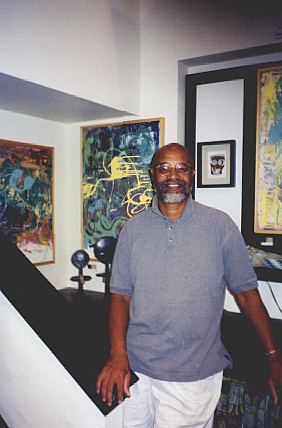
William R. Sands photo by Gus
Brunsman
William R. Sands, President and CEO of ethniciti, 668 N. High Street, opened his gallery/boutique in December 2000. "Our purpose is to celebrate Africa," Sands said, "through art, artifacts, and design. We're about interior design, and we allow the past and the present to merge. Time is a river."
Standing in ethniciti, I do feel inspired by an interior design mode that is contemporary and elegant, yet timeless. I feel like Isak Dinesen, or at least as though I'm on the set of Out of Africa. I am lulled by soothing colors from the veldt: browns, tans, stripes and spots. I see touches of ocher, sand, white, shell, red earth in a symphony of objects: paperweights, sculpture, artifacts, frames, paintings, goblets, swatches, mats, all tastefully arranged accoutrements of graceful living.
Standing in ethniciti, I see looped and draped fabric, cotton and mud cloth - brown, black, tan, and white - marked with spots, stripes, leaf patterns, all special-ordered and manufactured for ethniciti. I see caravan pillows and wall hangings and bolts of fabric.
Photographer and gallery host Henry T. Foster is correct in remarking that these dark-and-white patterns work easily together. The ambiance is lovely. Two dining tables are set with dark-and-white cloth and fine crystal drinking glasses and French and Algerian-inspired dinnerware.
At ethniciti, you can buy large Kwanzaa dinner plates in porcelain. They ring if you tap them, and there's a plate and a virtue for each day of Kwanzaa. What an heirloom!
Standing in ethniciti, I see three ancient spirit vessels - stone-etched, "primitive," estimated to be at least 2000 years old. Heavy and not entirely hollow, they exude sacredness, spirit. These vessels accompanied the dead and were "ploughed up in Nigeria centuries and centuries after the corpse had disintegrated" Foster explained.
The brass guard leopards near the front door are a gas! Painted black with popeyes and round ears, their tails absurdly long and curvy, they're probably antiques of Empire, Victoria's Empiah, my deah, and will surely bring you luck. I have named but a few of the objets d'art which have been so skillfully and unobtrusively arranged.
Scattered about and gleaming will be found jars for an elegant now. Berbere Spice Mixture and Caribbean Rum Cakes in pretty packages, and chutneys, and something called Smokey Amba-rella!
On the second level, other wonderful potions and scents beckon. For example, bath soap that looks like it should be in the Metropolitan Museum of art, and jars of exquisite fragrances: myrrh granules for a foot scrub and Heaven and Earth Bath Oil and Bath Scent Blend in Sweet Magnolia, and much more. Everywhere I look I see something else tempting and wonderful.
William R. Sands is right in saying, "Yes, Africa, interior design." - And yes, "time is merely a river."
African-inspired Artists
African-inspired artists reign at ethniciti. Kellie Knight Smith, Ben Macala, and Hagreaves Ntukwane are ongoing exhibitors. Ntukwane and Macala are well-known South African artists. They produce work of the highest quality and each of them deserves an article.
Should I select a painting that is my emotional favorite, I would choose one from Kellie Knight Smith's gemlike watercolor series "Two Dancing Baule Mothers." (The Baule are a tribe living on the Ivory Coast.) I would choose the one I have titled The Red Umbrella in which the two "mothers," one seated one standing, are chatting at an outdoor table with a purple-edged red umbrella. The women are but minimalist storm clouds and the painting is small, but murky - we can smell the roasting peppers and taste the cardoman spiced tea. Knight Smith, who holds two masters degrees from the Pratt Institute of Art, also paints bright travel-based colorfields available at ethniciti.
An outstanding sculptor, Omar will be featured in September. Knight Smith has Columbus roots, and Omar is a current resident.
A World of Jazz in Stone and Bronze
Omar, whose stone and bronze sculpture has gained national and international recognition, will be featured through September, and longer, at ethniciti. This talented Columbus resident is unique in the U.S.'s current sculpture niche. His work, while original and fresh, retains echoes of '30s "modernism." And cubism and Picasso. Yet his genre and his subjects are definitely his own.
The artist received a formal education from the San Francisco Academy of Art and from Memphis Art College in Memphis, Tennessee. However, he says, his "ability to carve stone is natural, inspired by ancestral spirits, cultural heritage, and by an environment filled with an array of natural beauty."
During September, ethniciti plans to show Omar's sculptural works from an exhibit entitled "A World Of Jazz In Stone and Bronze." Concurrently, Omar has a major six-month show opening at the American Jazz Museum in Kansas City, Missouri, "the cradle of all Jazz," the sculptor reminds us. The show will then remain at the King Arts Complex in Columbus from February 6 thru May 27, 2003, before traveling to Los Angeles.
Jazzmatazz. This three quarter limestone bust is a man with a mic. The "portrait" exemplifies Omar's tendency to divide and abstract his subjects - splitting them geometrically. The man's headwear, or hair, is light, textural. The strong nose divides the face so that it appears to be split. The smile seems about to break into buhballoo. The tan face speaks of a geometric coup.
The titles of Omar's pieces tell you where his heart is - with jazz! The tall (45" x 12" x 12") brown limestone sculpture, African Man with Guitar, is rich with musical avenues and curves. In dark brown wine tones, the Jazz Singer is all angles, his hairpiece as sharp as a boomerang across one closed eye. Man with Horn, flat-headed and cool, is cookin' hot. The Boxer is ready to go. He's two-toned and perfect. Jazz Man is takin' a break, and he is powerful with saxxy brown and white. Proud, curved, and tall. He's a bronze guy; you know him by memory and magic.
Man With Horn
Jazz Goddess, ah, what a gorgeous limestone fountain she'll be for someone! A dark shapely woman wearing a pale robe of carved flowers, she stands with her face lifted to the clouds, one hand on her sarong, one knee raised She will canonize all admirers with her beauty.
Within the past five years, Omar has carved a 14' monument for the city of Negril, Jamaica, West Indies. He has sculpted an 11-foot 16,000-lb stone monument for the Martin Luther King Cultural and Performing Arts Center in Columbus. He has sculpted a 7-foot limestone fountain for installation at VIP Services in The Bronx, New York.
Photos of Omar's work were available in August. But the praise of William R. Sands and the sophisticated élan of the photos, presage a joyous sculptural combo for all seasons. Ethniciti is located at 668 N. High Street. (222-6700), and is open noon to 6 pm Tuesday thru Saturday.
(From the Aug. '02 issue)
August's Shower of Art Stars
Marti Steffy
Marti Steffy, Ohio's queen of painterly dream-fields and impressionistic heroines, will reign at Art Access gallery, 540 South Drexel Avenue in Bexley, thru August 15. Among her vivid and poetic oil-on-panels included in "Pompeii to Provence": Maples, Summer Afternoon, Pompeiian Red, Athena and Night Sky. There are forty paintings in the show.
Steffy is a skilled intuitional painter whose work has been critically acclaimed and widely exhibited. In the finest sense of the term, she is a "best seller" locally and nationally. Her new works were inspired by the ancient city of Pompeii and by sojourns in her beloved Provence.
During August, possibly thereafter, Art Access will have available, fine etchings and lithographs by Picasso. Prints by Jim Dine, Helen Frankenthaler, Robert Motherwell, and Robert Rauschenberg, are also available at Art Access. Call 338-8325 or visit their site at www.artaccessgallery.com.
Two Strong Artists at ROY G BIV
David Sallot, an Ohio State University art Graduate, works on his art every day. He will present silk screen and mixed media works throughout August at ROY G BIV. His color tones vary, and he says he "tends to work in series of threes, sometimes fours."
A primal art image for Sallot is Raphael's Madonna and Gold Finch! The artist says that "The Lady appears in at least three silk screen depictions, one of which shows her near a nuclear reactor." Automobile tires and mini bites of urban life in Columbus are in evidence. Exciting!
When I remarked that silk screen technique is difficult, Sallot replied, "It's a pain in the É but that's what I like and I've been doing it a long time." He does it very well.
Ryan Orewiler's postcard invitation and his Times Square #2 painting is what attracted me to the ROY G BIV show. Orewiler is up for a CCAD graduation in August. He decided to call his Big Apple-inspired show, "New York." That's where he visited with friends and had a great time painting last year (before September 11).
Times square #2 is a large oil on canvas (20" x 30") and Orewiler has brilliantly depicted an actual now: the tall buildings, pressed against each other, have been rendered with precision and grace. A panoply of
advertising signs, you can read them - a rush on oncoming traffic, striding citizens, street lights and video cameras - all have been presented in detail yet without rigidity. The light is important, the sky is a luminous wash. The vehicles and the boulevard near us are shadowed. The bright red COKE sign fixes the scene. When I referred to Orewiler as a realist, he was quick to respond: "Well I'm not actually a realist, I'm kind of a mix of realism and impressionism."
Afterglow: Kim Elliott, who showed at ROY G BIV in June, was recently awarded an artist-in-residence fellow-ship from the Indian Dunes National Lakeshore. As part of her fellowship, she will spend two weeks on the beautiful Indiana Dunes in a Japanese style house especially designed and built for the grantees. (Kim's fellowship includes a four-week residence, but previous commitments prevented her from staying that long.)
At ROY G BIV in June, Elliot's meticulous oil paintings, especially Voodoo Vs. The Board Room and Looking for the Yellow Brick Road, provided visionary expressions of shared contemporary experience. The artist knows how to paint spiritual icons for a soundbite culture. She showed with another imaginative painter, Angela Liscoe.
Art Books at An Open Book
An Open Book at 685 N. High Street is a gay and lesbian bookstore. It is also the major bookstore in the Short North. A couple of years ago at the old An Open Book, I had bought my brother a beautiful book about Monet. So, shortly before Bastille Day (July 14), I went in to see if I could find more books on fine art. Yes!
Here are the books on my wish list:
Don't Worry Be Happy is a beautiful "coffee table book" with words by jazz artist Bobby McFerren and art by the sculptor Alexander Calder. The pages gleam with repros of Calder's sculpture and his geometric abstracts. The colors are bright, the shapes are simple. "In every life we have some trouble but when you worry you make it double."
Shirtless: the Hollywood Physique was written and complied by Donald F. Reuter. This book of superb photographs opens with a gorgeous black and white of a very young (shirtless) clint Eastwood in an open convertible. Gorgeous. Drew Barrymore's grandpa, the great lover John barrymore was gorgeous in 1928 when he made Tempest. He appears to be clutching a crumpled petticoat. Horrors! Sal Mineo will break your heart. Tab Hunter still looks good and Leonardi Di Caprio holds a spear in The Beach, 2000. The photographs and their accompanying bios are top of the line.
Baryshnikov in Black and White presents the one the only via 175 photos celebrating the last three decades of Mikhail Baryshnikov's dance career. Ballet hasn't been the same since the Russian invasion. Essays and on Art and Artists by James Fenton tops my list. The author teaches poetry at Oxford and the book includes 15 essays on art history and criticism first published in The New York Review of books. Matisse: A Portrait by Hayden Herrera is a must.
At Ohio Craft Museum
From the Indigenous to the Outrageous: Contemporary American Baskets will show at the Ohio Craft Museum, 1665 W. Fifth Avenue in Grandview, thru August 23. This is a stunning show by 25 basket makers from Maine to Florida and Alaska to Hawaii. It includes wildly contemporary, indeed, experimental, art baskets along with baskets strongly based in tradition and traditional crafting.
Luke Koonook, an Inupiat artist from a remote area of northwest Alaska (it's his first non-Alaska show) makes baskets of "baleen from whales and walrus tusks" gathered and prepared by the artist.
There will be "contemporary Gullah sweetgrass and bulrush baskets" from South Carolina. Gulla Weavers continue a 200-year-old tradition of African-American basketry, incorporating local sea and marsh grasses and coiling and stitching techniques."
Imagine bold and beautiful art recepta-cles which include: orange peel, waxed linen, black ash, red salmon skin, gut and willow. And more! How about recycled cereal boxes? A basket is a basket whether it's usable or not!
Admission is free. The museum is open from 1 to 4 pm Sunday and 10 am to 5 pm Monday through Friday. Parking is free. For information, call 486-4402. p
(From the July 2002 Issue)
Columbus Museum of Art
Art As Time Travel
The Columbus Museum of Art, 480 East Broad Street, is hosting the "91st Annual Spring Juried Exhibition 2002" of the Ohio Art League with two sequential exhibits. Part I will close on July 7. Part II will run July 13 through August 18.
"Grandma Moses in the 21st Century," an exhibit of over one hundred paintings by an American genius is now showing. Take a friend and see both exhibits. You'll find plenty to talk about!
Grandma Moses
At the Columbus Museum of Art, "Grandma Moses in the 21st Century" will close on July 28. The artist was a toddler during the Civil War. She lived to be over a hundred, began to paint when she was sixty, and worked, with failing eyesight, until the end (or the beginning). "I've always had to keep busy," she said.
She taught herself; she practiced. She improved. She possessed a delicious and unfailing sense of composition and an affectionate memory.
Her perspective was skewed. Never mind. She flattened and ironed out skies and hills so that they danced like freshly ironed drapes. She was a master at the moods and hues of snow. All winter afternoons are not the same. She used glitz when glitter "came in." For snow, but only when appropriate.
Her palette? A disciplined corps de ballet. She knew how to balance colors, how to attract the eye to certain spaces. Folded red napkins lead to red patches on a quilt. A child's orange pinafore reflects coals under a cook pot.
The artist had a talent for specific colors. Her blue skies are not always baby blue. Certain skies have been tinged precisely, as with pine tincture or laundry blueing from an eyedropper. A few sunsets contain poppy stains.
The Quilting Bee
The Quilting Bee, oil on pressed board, is a panorama of celebration!
This painting, like Grandma's other paintings, contains small simply drawn people-figures in postbellum garb. We cannot see buttons, hooks, stitches, or eyelashes and pearly teeth, but we can see the well-defined cut of garments and the natural motion of arms and legs while a myriad of people socialize and work.
The locus is probably a schoolroom, possibly a church hall. Five soberly dressed women (and a man) sit behind the quilting table. Their postures reveal that Moses not only understood quilting but understood human anatomy even when the people were smaller than clothespin dolls.
It's likely that the quilt will soon be finished. The windows fill the hall with a particular daylight as only Grandma could paint it. We see a cake table, not to mention a white-clothed dining table set for a repast after the quilting bee.
It would take pages to catalog everybody and everything that is going on in this painting. Yet we are not distracted or confused because Grandma Moses has arranged everything so well. Children and women bustle about on various errands. Men are helping too.
On one knee, a man in a brown suit is explaining something. The elderly woman is knitting red socks. Modestly garbed in black, she sits with legs crossed and one foot resting on a stool. The red yarn in the stockings guides us to red darts on the miraculous quilt &endash; all of those quilts were miraculous &endash; and to the red shirts and skirts of children and the neatly folded napkins on the white table.
Anna Mary Robertson "Grandma" Moses, 1860-1961, is an American genius. Her work transcends such labels as "quaint" and "cute." The proof is in the original work, not cards or reproductions.
A sophisticated painter, Moses has traveled through time and emerged in very good shape. Go. Absorb the colors, the moods, the seasons, the brush strokes. Take notes. Take time. p
Ohio Art League
As juried by Marc Mayer, Deputy Director of Art at the Brooklyn Museum of Art, the Ohio Art League "91st Annual Spring Juried Exhibition 2002, Part I," at the very least, makes a strong first impact.
This show consists of 14 works by 9 artists. You're bound to find a favorite or favorites. Mayer's incisive Juror's remarks (on the show's printed guide) explain why he privately called this "a guy show." But if I hadn't read the statement, I'd have simply thought: This is a sharp-edged (not necessarily cutting-edge) no-nonsense show by a curator who honors good painting and the tangential phenomena of contemporary art.
As well as several large overpowering paintings, there are mixed media, installa-tions, photographs, and Joe Warburton's (glass) Black Vases #1 and #2.
Robin Assner's C-prints, Untitled #7 and Untitled # 100, won the Renee Steidle Fund Award. Jonathan Fisher's Winter, Gelatin Silver Print, and Jerry Hazard's Guess Who I Ran Into Today, are first-rate photographs that counter-balance each other. Clinton King exhibited two divergent efforts. His installation, Genetically Modified Vibration/New Rock Sounds, Modified Vibrations, is an installation designed (or assembled) to titillate and mystify and no electricians need apply. What loosely resembled rock band equipment, including a huge orange extension cord, serves as a conversation piece, to say the least.
King's Snow Has Mass is a rather large mixed media "painting" in which paints and resins were allowed to play under plexiglass. Art League director Nicole Tschampel notes "It's a piece in which the play of light is a critical element."
Lyrical and energetic, the piece shone like an abstracted garden under ice. Congratulations to Clinton King; Snow Has Mass won the Gallery V Award.
Chance remarks by Blue Cube Arts' Edmund Gaisie described Jeff Anderson's vibrant and complex paintings in acrylic and pencil as "including something techno spiritual. They have a spiritual quality, yet are very -hard to describe - postindustrial something, and I like that."
Anderson's Burn and Sacred Heart writhe with color, with geometric symbols and forms that have been executed with energy of paint and exactitude of line. At least one shamanic mask is in evidence. The two paintings, alike but different, seem psychedelic in tone. Gaisie's approbation was astute; he was traveling in his own urban time.
I was emotionally, if not critically, drawn to three representational and dramatic works by two artists, Kevin Simpson and Justin Rabjohn.
Kevin Simpson's large, probably over 5' x 4' oil paintings, knocked me over. There were two. Not Once But Many Times and Vacation With No Foundation -like Anderson's Burn and Sacred Heart - are companion pieces which can stand as self-contained works. Whether with tongue in cheek or with a sense of the sacred, Kevin Simpson has traveled through art time:
In these huge paintings negative blue-black space bears cosmologic meaning into now. Vacation With No Foundation is oblique with black hole mystery and if you look closely, outlines of a blossom or two. Lower left, glowing in darkness, is a modest mobile home, possibly a camper. This is not a wealthy suburban outpost. Upper right, in the black brush-stroked firmament, a Man, his face half-turned, contemplates a lonely, but transcendent existence. Listening to all-night therapists, perhaps.
Not Once But Many Times present a chasm of blackness in which a luminous extended hand is at work in the contemporary void. There is no doubt but that Michelangelo is out there in the radioactive dark.
Dustin Rabjohn's Rebirth is a realistic oil painting in which a youthful man, virile, nearly life-sized, spills off the canvas. His eyes express agony, wonder, determination. He grits his teeth. His strong torso and limbs seem covered in blood, afterbirth, perhaps the jabs of spear wounds. Rabjohn is a darn good painter. The emotional reaction of viewers probably includes the contra dance of angst and hope resonating from the September 11 disaster. Rebirth.
Dietrich A. Wegner's Blooming Anus in epoxy F6R 95, fiberglass, paint, steel, won the award from the Mary Lou Chess Memorial Fund. The large black shining blossom worked with or without the title. But my personal reaction to the title? I felt weary of shock value as I traveled through my own time. No matter. A bloom is a bloom. Well-made art is art.
Congratulations to Rebecca Ibel curator/owner of Rebecca Ibel Gallery. Rebecca was awarded the Ohio Art League Outstanding Service Award that she so much deserves. The League also awarded Teresa Weidenbusch's diligence and expertise with the Ohio Art League Outstanding Contribution to the Arts Award.
Nicole Tschampel, current director of the Ohio Art League, reminds us that the League has provided venues for the presentations of Ohio artists since its inception in 1909.
Such Ohio Art League stalwarts as Linda Gall, Eddie Fulcher, Kurt Lightner, Ellen Grevey and Rory Krupp have work in Part II. Marlo Linch will show Buckeye Donuts, Colored Pencil on Toned Paper. Can't wait. Grab a donut for H. G. Wells and start the time machine!
Memory Paintings
Lindsay Gallery, 896 N. High Street, will host two fantastic memory painters during July. (Grandma Moses was a memory painter.) Janice Price lives in Newark and paints large wonderfully detailed paintings of small-town memories that are still fresh in our own memories.
Try a nice house and a picnic table on the lawn. Add grandchildren and a red white and blue flower bed. She's terrific!
From Tipp City, Charles Green is almost 90 years young, legally blind, and paints like a live wire. He is a live wire. He's also a railroad aficionado. Go for it.
Art & Cuisine at Lemongrass
A new show will be up at Lemongrass 614 N. High Street, in July and August and we'll take a good look. David Schackne was on the way in at this writing, and Susan Rosenthal and Homer Echard in "Primavera," a superbly pleasing show, were on the way out. Ursula Lanning provides art at Lemongrass.
Chor reminded us that there is a new sushi menu there. The Lemongrass salad reads and tastes like poetry and Mai Tai is a bit hit. Chor brought me elegantly prepared plantains, delicately flavored and arranged with chocolate and creme cake. Dessert as art! I flew away with a celestial taste of Asia in my tummy and Susan Rosenthal's absolutely marvelous Angel in my heart!
(From the June 2002 issue)
Lanning Gallery
Luminaries Light Up Lanning
-Axis Art Ambitious -
AXIS: One or more theoretical central lines around which an artistic form is organized or composed.- Definition printed on the invitation to the opening of "AXIS: Fine Arts," the current Lanning Gallery show.
"Axis," the work of twenty-two of Ohio's most able and lauded artists will show at Lanning Gallery, 990 N. High Street, beginning May 30 through June 29. An alphabetized list reads like a roster from Who's Who in the Best of Ohio Art!
Robert Wright
Robert S. Wright, a leading "AXIS" show contributor, is a highly successful alumnus from the Rhode Island School of Design (RISD), with which he still has strong professional ties. In 1998, Wright was responsible for bringing "The New England Connection," a RISD (pronounced RIZ-DEE) show of graduating seniors, to Lanning Gallery.
Wright's 2000 Lanning show, "Change + Motion," was both popular and critically appraised: Art critics for The Columbus Dispatch selected "Change + Motion" as one of the top 14 exhibitions in the Columbus area for that year.
His "Painted Metaphors" show at Lanning Gallery in May 2002 was a marvelously facile exhibit. The large new mixed-media paintings were evidence that Wright's work is in transition. Evolution is the hallmark of a true artist.
Previous Work
In previous shows, a strong narrative strain has informed Wright's work. His scenes include recognizable human figures, however sketchily designed. One of his best-loved paintings, among his "Sledders" series, depicts a sledding hill. The sledders, minimally rendered in their snowsuits and hoods, seem dwarfed against the heartbreak of a winter sunset. We know Mom is calling supper. It's a shared moment &endash; as spare as haiku; frozen in time.
Another large oil painting (from a show at Lanning at Lemongrass Gallery) depicts a thunderstorm breaking over a municipal swimming pool. A multitude of swimmers, each feature well defined, are leaping out of the pool. Wright, an artist who is hearing-impaired, swims blissfully on.
In the swimming pool and on the sledding hill, there is movement a-plenty, although the sledding hill is less detailed. The hill, with its sketchy figures, presages Wright's marks &endash; his calligraphy that appears to move. These marks were also evident in "Painted Metaphors."
At first glance, the "Metaphor's" show seemed to be one of large intriguing abstracts. A second glance revealed even more complexity of media and genre. Wright uses newsprint as a kind of reverse collage gambit. His main source of print is The New York Observer, a weekly that reflects, as Wright says, "celebrity, lavish living, beauty and high culture."
To construct a painted metaphor, Wright first creates his highly complex collage work (some of it painted). He uses masks - masking tape, marker, rubber cement - over the collage, and paints a mélange of predominately somber colors over that. This layer of painting, with its calligraphy, becomes an overlay.
When Wright scrapes and cuts through the overlay, he says, "I forget what lies beneath the paint. When the paint is dry, I pull off the 'masks,' thus exposing the veins of collage imagery."
Wright's evolving, shiny black marks are visible throughout "Metaphors." The artist says, "The figures have become more fragmented and more iconic than in the past. They present what I understand of form and motion."
The use of newsprint, specifically from The New York Observer, is the theoretic axis &endash; layers of experience and the popular culture - around which Wright's current work revolves. American Beauty -&endash; large, textured, and complex - epitomizes this idea.
American Beauties
American Beauty, mixed media on canvas: The title intentionally echoes the popular and disturbing 1999 film. Look closely and you will see actress Annette Bening's name showing through the paint, if faintly.
One also notices intricate scrapings and layers: sound bites and words trying to emerge. American Beauty, like the other works in the "Metaphors" show, is rich in texture and color. The dominant colors in American Beauty are blood reds and oranges, moody patches of black.
Notice green streaks. Notice squiggles, human marks, flesh pink, pale yellow. Smears, scratches, wrinkles, a ballet of brush strokes. And yes, Wright's calligraphic marks, highly abstracted human figures. There is no central focal point. Instead, we enter into a jungle of passionate yet somber hues. The painting is approximately four feet by five feet. The frame is collaged with newsprint. American Beauty can be a bouquet of faded red roses, or an inferno. It's us.
Yet, in dealing with popular, or current, culture, Wright does not choose a fluorescent palette or flashy high-tech gimmicks and attachments.
U.S. Forces Gather is around 24" x 30". Note the headline: U.S. Forces. I notice two heavenly purple shades; each suggests a bird, a bomber, or a "V." Seek and find: black strokes, shards, smiling swimsuit models, and sections of green-blue.
Mall I, a very large collage, presents multiple layers of shoppers' cultural experience and material. Layers. Red letters: G-U-E-S-S (denim) in the center. Patches of black. Blue stripes. A man's hand. Almond smears. Enlarged calligra-phy. The merging of décor and high art.
Helmets
Fine art objects or funky helmets? Both. Using actual sports headgear, Wright has re-formed and colorfully lined a baseball cap and a football helmet. The baseball helmet is black, reminds one of a warrior helmet from Rashomon. There are weird yellow calligraphy and strange green marks. The inside is marked: hit hit hit! It scares me! The football helmet has been decoupaged with marks that suggest play-ers; it's lined with, yikes!, "Kill kill kill!"
American Beauty and other of Wright's new paintings resemble a quiet bombard-ment. This show of highly textural abstracts was about us. Most of all, about manipulation &endash; of paint and materials and created art. The latter is, ultimately, an axis, a metaphor for life itself.
More of Wright's work is currently on view in June during the "Axis" show and is available through Lanning Gallery.
Among the Stars
The internationally known printmaker Sidney Chafetz has art in Lanning's "Axis" show. Concurrently, Chafetz's "Satire and Cultural Heroes" will be on exhibit at The Ohio State University's Faculty Club, 181 S. Oval Drive, through June 28. During his long career, Chafetz has achieved many honors, including awards from L'Ecole American Beaux Arts in Fontainbleau; the Library of Congress (purchases), two Fullbright fellowships, and a Ford Foundation grant. He is also an "Axis" star.
Chafetz has made his bright orange-haired and tomato-lipsticked (ditto, the fingernails) Gennifer Flowers available to the "Axis" show. The 2002 color lithograph is aptly titled She weeps and ought to. In 1948, Chafetz did a small black-and-white etching called City Houses that will also be available for purchase.
Copies of Chafetz's illustrated publications - Thirty Years in Ohio, The Perpetrators, Chafetz Graphics, Satire and Homage (about Holocaust criminals) - are available for purchase.
Marjorie Bender, known for her amazing and satirical sculptures, will show her new "Card Series" during "Axis." These are small framed, mixed-media collages, delicate and numbered. The Four, Five and Eight of Spades. No. 4 includes Arabic or Persian script. Each square paper collage includes a colored line-drawing of a black-haired Benderian woman.
Bender is an OSU alumnus whose mentor was Sidney Chafetz. She has a strong interest in mythology and folklore, and her work has been shown in such notable venues as the Joy Horowich Gallery in Chicago, Artifacts in Indiana-polis, the Miller Gallery in Cincinnati, and Lanning Gallery and Gallery 200 in Columbus.
Barbara Vogel, artist/photographer, earned her MFA from OSU and is a gallery assistant at Lanning Gallery. Her exhibition list includes Barth Gallery, Lanning, and Franklin University's Bunte Gallery, as well as a current exhibition at the local corporate office of McGraw Hill.
Vogel works in mixed media, photo-based with oil paint and sticks. She "resurrects old family photos and pictures." The canvas serves as a surface for developing a negative. Vogel adds color, detail, and imagination. The results are warm, appealing, imaginative.
She will display three works in the "Axis" show. Red Umbrella, Rose, and Weenie Roast is a photo taken around 1890. In it, an elderly couple sits with a beloved daughter who is dressed in a yellow and white gown and hat. She holds the hotdog. The mother figure holds a rose. A red umbrella floats to one side.
"You can imagine," Vogel says, "how the daughter will always be with them in their home."
Father& Son, Two Rangers is probably of the same era. They could be Butch Cassidy and the Sundance Kid, with their low-slung belts and blue jeans. Golden sagebrush is below and imaginary prairie flowers are above them.
Fourth Grade, Parkinson School is Vogel's class - but we are all there. We know the striped t-shirts, the saddle shoes and white anklet socks, just the way we know Wright's sledding hill.
Vogel says, "I wish the viewer to discover the similarities and ironies of the human condition."
Like a Garden
The "Axis" show - and the Lanning Gallery - is like Monet's gardens: depicting first-rate beautiful art.
Robert Patricy's oil painting, Salad Girl - her hands, her apron, her milieu, is to die for. His Piano Man is superb; I can taste the gin and breathe the smoke.
Paul Emory's oil painting, Garage, is a must-see. Five big cars, five big mechanics work in a huge garage, each hood raised, engines peered into. Wayne Savage's wood-carved Chittenden Hotel is a wonder of the near past. Joseph Kelch's "Lunar Series" - the dark mounds and shadows, the gritty stardust - seem almost three-dimensional, but they are small oil paintings.
No one is more refined and deft, more expressive in the exploration of shapes and colors with the added dimension of texture, than Dottie Lipetz. Her collages, combined oil painting and monoprint, are masterly. Lipetz has work in the National Museum for Women in Art and in the Columbus Museum of Art. She teaches art at Ohio University's Lancaster Campus and at the Concourse Gallery at the Upper Arlington Art Center.
Many of the artists listed on the "Axis" roster have been the subjects of recent Short North Gazette articles and Columbus Dispatch critiques.
If you'd like to buy some art- as an investment or just because you like it - "Axis" at Lanning Gallery is the place. Curator-educator par excellence Ursula Lanning says, "Investment is unpredictable. There is one solid reason to buy a piece of art: Because you like it."
Lanning Gallery, 990 N. High Street, is open Tuesday through Saturday, 11am-5pm or by appointment. Call 291-4421. The "Axis" show closes June 29. p
A Muse Gallery . . .
The Poetry of Women at A Muse
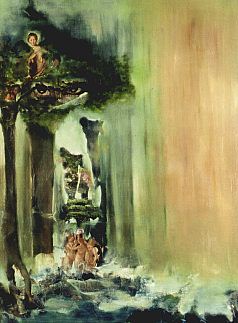 The
Three Graces by Carol Pryharska
The
Three Graces by Carol Pryharska
Twelve women artists, most of them academics and teachers - a cluster of them now retired and painting from Sante Fe - will present at A Muse Gallery, 996 West Third Avenue in Grandview Heights, during May.
"The Poetry of Women" is indeed a high quality show, daring to range from the romantic and pleasingly decorative to the cutting-edge and the fetchingly kitsch. But poetic is the ruling aesthetic, as in lyrical and engaged - no boring stuff here, yet nothing outrageous.
Taking a tip from portraitist Robert Henri, I looked at most of the yet-unhung pieces and took notes. Then I tried to scull from memory outstanding visual moments.
The Decorative Award goes to Christina Hall-Strauss' Four Season panels. These paintings verge on the startling with their tinge of clumsiness. Seasons are represented by flowers, not fantasy flowers: tulips, sunflowers, drooping lilies, perhaps a poppy or two seem to have been painted so as to suggest embroi-dery patterns from the last century.
The gold and yellow sunflowers have brown stripes on their curving petals. The flat green stalks and leaves seem to flow off the paper. The sky is aquamarine; the earth is a midnight hue. The colors dance and work together, the way a homespun quilt pattern can dance with a certain innocence.
The Cutting-edge Gorgeous Award. Cynthia Fustillo's Casa de Aqua, mixed media on wood, isn't exactly cutting edge, but it certainly is gorgeous. The "painting" is cut away over spackling compound, cut away ever so intricately. How does she do it? The result is fronds, ferns, leaves, grapes, raindrops, suggested flora and fauna that is, well, beautiful and inviting. As though describing a dwelling (casa) of aqua and agua!
The Kitsch and the Elegant Award goes to Karen Margraf's The Wilt, a mixed media clay tile. This artist knows how to handle her medium(s)! The Wilt was near a cornice in April and reminded me of a tile from an ancient Netherlands stove, but from the thirties. Loved it! A single large tulip is drooping its geometric head; a gold spot gleams somewhere among the sections. This piece verges on decon-structionist, yet is lovely. "Up with its hands before its face!," to quote The Gingham Dog and the Calico Cat.
The New Romantic Award goes to poet Carol Pryharska for her painted and decoupaged "box" series in which the sides of the box-frames have been painted to meld with and enhance the central painting. Pryharska is probably familiar with the paintings of Dante Gabriel Rosetti. Green Dreaming Her Sea presents a lovely, yet radiant face peering through a romantically green-blue ocean on whose crest float a few yellow chicks!
The Lady of the Lake perches on an Arthurian lake, but she is a new woman wearing jeans and a tiara of birch leaves. These large (varnished) oil paintings form a lyrical piece de resistance. Less florid than Rosetti's depictions (The Magdalen, Ophelia, Beatrice) Pryharska's women are supremely feminine and feminist in their simplicity, in their cloud-hued war tones. The box paintings epitomize neo-romantic cool, and they're spiritual, like a Gwinevere with a natural makeover.
Cutting-Edge Yet Classic Award. "Spiritual" might also describe the pleasing flow of Sanguine, a wall enhancement by Signe Stuart in the "Art for Life Artists" show. Seven strips, each 72" by 6", of embossed mulberry construction paper are sanguine. In hue and in essence. Sanguine means brave. In this case, like a zen painting. Design magic, beyond décor.
April's "Art for Life Artists" show at A Muse offered much fine art and some surprises. Rob Colgan, Chas Krider, and Scott Cunningham broke their own photographic barriers and did wonderful new things!
Randall LaGro will return in June for the "Assemblages" show in which many A Muse artists branch out into unusual efforts. LaGro, known internationally as a master monoprint artist, exhibited two pieces in the April show. This complex and difficult print method, viable since the Middle Ages, is rare in 2002. Yet, LaGro honors tradition, its dragons' wings, nude angels, and daemons, in a less rigid way, allowing his personae to operate in cloudier and more non-linear realism than his predecessors.
In May, the multitude of paintings in "Poetry and Women" will likely be displayed with skill. The A Muse "Art for Life Artists" show, in which some of the poetic twelve were evident, was testimony to Caren A. Petersen's gift for spacing and coordinating a multi-artist show. That's no mean feat!
Would that I could visit all three shows a dozen times. A Muse Gallery is open Tuesday & Wednesday 11-5, Thursday & Friday 11 to 7, and Saturday 11 &endash; 4. Call 299-5003 for more information.
(From the April 2002 Issue)
JungHaus
Sacred Thrones: Behold And Discuss
She was a
beautiful girl who visited gypsy camps in her youth,
wrote tender letter to her husband, loved books and their
stories,
fed raccoons from the palm of her hands, grew fragrant herbs,
listened to Beethoven and Porgy and Bess. Her hands were as
soft as the cloth called velvet.
-Sharon Weiss's words on Lorain Mae Robson Coombs.
"Sacred Thrones: Honoring Our Mothers," at JungHaus through April 27, serves as a picture window into the multifarious lives of the moms and daughters of Now.
The "Thrones," actual rehabbed chairs, once belonged to eleven Columbus-area mothers. Now these chairs (and one church pew) have become recycled art at the hands of their multi-talented daughters.
Lucinda Kirk, of The Ohio State University's Writers' Intensive Workshop, was the inspirational springboard for the show. Kirk is actively engaged in the American Folk-Lore Society, The "Sacred Thrones" were exhibited for one weekend two years ago at Sharon Weiss's Antiques and Art on Poplar in conjunction with the American Folk-Lore Society Conference.
Kirk met with the women for a year, discussing mother-daughter ties. At the time she produced a fascinating correlative book which is currently out of print.
Ofrendas
Ofrendas, "offerings" which decorate graves on the Day of the Dead, gave Kirk the idea for "Sacred Thrones." On that occasion, some Mexican people place altar chairs on the graves, plus some of their loved one's belongings: costume jewelry, cups, hats, photographs, etc. The "Sacred Thrones" show echoes these practices.
An ofrenda-like practice is evident in the United States when teddy bears, toy trucks, golf clubs, or other reminders are placed on grave sites; when plastic crosses and flowers mark fatal accidents along the highway. When Jaqueline Kennedy died, an adoring anonymous public left flowers, lighted candles, and other objets, at the door to her apartment building &endash; ofrendas.
The Moms
Doris: Joan Abbot-Motil is the daughter of Doris Marie Poche Abbot who died in 1997. An active RN and passionate community volunteer, Doris went to St. Michael's early mass every day, rain or shine. Thus, her daughter Joan had découpaged an actual pew in honor of her mother whom friends often referred to as "The Rose Kennedy of Worthington."
The pew has been expertly and care-fully embellished with family photos and symbols. It is one of the few "Throne" installations which, as is, could easily blend with furnishings in a home. Like its honoree, it is both useful and vivacious. The pew's natural wood glows under its lacquer. The seat is slick with family snapshots, event tickets, and the Saint Francis Prayer. A small American flag, upright on the seat, is the only detached object.
One arm of the pew has been découpaged with a large paper rosary. The other arm holds a marriage license. There are borders of stars and cerulean blue, and an attachment of actual service ribbons. Poche Abbot was a WAC, an army nurse. There are two large photos on the pew's back. In one, her lovely face glows, framed by permed locks and a military cap. In the second photo, she is a slim, very young woman in a long white "formal," probably a graduation dress.
Daughter Joan says, The hours spent creating this memorial was time devoted to being in communion with the woman who taught me to live from the heart.
Lois: Lois Stahl Sims's chair is an emotional gem, well executed. An aloft chair holds The Lost Princess of Oz and is embellished with puzzle pieces. Playing card dangle in exactly the right spot. On a rung, Scrabble pieces spell out "quixotic."
Daughter Martha, one of five kids, recalls, We all snacked on the same kinds of home-baked treats; we never had store bought. Mother and Father read the Oz books to me. They loved books, taught me school and learning were ways of enriching life.
Dorothy: Daughter Ruth has captured Dorothy Mae McGeorge Stavely's essence via a casual mode (primarily that of arranging objects) which sends an immediate description. On the covered chair seat Stalking the Wild Asparagus catches the eye at once. We see garden gloves, an apron, empty pineapple cans, supplement bottles, many objects which introduce us to a woman who knows "herbs and butters."
An angel on each chair knob bespeaks what daugher Ruth knows: Mom has recycled her religion, goes to weekly Gospel study, has visited the Holy Land; her spiritual journey is never ending. F
Ermajean: Ermajean McDonald Tucker's aloft chair is an expertly assembled art object. Like Motil's pew, the Tucker chair has been affixed and embellished with technical aplomb and a strong sense of composition. Tiny Smirnoff bottles dangle from a bottom rung. There's a mixed drink that's really a candle, or maybe a lemonade that's really a cocktail with a wick! Ermajean loves jewelry and that is precisely arranged.
Curator Lucinda says, Mom is mother, artist, wife, joke teller, sister, daughter, friend, golfer, seamstress, aunt, mother-in-law, reader, traveler, partier, does almost everything so well.
Sally, The Mom I'd most like to meet: This mom is Sally Saperston Levy. Her white plastic reading chair, with round bold-rimmed eyeglasses aloft, is shod in bold white tennis shoes! It's a yikes chair! Kind of throne together without many (affixed) attachments: magazines, books, cigarettes, the 6 oz. Coke can. This inveterate smoker and Coke drinker tends to camp out in any chair, to read, smoke, drink coke, speak her mind.
Daughter Jill says, Put her in any chair, give her a book, and she looks right at home. Even after my own numerous years of therapy and the inevitable maturation process, this diminutive spirit can still send shock waves through my heart with little notice."
Postlude
"Sacred Thrones" is an interesting show defying labels. Try: Folk-Tech-Craft-Pop-Art-Interactive-Conceptual. Above all, Interactive. Take a pal, share thoughts. On two white shutters you can jot a line on "What your mother always told you" and "What you wanted to tell your mother."
Chair artists for "Sacred Thrones" are: Kathleen York, Carmen Maron, Sharon Weiss, Joan Abbott-Motil, Betsy Loeb, Ruth Bolzenius, Lucinda Kirk, Martha Sims, Linda Larrimer, Rikki Santer, Lucille Kirk, and Jill Levy.
Each chair in the show is wonder-full. This article was intended to express the variety evident in "Sacred Thrones: Honoring Our Mothers."
JungHaus is located in the Short North at 29 East Russell Street, open Tuesday thru Saturday, 11 am - 2 pm. A reception will be held on Hop night, April 6, from 7 &endash; 9:30 pm and a Gallery Talk is planned for Saturday, April 13 from 10 am 'til noon. Call 621-8217.
School of fish in "Mood River" at Wexner Center for the Arts
Wexnermania
"Mood River" will run at the Wexner Center for the Arts through May 26. Intrinsically an industrial design/consumer goods gambit, the show provides an avalanche of artistic impressions.
Being the kind of person who wants to lounge around in Helen Bonham Carter dresses and read Jane Eyre in my wilder moments, I resisted "Mood River."
But I was enticed and subdued before I had left Gallery A, and undone completely by the time I had left Gallery B.
Many superb and simple artifacts &endash; in plastic compounds, in glass, steel, fiber-glass, &endash; glittered with geometric purity inside Gallery A. Housewares and machine parts became "design for design's sake."
Ansel Thompson's Chair #1, a blue-green low slung wonderpiece glowed, through the marvel of fiber optics, like the aurora borealis.
"Mood River" flows, becomes a Reef in which the suspended creatures are tooth-brushes, pens, taillights. The concept of Garofalo's eco-based Reef (once shown at ACME) is expanded and merged into the grandeur of technology.
The river wends beside a Dead Horse, and a gorgeous hunk of car metal, beauty-fully painted, and a wall-splatter of sport shoes. Explode, a white "paper" construc-tion, one of the best I've ever seen, seems to explode every which way on heavy wires that are an integral part of it.
Basin & Post Basin
Through April 14, you can visit, and bring your own skateboard to, Wexner's astounding skateboard bowl, Free Basin.
Indeed, you will be greeted by projections, live images of the skaters, as you enter "Mood River." The Basin's roar grows louder as you progress through the galleries toward it, passing under a waterfall of clear plastic lawn chairs rainbow-hued! To misquote Wordsworth, "My heart leapt up!" Through a cerebral mist, I imagined Jane Austin's Emma in
Hussein Chalayan's weird but romantic Puff dresses!
Reaching the Basin itself, I sat down, pulled out a gold wrapped Chicklet and gazed about me "in a wild surmise." (Keats, children, Keats.) I noted, from the blazingly pink "Mood River" brochure, that Chalayan will speak on April 24; I'll be there. Some of his Spring 2002 fashion collection will open at Wexner April 23.
The Free Basin skate bowl itself will vanish in mid-April, and Galley D will be the home, or pod, of Fabian Marcaccio's Paint-Ball Robot and Minako Takeno's Protrude, Flow. Am I ready for this? Go, Wexner, go, go, go!
Wexner Center for the Arts is located at 1871 N. High Street on the Ohio State University Campus. Hours each day except Monday. Call 614-292-3535.
Bierstadt, Bierstadt! Carlisle, Carlisle!
Two germinating dreams stir within my psyche as I write. The first? O'Keefe willing, I'll soon attend a guided tour of "Primal Vision: Albert Bierstadt 'Discovers' America, 1853 to 1893" at the Columbus Museum of Art.
Having seen Bierstadt's huge, as in monumental, paintings only in books, I can't wait to see the real thing - art history and American history, live. Autumn in the Sierras and The Landing of Columbus should please almost everyone with their grandiloquence - "Oh, beautiful for spacious skies."
Bierstadt saw "Eden" in the American West while it was still a hidden paradise for the Indian people. Indian artifacts from the Columbus Museum of Art collection will be exhibited. Fifty paintings and photos will be shown, including those by other intrepid pioneer artists, Thomas and Edward Moran, Eadward Muybridge, and Fredric Church.
Here's some Americana: Bierstadt's paintings were expensive. He frequently arranged shows in which a single large painting would be displayed in a setting of shrubbery, flowers, artifacts, music, etc. The painting would often be covered by a curtain until a magic moment. People paid admission to see this realistic if idealized glimpse of the then new Old West. Bierstadt continues through May 12.
Check out fees and schedules for "Art in Bloom," April 11-13, when the Museum becomes a fantasy flowerland. 629-0314.
At Sharon Weiss's Antiques and Art on Poplar, 20 E. Lincoln Street, on April 5, another dream will come true! I'll get to meet a guy I've heard, and seen, so much about. Craig Carlisle, once of Columbus College of Art and Design, now of California, will be here to open an April show of his new paintings, "Pink Monsters." Craig has been painting those super-identifiable smiling heads for years. He's a hit! Drop by, and think pink. I was at Antiques for a mere 10 minutes one afternoon, and three (separate) out-of-towners came in to "see a Craig Carlisle head!"
Bierstadt, Carlisle. From sea to shining sea, the Evening News pales in comparison to the turbulent diversity of art.
- Elizabeth Ann James
"Sacred Thrones: Honoring Our Mothers" will remain on view thru April 27 2002 at JungHaus, 29 East Russell Street. Hours are Tuesday - Saturday 11-2. Call 621-8217.
Chair artists for "Sacred Thrones" are: Martha Sims Lovely, Sharon Loraine Weiss, Jill Levy, Rikki Santer, Cathleen Hrady York, Lucinda Tucker Kirk, Lucille Cox Kirk, Joan Abbot Motil, Carmen Caldmwell Maron, Linda Gentis Larrimer, Betsy Renair Leob, Ruth Stavely Bolzenius.
Lanning Gallery
(March 2002 issue)
PEPPER - I stop and wonder -
The ceramist/sculptor Pepper will show her unique pieces at Lanning Gallery during March. Youthful and vivacious, the artist is bound to have many surprises on board.
Pepper is one of the few ceramist-sculptors who construct pieces which include both clay and glass. In fact, as a "clay person first," she says her Ohio State University glass instructors "couldn't figure out how I did it!"
"I have always tried to learn from masters," Pepper says. "I worked with the glass masters, the master potters, I learned to paint and so on. When I teach, I have to remember that, in more ways than one."
Pepper teaches for Columbus Parks and Recreation Department. She is a graduate of Central State University and The Ohio State University, with post graduate studies at Montclair State and Ohio State. Her art has been exhibited in many noted galleries in Atlanta and Columbus.
At this writing, she has six pieces on view at the Hale Center on The Ohio State University campus. Her noted Grandma's Quilt will be at the Chicago Museum of Science and Industry through mid March.
Glass Bowl
Pepper will show at least eight pieces at Lanning. Cradle of the Elements expresses Pepper's love for all life and its "materials." The Cradle is a somewhat cloudy glass bowl seventeen inches in diameter; it includes woven willow. The textured clay coils resemble snakeskins under glass. The bowl will hold water. Water represents clarity, negative space, Jung's "dark." The bowl's rim is a tinted green.
Social Unity, also a chalice of cloudy glass, is slightly over twelve inches in diameter. Inside, a lively network, coils of three, resembles African or Celtic knots and loops. "Don't use purist glass," Pepper warns, "Be as earthy as possible. Here is clay interacting with glass. Remember, water, glass, earth, light."
Children of God is a wall plaque, vivid with earth tones: turquoise, metallic brown, yellow, orange tones, yet includes green shiny glass. And if you look on the "desert" side, you will see the brown Children of God holding spears, dancing. "Now you see them, now you don't" Pepper says, tilting the sculpture. "Like slavery; they were dark and blended into the African forests. Escaping, hiding."
Fire on Earth vibrates with sun/earth colors. The tree branches? Lavender twigs with lavender scents! "Fire, death, birds of life."
"Don't lock yourself in," advises Pepper. "Practice your craft. And then be imaginative!"
Portrait of Self includes Pepper's reflecting bowl motif: glass "interacting" with clay, water with glass and light. "The negative, the positive." The piece includes colored glass shards, some curved, some piercing, because life is pierced by challenges and hard times. Yet, the light shines through, and the chalice continues to hold water and can hold fire, as candles.
Grandma's Quilt
As an example of clay-glass fusion, Grandma's Quilt honors Pepper's beloved Grandmother Milner. Reflecting shades of red, this piece is unusual in size (17" x 7/8" deep) and is a coil piece. Again, the clay and water "interact" showing reds and yellows, unique in texture, "like a ragged quilt."
The "Quilt" is actually "two houses patched together," and represents Mrs. Milner's ability to build connection and community on a level that was, and is, a wellspring in Pepper's life. Although Grandma's Quilt will not show at Lanning; it is mentioned here because it is representative of Pepper's aesthetic, indeed, her ethos. As Pepper says, "There is interaction, struggle, then creation. And people can actually touch my work."
Spirit and Memory
Pepper remembers the extended family and a lovely connected neighborhood that existed before the freeway cut through Grove Street. When she was at school, she could look across the street and see Roman Johnson painting! Pepper's mother, grandmother, and aunt, were powerful sources of inspiration.
"They taught me the artistic gifts; they taught me patience. Art is painstaking. I learned that from them. When I was in Atlanta meditating, my dying mother in Columbus knew, without being told, the exact hours I was meditating.
"Her death was a major loss, but she is with me, they are all with me. They taught me to dance, spiritually, actually. Dance is therapeutic! We must dance, in life and art. My father had an RCA Victor phonograph; he'd open the windows and play for the neighbors and everybody and we'd all dance. It was wonderful!
"I'm interested in everything and everything is a part of us and to be wondered at. If a lightning bug lights on my hand, I stop and wonder."
Louis
David Louis is the proficient and esteemed other half of Lanning's March show. His large abstract paintings resonate with color strokes and lines and deserve critical attention that time and space considerations did not allow. Go see, admire. He's movin! Lanning Gallery, located at 990 N. High Street in the short North, has hours Tuesday thru Saturday or by appointment. Call 291-4421.
Post Script
Gifted photographer-mixed media artist Barbara Vogel guided me through the fabulously jumbled workstudio shared by Pepper and one of this nation's distinguished photographers, Kojo Kamau. Looking around, I could find James Baldwin, Nikki Giovanni, and the lyrical warrior, Dr. Mary Ann Williams among the honorees. There were many other poignant spirits and reminders. It was an honor to be in that space. Mr. Kamau reminded me that ACE Gallery is alive and in orbit. As curated by Larry Winston Collins, Art for Community Expression is represented by a members exhibition at the beautiful Frank W. Hale, Jr., Black Cultural Center 153 W. 12th Avenue at The Ohio State University until March 28. The last time I looked, Roman Johnson's superb work graced the Hale Center walls, and I expect it still does.
Life on the Street at Lindsay
Peyton Morris Petty's "Life on the Street" paintings, at Lindsay Gallery through March, will likely jar viewers out of urban-ennui and into vibrant responses. Owner/curator Duff Lindsay should be congratulated for bringing this sophisti-cated and unusual artist to Columbus.
Eight medium-sized (around 12" x 16") pastel paintings-on-board were available for critique during February. Larger paintings were en route to the show, which opens with a reception on March 1.
This artwork is startling, not shocking, and catches one off guard. Each work presents at least one shoulder-high profile of a shiny black entity who provides a kind of negative space in the midst of vivid shapes. Each figure is looking at, or selling, something. More than one painting includes large naively drawn tropical birds.
The Shirt Seller depicts a triumvirate of shoppers. The central figure, probably a parent, is taller than the two "children," who stand wistfully on each side of him or her. They're all concerned with a big yellow tee shirt and a small red tee shirt. A "Sale" sign and "No Loitering" are in evidence. The trees, actual or artificial, form groping fingers. Everything balances in threes, one central object balanced on each side by another object, etc.
The monochrome shoppers wear subtly textured orange shirts. Their eyes seem cut from typing paper. The textured sky is a melee of stark blues.
Peyton makes her own paints, mixing liquid dye and pastel primers and using a sealant. The works shine. Look closely. The delicate texture that inhabits the paintings makes them less flatly opaque. This affect derives from an underpainting of tinted gesso and ground pumice.
Petty's art, deliberately naïve, is actually about color and design. Yet, the crudity and simplicity of the shapes throw the viewer off balance, back to another era - when birds were painted on caves, perhaps, or better still, 1905, when the critic Louis Vauxcelles declared the work of Matisse, Rouault, Vlaminck and Derain, to be that of Wild Beasts, and coined the term Fauvism.
Petty's colors, sun bright, not tech brite, seem somehow beyond primary. The Fauves, painting in the Midi, southern France, thought their perceptions of nature were more direct because of the relentless sun in which they painted. Petty is no "Beast," but her colors, forms, and their arrangements are unusually direct and simple, thus "wild" as compared to our jaded expectations.
Peyton Morris Petty holds an art history degree from Wellesley College. She has exhibited widely in the Virginia, Pennsylvania, and Ohio area, and she is the founder and coach of Walnut Hills Studio Workshop, Cincinnati, Ohio.
Her exhibition list includes, of course, a list of paintings, the titles of which may presage the flavor of the March show. A sampling: When Mother Stole the National Flag and Other Stories; Joe Pillowman: The Elusive Street Vendor of Peebles Corner; Growing Up (Almost) Rich, and Other Childhood Memories.
Petty was juried (by Sidney Tillum) into the "201 Banana Factory Show" with her I Killed the Cat.
Peyton's parents live in Jamaica. When she visits them, she is enchanted by the street vendors, their calls and merchandise. In Cincinnati, she works in an area where there are still street vendors and periodic street fairs. Hence, "Life on the Street."
According to Lindsay, "She seems like a calm suburban housewife, but the life in her mind is volcanic."
Lindsay Gallery is located at 986 N. High Street, Call 291-1973. Hours are Wednesday thru Saturday.
&endash;&endash;&endash;&endash;&endash;&endash;&endash;&endash;&endash;&endash;&endash;&endash;&endash;&endash;&endash;&endash;
In Like A Lion
ART ACCESS: March continues the Jance Lentz show at Art Access through March 21. "Mostly France" is neo-impressionism at its most fetching. The artist has traveled and painted widely in the Loire Valley and Brittany for the last two years. She is represented not only by Art Access in Columbus, but by The Bonfoey Company in Cleveland and Fisher Galleries in Washington, D.C. Art Access is located at 540 S. Drexel Avenue. Call 338-8325 or visit their Web site at www.artaccessgallery.com
ACME ART COMPANY, 1129 N. High Street, is likely to be more than the usual super during March! Xan Palay will turn Main gallery into an installation resembling a miniature city. Palay is noted for the signs she built for SPACES in Cleveland. Melesa Klosek, ACME director, describes SPACES as "falling somewhere between ACME and Wexner when it comes to marketing and exhibiting cutting-edge art."
Milwaukee's Greg Klassen will show in Spot, with Sylke Krell curating. Zerek Kemp will use video and other techno components for Bath.
In February, Janet Bloch's painstaking, yet fluid, gouache paintings (with their individualized frames and mixed media augmentations) won this Muse's blue ribbon. The works successfully combined elements, and documented, without pathos, the artist's mother's death from Parkinson's. A truly remarkable show by a first-class technician and a creative wizard.
Save September 21 for ACME's Art Auction, which will be held at a vast new space TBA. (No, ACME isn't moving, but the Auction is!) To learn more about ACME and the ACME auction, log on at acmeartcompany@aol.com or call them at 299-4003. Hours are noon to five, Wednesday thru Saturday. The kind of new great signage at ACME art was built by Craig Turner! As Melesa says "It's your gallery, Columbus. Help it make you happy!"
Insight Studio
This is My Camera, This is My Film, is being offered by Insight Studio And Gallery, 47 West 5th Avenue near High Street. Eight-week beginners workshops start March 20, 6:00 &endash; 9:00 pm. The fee includes a three-month membership. If you're an almost beginner, teachers will be around to help you too. For non-beginners, a diazo workshop will be held on March 16. There is a fee for Insight membership privileges and classes, but the cost is much lower than totally funding your own photo work. Call 294-4155 to register.
First Call
Elastic Ekphrastic, a tour of art galleries poetry writing workshop, sponsored by Pudding House Innovation Center, is accepting registration from interested poets. The peripatetic workshop will be held May 2002 thru January 2003. Visits to Riffe, Columbus Museum and other sites are on the agenda. Elizabeth Ann James will lead the Short North workshop/tour with the able guidance of Jennifer Bosveld, director of Pudding House. The proof of the poem is in . . . Limited registration. Call 740-967-6060.
Call Now
MARCH 1, 2, 3 concludes Women at Play's contemporary take on the Demeter/Persephone myth, and it's an X Generation gas, as in the oracle at Delphi. She of the Lovely Ankle held in Studio Three of the Riffe Center. General admission: $15, Others: $8. As Athena is to street smarts, Katherine Burkman is to collaborative scripts. 457-6580.
Raffensberger
Celebrate the one-year anniversary of Raffensberger Gallery and the seven-year anniversary of Raffensberger Photo-graphy and Framing in German Village throughout March with Seven-Way Store-wide Savings, including 30 percent off custom framing, 40 percent off wedding invitations and 10 percent off everything! A special celebration, hosted by vocalist Melissa McCamish, will be held in the
Short North store on Gallery Hop night, March 2 from 7:00 &endash; 11:00 pm.
Roger Williams: The Culture Surrounding Cyberspace
(FEBRUARY 2002 ISSUE)
I've always been interested in how fast can art go in lyrical terms &endash; Artist's statement
Preludes
It was at Lanning Gallery that I saw a Roger Williams Speed Machine for the first time. Williams himself, tall, bespectacled and eagle-eyed, was there, gazing at a Kathryn Kadish painting and discussing surrealism, a term I like to hear.
The large wing-like structures - joyfully reminiscent of colored paper airplanes - blew me away, or flew me away. Williams himself aptly describes them as "mystic ethereal interplanetary speed machines."
A Williams' wood-based Speed Machine is intricately painted with a multitude of bright hues. In this sense the work is formalist; everything the artist creates begins with spontaneity, yet it is rendered with exactitude. The created object resembles, or has been transmuted to form, something other than a painting, something magical that a former Wexner show would have described as "Division and Displacement."
That first evening, Ursula Lanning told me how five of Williams' Speed Machines had been purchased and installed in the new West Concourse at Columbus International Airport. "He's supremely creative," Lanning said. "He can do almost anything."
I made the airport trek, was impressed, and wangled an appointment to visit Williams' studio/gallery in Olde Towne East. There, I listened to the artist reminisce and explicate. There, I saw art which, justice prevailing, should even-tually be known as some of the most important and engaging art of this century.
As a deprived farm kid in southern Ohio, Roger loved pinwheels and made them. He also carved tikis, small wooden totems, and sold them to classmates. He was a "bad" student, but he managed a scholarship to Columbus College of Art and Design where he flourished. Later, he moved to German Village where he sold a number of paintings, enough to earn his right of passage to New York City! There he lived, gloriously, intensely, for fifteen years until the nineties stock market crashed and Columbus began to seem as possible as New York.
New York, The '80s, and Neo-Abstract Expressionists
Williams saw over one thousand art shows during his eighties sojourn. It was the vavoom era of neo-abstract expressionism. The neo-abstract expressionists, Williams explained, used something purely interior as their motive yet became very high-tech. In most cases, the results were totally non-representative, "nothing realist or derivative."
In Columbus, Charles Csuri had waved a wizard's wand. In New York, Soho hadn't been gentrified and Mary Boone hadn't moved uptown. There were a zillion galleries in the East Village, and, as they do today, people threw around such terms as "decorative decadence" and "glitz." Jackson Pollock was "coming back in the eighties" (Coming back? From his heyday in the forties, I guess.)
Andy Warhol was not a passive ghost. Keith (Pop Shop) Haring was around. Williams knew and worked with Anina Nosei, a real shaker and mover.
The Graffiti King, Jean Michel Basquiat, who had once slept in a cardboard box in the park, who had been a Madonna pal, was Roger's friend: "He (Basquiat) was quiet and generous. He loved to pick up the tab for his friends. He didn't die poor, and he enjoyed the good life until he died of a heroin overdose at age twenty six. Then he became the hero of the full-length film Basquiat.
"Yes, he was gentle. But if he thought you tried to rip him off or made fun of him, he'd get back at you non-violently. Like putting crazy glue in your locks! His tragedy, addiction, resembles the Pollock film that way."
Gallery/Studio/Art
Now it's 2002. There are several large Speed Machines in Roger Williams' private gallery/studio, a vast contemporary space in which many objets are arranged, just so. Williams can write or dine on his large square aluminum table, as solid and invulnerable as a glacier, that bears the carved filigree of blizzards. Decorative Decadence - love it!
"Phenomenon (or Phenomena) art means 'let it happen,'" Williams said, looking at his large painting HEARTHANDSNAKE. "That's how I paint, not with a brush."
"Fractals. The presence of electronic fields. None of these, the speed machines or this painting, were painted with a brush. I use negatively charged surfaces, paper, board. So the paint floats; I spray it on with an airless hydraulic gun. These black lines, the snakes, they make the floating paint stay inside the lines where I want it to. I have control of that, but the floating paint kind of happens. This area dries and then that area dries."
The results are quite intriguing. HEARTHANDSNAKE resembles an exacting collage. The floating fluorescent paint has formed patterns in the background. Heart, hand, snake, form an interchangeable whole, like a Celtic lovers' knot. HEARTHANDSNAKE reads as different words. Observe.
Williams loves pinwheels. His 7-foot Great American Guilt Ventilator was a big hit at a Columbus Cultural Art Center show, even before anybody had noticed that each spoke is a nude profile of Marilyn Monroe! The love goddess, laminated mahogany and fluorescent yellow, toils not, but she certainly does spin!
Williams' newest work incorporates laser disks. His Valentine Variations, ruby CD hearts with dangling Fluxus chains and clasps, works as a complete wall sculpture, or separately. The wistful gaze can materialize a postcard, an earring, a token, on each clasp.
A recent acquisition consists of an actual circus trapeze, wrapped, stamped with tiny skulls. Art, like flying, is high risk.
A large Elvis Pinwheel includes the words HILLBILLY CAT and spins with the emotional, or political, heft of a stained glass window. On the walls, vari-colored aluminum bars shine, a Winchester cathedral of now. There is not enough space to describe the art in Williams' studio. Hundreds of paintings remain, unviewed, throughout his studio.
Roger Williams' art can be found in over thirty corporate and museum collections, including the Bank of Japan, New York; Merrill Lynch, New York; Ohio Bell; Standard Oil, Illinois; Columbus Museum of Art; Columbus Metropolitan Public Library; Applied Innovation, Inc., Dublin; Zanesville Art Center; United Nations Plaza; Wexner Executive Offices, Express Limited.
Williams' 1996 collaboration with the Karlsberger Companies was instrumental in bringing the Columbus chapter of the American Institute of Architects (AlA) awards to the Short North's Coffee Table restaurant and to the Midwestern Auto Group. The MAG installations include a 13' carved aluminum (five-legged) oval conference table and carved aluminum overhead lighting. They're imaginative and corporate, which is terrific, and so is the car door-shaped cabinetry.
Williams' large Tetrahelian, a collaborative project made with his twin brother Ralph Williams, a Columbus sculptor, is ready for the New Albany Local School library. He looks forward to a number of upcoming architectural collaborations.
In conclusion: critical enthusiasm for visual art is always arbitrary, the writer's descriptions being informed not only by what she sees and how she feels, but by what she knows about process and history.
Nevertheless, I doubt this hyperbole is misplaced. The finesse with which Roger Williams executes his art must be seen to be appreciated. Excursions into peripheral discussion and attempts at description fade in comparison to a careful viewing of the actual work. Behold the cachet of a zybertech renaissance man. Roll over, Beethoven. Rather, roll over, Jean Basquiat. Laser disk art and exploding pinwheels are breaking ground. To contact Roger Williams, call 258-3994 or Lanning Gallery at 291-4421.
New Infancies
Fritz Nelson Kappler earned his Master of Fine Arts at the University of Pennsylvania in 1997. He has been exhibiting and painting steadily before and since then.
"New Infancies," his February show at Rebecca Ibel Gallery, 1055 North High Street, should prove startling and appealing. Kappler's career began in Seattle where his father, in the printing business, couldn't bring home "scrap" paper fast enough. Fritz filled them up with drawings!
Now residing in Columbus, Fritz Kappler, himself the young father of three, paints nearly full time and teaches adjunct art and classes for children. Come March he'll be teaching collage to grownups at Columbus College of Art and Design.
Kappler paints big and direct; his broad images rivet the attention. His palette is unsullied, flat. There is very little shadow and light. The inert yet bold colors inhabit their own lines. They draw your attention from across the room and that's good.
His large (42"x34") oil paintings of children's faces exude the ambiance of huge desktop photographs and coloring books. You may like them, you may not. But you'll remember.
The natural expressions on these large faces are interesting. Look closely. At Olivia, wistful in a red cap. Tow-headed Hannah and her impish grin. Peter the audacious carrot top.
From their own perspectives, infants live in a huge and overwhelming adult world. Kappler has reversed this view-point. Looking down at us, the faces of his giant children emanate mischief, vulnerability and joy.
Although I did not see Kappler's landscapes, they probably glow like a pile of enormous pick up sticks. And I haven't seen his pièce de résistance, a painting so large he was afraid it wouldn't get through the gallery door. Over three hundred infants appear on this canvas. Yikes!
Among the great "New York" work at Rebecca Ibel's January show, Robert Amesbury's 26" x26" Purple House was one of my favorites. Amesbury employs that kind of new paint-by-numbers aesthetic that balances, plays off, tech colors as though they are Lincoln Logs. The sunny old "stacked" purple house served as a perfect vehicle for that gambit which all too often leaves me cold.
Ohio's Linda Gall shone in Zig Zag Ribs and Flying Arches. Here, a group or family, including a matronly woman in a bra, have been painted with dignity and quirkiness as only Linda Gall can paint them. Gall is to be congratulated on her new series in which ordinary people have been upended in time and space. Hence they appear against domes, arches, mosaic patterns, which suggest the fast track dislocations and circumlocutions of contemporary life. We have all become immigrants, one way or another. p
Rebecca Ibel Gallery is located at 1055 N. High Street. The gallery is open Tuesday thru Saturday from 11 am to 5 pm and by appointment. Call 299-2555.
Blue Cube Arts
(From the January 2002 Issue)
Alive Plus at Blue Cube Arts
Art is dynamically alive at Blue Cube Arts, the new gallery at 761 N High Street. The Cube runs on a high-powered engine of talent, and four wheels: Nate Lucas, Clint Davidson, Chrissy LoConti, Edmund Gaisie.
These artists have CCAD connections past and present. Their talents are strong yet varied, and they are not afraid of work, i..e., getting their hands dirty. There is a wood shop under the gallery; Nate Lucas designs and builds furniture down there. His co-worker is Rob Sanford.
Blue Cube Arts is where the spacious An Open Book used to be. The gallery is wide, light-filled, definitely now. The sofas and chairs in the reading lounge are classic, contemporary. The furniture is for sale, on loan from Vintage Antiques in Clintonville. Lucas and Sanfords' adjunctive chests, tables, and cupboards serve as functional, durable art pieces. Take the blonde Chest, for example.
Treasure Chest
Rob Sanford used mahogany and ash when he built the blonde waist-high chest of drawers. The wood, planed to show the grain, is part of his aesthetic, a sophisticated appreciation for natural timber. The piece contains three levels of drawers. The two upper levels shut even. The wide bottom drawer includes an open space, does not close flush. Pay attention. See dark blue glass and decorative soddering.
Nate Lucas builds furniture that is elegant, simple and sturdy. He works out of a tradition that is European and contemporary. He knows about wood, can talk about "birch ply" and "dense pulpy wood from Africa."
"I'm real hands on," he says. "I think about what I'm doing all the time. I like to get into my work."
When it's necessary Lucas is a cool and affable spokesperson for Blue Cube Arts. He is a painter and studied painting at CCAD. His furniture is beautiful.
Davidson
Clint Davidson will show at Blue Cube in March. His work is quiet, provocative, and original. His not very large paintings are complex. "Self Destruction Series," acrylics and collage on panel, makes us ask questions: "Who painted these? Why the muted tones?"
The flat muted colors include, in Davidson's own words "depressing hospital greens and grays." A stocky man gazes down at a limp penis. Cigarette wrappers form a lamp. I like Davidson's work because it's authentic, straight on, the way he sees it. He suggests and puzzles; his mode is neither openly narrative nor jarringly symbolist. Perhaps by March his new work may be even more bold in size and color.
Davidson sometimes uses music when he paints, although he doesn't paint to it. He describes both the music and his painting as "urban, contemporary, somewhat having to do with popular culture. Experimental. Non objective, yet I want people to relate."
Can't wait until March.
Saul Applebaum
Saul Appelbaum's "Recent Works," - tall, wide, 4'x5' abstracts - were up in December and they are terrific. The seven oil on canvas paintings consist of brite, color-full vertical brush strokes. The drippage is not thick, but that effect is there. From a distance the paintings are so dramatic that the apparently undulating "stripes" illumine the gallery from across the room. Yet, as Nate Lucas observed, "When you look closer you notice even more dimension and nuance." The colors merge, submerge, drift. The paintings have sophisticated titles: Indeterminate to Determinate, Anachronism, Excessive Naturalism, and Who's Afraid of the Zip?
Appelbaum, a Fort Hayes alumnus and graduate of the Art Institute of Chicago, is presently Assistant to the curator of 20th Century and Contemporary Art at the Columbus Museum of Art. He possesses an engaged interest in philosophy. His artist's statement is resplendent with references to Aristotle, Junk, and the architect Alvar Alto.
Edmund Gaisie is a strong presence within the managing team at Blue Cube Arts. I first met him at his wonderful two-man show (Nufsed/Edmund Gaisie) at the Ohio Art League. His work, much of it three-dimensional and mixed media, is admirable. He understands clarity. His symbols, images, and forms, well constructed and conceived, convey an instant image and impression of solid mass. He's a master when it comes to rhinestones, metal, wood, not to mention fabric, leather, etc.
Gaisie's Vino-ed Asiago, acrylic mixed media on panel, is a smaller than usual Gaisie, but is vintage! Edmund, nonetheless. The wood frame is solid, the bottle is solid and, voilà, to paraphrase Omar Khyamm: a slice of cheese, a bottle of wine, and rhinestones!
Chrissy LoConti studies paper-work at CCAD. Her work is currently not on view at the Blue Cube. Mohammed Omar's darkly mysterious abstract paintings Aziza and Noor, in their heavy frames are a must see and deserve more space. Omar comes from the Sudan and spent five years in an Egyptian Art coop. Eliza Quay's jewelry is fabulous and Kevin O Grady's glass bracelets, ditto.
In January, Blue Cube Arts will present a photo show. At this writing, viewers can look forward to seeing works by Whitney Lee, Cory Piehowicz, Kristy Roberts, and Damon Taylor. William Carlos Williams, Elvis Presley, and Chopin - with their blue notes, blue suede shoes and blue guitars - will be sending best wishes!
John H. Behling
John H. Behling is a painter's painter and that's a high compliment. He is more than competent at technique. From a look at his students, Rachel Stern and Bernice Koff, for example, he's an excellent teacher. He's an excellent painter too. Years of what Zen teachers call "practice" have given his still lifes and interiors a certain zest, freedom, joie de vivre.
Behling currently teaches research at the Columbus Cultural Arts Center. His exciting art education background began when the "bright hot colors of the Mexican landscape" inspired him while studying art at Mexico City College in l953.
In December, Behling's watercolors at Civilization gallery, 3520 N. High Street, dance off the wall! His subjects are familiar. A lake shore. Cottages on a shady street at Lakeside, Ohio. Factory buildings. A green house. The artist does a great job at the cast of branches, shadows, sunlight. He says, aptly, that his "mosaic-type style, its bits, pieces, spots and marks of color will be assembled by the viewer's eye in order to produce meaning."
Breakfast Porch, an indoor-outdoor room, contains yellow walls and chairs, a red table top, purple windows, and green strokes rustling outdoors. I wanted to sit there.
Behling has painted unusually fine nature/flower abstracts. Dreaming of October, smoky and purple blue, blew everybody into a snowdrift. There is a wonderful series of Hollyhocks!
2 Co's:Seduced by Color
The paintings of John Behling and Bernice Koff will appear together at the Gallery at 2Co's until January 27. This should be a don't-miss-it show. Both Koff and Behling have considerable art backgrounds and are docents at the Columbus Museum of Art.
Koff recently decided to liberate herself from the stringent techniques of water-color and has created photage, cut-up photos which she glazes and layers with oils and acrylic. She uses sticks, brushes, works "spontaneously, furiously." We hadn't seen Koff's work at this writing but it sounds terrific. The artist says, "dropping paint onto paper is creating magic."
Voilà. Koff and Behling. "Seduced by Color." The (I mean beautiful) 2Co's gallery is open before and after 2Co's Cabaret shows, and on Hops, and by appointment, 437-2267.
Antiques and Art on Poplar
(From the November 2001 Issue)
Color-full Art on East Lincoln
Antiques and Art on Poplar is really at 20 East Lincoln "just around the corner" from High Street. Sharon Weiss is the talented and personable curator and owner. Her gallery/shoppe is open Thursday through Sunday.
Sharon always provides elegant white space for her openings. Dauntless, she moves antiques, paintings, and objets to other places, thus highlighting displayed work. The wide front windows add a pleasing aesthetic as well as extra light to Antiques and Art on Poplar.
Lubkeman
Eric Lubkeman is one of the most ubiquitous, sophisticated, and popular painters hereabouts. We are likely to write more about him soon; he will be showing at A Muse Gallery in March, and he is a member of Sharon Weiss's "stable."
The painter has traveled extensively, at first because he worked with the glamorous Club Med. Later, on his own, he traveled to such sun-and-sand washed areas as Costa Rica, the Dominican Republic, Mexico, and the Caribbean. His work is informed by these memories. He's an intrepid and joyous painter.
Lubkeman was once a theater major and continues to work professionally at designing sets and costumes. His art career began in his youth when he earned scholarships to CCAD Saturday classes.
"I like art for art's sake," he says. I manipulate color into something beautiful. People come home from work tired, and they escape into a slice of something I've seen."
When I mentioned Lubkeman's oranges and reds, he replied, "I'm not afraid of colors. I'm a colorist. Those are the artists I admire."Lubkeman says he is now beginning to work on monoprints and that he wants to evolve from his use of "black lines."
Sometimes he works from photographs. He says he is now including more representations of people, landscapes, fish. I told him I remembered seeing his lush Costa Rican painting that had "laundry blowing on lines." Lubkeman chuckled, "Those are pareos, fabrics for sale. They're hung on lines along the beach and they blow in the wind, like floating stained glass."
It's a fine painting. When you see a Lubkeman you see the zest and rhythm with which he paints. His brush is a conductor's baton, a magicians' wand.
Hara
Hani Hara is but one of Sharon Weiss's talented painters. His September show was a delight. The artist has always loved art, although he has been painting only a few years. He says he works by intuition. There is an unusual liveliness to his still lifes and dreamscapes. Consciously or unconsciously, he is definitely influenced by cubism. And he is fabulous at painting dream-like interpretations of actual scenes.
Man With A Purse
In this deceptively simple oil painting (36" x 14") by Hara, actual perspective is skewed. It's a tilted scene! In the background, an office building, a construction of cubes, squares, and a lot of glass, reflects the gray and blue of other tall glass buildings. Viewers may think of the Wexner Center or the Convention Center. (I love 'em both.)
But the scene is Montreal; the mood is cubist-esque! The tall blue-eyed man has a pale-and-peach face; he has gray lips. His brows almost touch the dark wide brimmed hat. He is visible only from the waist up. Yet, we know he is a contemporary Man in a Gray Flannel Suit walking rapidly out of his frame toward now.
December: Akers
Rick Akers, artist and sales representative, and his wife Jo, an interior designer, live in a 155-year-old home in Groveport, Ohio. The couple have two daughters; both girls paint. For the last two years, the eleven-year-old has won first prize in oil painting in the Girl Scouts Contest at the juried Ohio State Fair Show. Her mom, Jo, has vanguarded the successful restoration of a century-old Groveport school currently in use.
Rick Akers himself had two works juried into the prestigious Ohio State Fair Show (professional division) in 2001. The artist holds a degree in design from the University of Dayton. He has been drawing since he was "Magic Ricky" to all the kids in his third grade class.
Today he paints, always on site, plein air, and never from photographs. He has had other successful shows at "Antiques." Aptly referring to himself as "an Ohio landscape artist, impressionist and expressionist," Akers sees patterns and colors everywhere. Sometimes, on the way to work, he scribbles colors and shapes while he is driving! His small gold-framed, earth-sky-sun "designs" - to me they resemble abstract paintings - have been very popular at "Antiques." Brilliant planes of color: stripes, layers, curves that suggest sun over fields, skies over highways.
From the second floor of his 155-year-old house, Akers can look down at the rooftops of his neighborhood. Up there, last winter, he began a fantastic series of six monoprints. They are quietly superb, like poems on ancient Chinese parchment.
To explain a difficult process simply: one way of doing a monoprint is to press a fresh painting on glass and then use the glass to print the painting on board or paper. It's an intricate and difficult process, and there's only one print, a monoprint.
Our Village
Our Village, a small monoprint juried into the Fair, suggests small towns everywhere. An 1885 red brick church with steeple is visible between a modest home, a blue-green frame, and a snow-topped scraggly pine tree. Toward the front, a squat powder-blue garage completes a cluster of attached buildings. The eye is drawn to the church, hence to "the village." The marvel is, however, that Akers is able to use paper grain and negative space in order to form ridges, shadows, new snow, the dim lines
of shingles. The first glance is wonderful, but a closer look brings amazement. The emotional setting is Thornton Wilder's Our Town, only now. Perhaps the series will extend to include a gas station or a foodmart, more houses or a library in "the village." The monoprints are wonderful, charming without being "pretty." The chipboard adds texture and depth to shapes and colors.
Dogwood, Lockbourne, Ohio
This 16" x 20" oil painting presents a slope with all the freshness of an Ohio spring. It is rich with Akers' lush yet calm brush strokes. (Palette knife strokes.) The tilt of them bespeaks an April wind. Brown old growth is pushed aside by emerging lime green. The orchard, wild perhaps, is spectrum of green "knife" strokes, and the dogwood trees toss bouquets of roseate smudges. The sky is a bold robin's egg blue. Akers has a way with blues. He can use them the way some painters use variations of red. He has a way with color even when his tones are subdued and somber! This is, indeed, plein air, fresh air!
"People enjoy the spontaneity the palette knife creates and I enjoy that way of painting," Akers said. On the back of each painting, Akers records the site and date, and eventually, an appropriate Bible verse. Rick's painting honoring the September 11 disaster victims and their firefighters brought a very high sum during the auction held by Sharon Weiss to help victims of the recent national tragedy. "Thanks" to Sharon and all the artists.
The artists at Antiques and Art are a varied and lively band of painters. Each one is first-rate and likely to be seen in this column soon. Rachel Stern will show at Michael Orr in December. Paul Emery, my favorite romantic, was at 2Co's recently. One might say that nationally known Craig Carlisle is a-head of everyone! Matthew Kinsey is a pleasing realist. Ric Borg is Ric Borg and you can't beat that.
Gallery V: Love At First Sight
Potter Jenny Floch's Vessels are on exhibit with the esteemed work of painter Paul Bourguignon at Gallery V through November 24. Bourguignon's name speaks for itself. A master in her own right, Floch is a potter's potter, an artisan/artist par excellence. Her vessels, unostentatious and non-experimental - as in the label "in your face" - strike the viewer with their innate beauty and craft.
Jenny has continued to work (and to sell) since her successful shows at the gone, but not forgotten, Gallery 200. She describes her new work as somewhat "looser, freer, in some cases larger." She has developed a technique for throwing "oval pots rather than round ones. Most people throw round."
Floch's Gallery V show consists of a variety of shapes and sizes. A gorgeous patterned green-and-gold bottle - it resembles treasure from an ancient ship - "was 20 inches tall when I threw it and is now 18 inches. It's hard to throw 20 inches, I've succeeded," says Floch. Jenny glazes some of her pots and then has them sandblasted by auto specialist Martin Denney. "That gives them their stony look. Some suggest strata, what one sees at Hocking Hills. - I use silver too."
As Linda Fowler is to fabric (and painting), Jenny Floch is to pottery. A master. Floch made ceramics in junior high school: "Later at boarding school, I saw a potter's wheel in the art room. It was love at first sight."
A Muse Gallery: Soul Cages
Caren Petersen, the muse at A Muse Gallery, says that the title "Soul Cages" is from a Sting album: "Our bodies encompass us, our souls. What we project may be different than our emotions."
Randall LaGro and Ron Arps are featured artists in "Soul Cages," an A Muse show that closes November 15.
Mitzi Prince, Kristi Hager, Richard Garriott-Stejskal, Tim Brown, Julie Byrne: Each of these "name" artists have work in "Soul Cages." Ron Arps lives in Columbus and shows and sells widely. Randall LaGro lives in Taos and does the same.
Randall LaGro
Randall LaGro has tackled the difficult medium of monotype. What he produces is intricate, detailed, imaginative.
"He's a classicist in technique," Caren says. "You don't know whether you're looking at a dreamscape, a medieval palace, or a costume ball in your imagination. Look, see more and more: images of snakes, spirits, angels." Described by Caren as "realist and impressionist," the nationally viewed LaGro has ten paintings in "Soul Cages."
Ron Arps
Caren says Arps paintings are becoming more classicist. "Both of these guys honor tradition. Ron is echoing Rembrandt; the use of back lighting, when the face is dark, when the light rises behind it. - Ron's falling away from the decorative."
Each painting, oil and/or acrylic, is painted on linen. Each painting is of one woman, but not the glamorous femmes of past Arps paintings. These women are shadowy and somber. They have veins and fat deposits. "They're slightly disturbing, will catch people off guard," Petersen says, "but they're beautifully painted."
In Dragonfly, the woman's face is shadowy, her robe is dark. Her mysterious face gazes down at her hands, at the dragon flies flying off them.
If you want to see an exciting show with exciting art, see "Soul Cages."
A Muse Gallery is located in Grandview Heights at 996 W. Third Avenue. Gallery Hours are Tuesday thru Saturday, 11-7.
(From the Oct. 2001 issue)
Lanning Gallery
A LIGHT FANTASTIC
"When I began these paintings, I was interested in what the inside of the fruits revealed. The seeds and veins, and the translucent flesh and color changes, were intriguing. The more I focused on them, the more fascinating they became. I soon began to see the works as a metaphorical suggestion for the transitory nature of life."
&endash; Dennis Wojtkiewicz
American
Artist, June 2000
At Lanning Gallery through October 20: "New Light," Pastels and Oils by Dennis Wojtkiewicz. To be brief, this is a wonderful show.
Although the large bright pastel and oil paintings create a strong first impression, more and more intricacies become visible when the viewer walks slowly around the gallery, pausing before each piece.
In the show, Wojtkiewicz's "Citrus Series," each painting is skillfully infused with light, yet there is no other light source than the painter's palette! A large slice of kiwi has fine webs, like wagon spokes, and a dark center, and appears to be backlit, but is not.
Except for the two muskmelon slices resting on subtle red and green shadows, each painting, oil or pastel, contains a single realistic image: a large piece of fruit, halved or sliced.
Although we may glimpse table surfaces and walls, the fruit is the single focus of each painting. Each fruit &endash; watermelon, tangerine, kiwi, muskmelon &endash; is larger than actual life size. Again, each fruit is infused with light. The bright-rose watermelons, their textures and seeds, just so, are Eden-esque in their tempting beauty.
"New Light" is a show of such startling simplicity that curator Ursula Lanning had her already clean white walls repainted for it.
Sold at the opening, Citrus #5, a 4' x 6' Oil on Canvas, presents a gorgeous tangerine; the center, the pulp, the veins; the vanilla edge of the rind, visible, and aureate.
The Rosette Series, single, halved kiwi and oranges, are luscious in colored pastels, and resemble, in this their natural state, the stained-glass "rose" windows in a church.
Having praised the Citrus Series and its painterly light, let me add that this is not an ostentatious show. Nor is it a traditional or romantic one. Rather, as much as labels are useful, it falls into the category of contemporary pop art: a single accessible object &endash; in this case, from the natural world or the supermarket or the fridge &endash; has been, if not exalted, explicated, enlarged. The artist, as was the case with Warhol, is both painterly and experimental, having used dissection as a kind of abstraction. The simplicity is deceiving; the splendor becomes evident to those who can apprehend technique and imaginative esprit working together.
According to Ursula Lanning, Dennis Wojtkiewicz, a Bowling Green University instructor and Ohio Arts Council recipient, has always worked "larger than life." - in more ways than one.
Lanning Gallery, 990 N. High Street is open Tuesday thru Saturday, 11am - 5 pm. Call 291-4421.
OUTSIDER ART IS IN:
- At Marvelous Lindsay Gallery &endash;
Former TV producer Duff Lindsay has loved art, specifically folk art, for most of his life. His knowledge of folk, outsider, memory, and brut is encyclopedic, as is his ability to explicate each category. He is a brilliant and knowledgeable raconteur. He returned recently from a successful "gig" at the National Folk Art Fair in Atlanta.
Lindsay's Upper Arlington gallery was highly successful for two years. The glittering precise art images of the sophisticated (and youthful) folk artist Levent Isik was a bestseller there. His work continues to do well at the new Lindsay Gallery, 986 N. High Street. William Hawkins and Popeye Reed, many, many wonderful untrained yet gifted artists are in resident at 986. Kentucky's Ronald Cooper delights with his very-mini grocery store installations, good to the last tiny soda can. The shoppers are
painted clothespins, but you'd never guess! Wonders at Linsay entrap; an intended 15 minute visit becomes an hour, then another. One article isn't enough.
Foster and Anderson
Works by Columbus artists Leni Anderson and Marilyn Foster could be seen in early September although other work was coming and going.
Marilyn Foster's whimsical pair of Football Players are awkward, childlike, chunky, and made me smile. The very young Dallas Cowboy and the Cleveland Brown stand side by side, posing self-consciously. The Cowboy wears 3-D leather shoulder pads and also holds a triangular stitched-leather football.
Encouraged and inspired by her son Leni Anderson, Marilyn Foster began to paint, not only as a form of self-expression, but as an antidote to health and personal problems. Her paintings, especially those of plump quizzical women in brief and brite attire, are both quirky- as in unusual and perky- and charming.
Leni Anderson's work is brite, flat, daring, intentionally naive. He paints in acrylic and has control over his medium. Influenced by Joseph Campbell's themes of myth and journey, his work travels time and space.
In Matsya, a patchwork of straight up blues and greens, the multi-armed Hindu goddess emerges from a large-mouthed fish. She is pulling her consort up through green water by yanking on his pigtail. Red and green dots, and bright yellow gleam. The figures are uncompromisingly defined "folk" figures. Voilà, an Anderson!
A Folk Star is Born
A struggling single mother, Vivian Pitman lived with her mom and made cute hats that friends occasionally purchased. She used cardboard and various "scraps" and began finally to make dolls, to the delight of children; and in 1997 she began to paint. Noticing that "there was no art" on display at St. Stephens Community Center, she began to display her work there. She was gossiping in the Food Pantry when she happened to mention the hours she spent painting. Somebody overheard and suggested that Duff Lindsay might be interest in Vivian's work. the contact was made. Duff went to the paintfully austere Pitman home, and shazaam. The rest is history (or herstory).
Vivian's one-woman exhibit, not only of paintings but of homemade dolls, will show at Lindsay Gallery through October. The artist herself will be present at the opening on September 28.
Guys and Dolls
Curator Lindsay aptly describes Vivian Pitman's folk art dolls as falling into two categories: the "doll-like" dolls, and the "more primitive marionette-like" dolls. The first group is exemplified by a rather large African American girl doll in a frilly white dress. The white-paint teeth form an ingenuous smile. The hair is beautiful soft hanks. The feet, toes protruding, are shod in pink clay shoes fired in Vivian Pitman's kitchen oven. One of the marionette-type dolls is a thin lanky guy (around 9 inches tall) wearing an awkwardly stitched leather suit. His dark face has a wistful expression. Come, see, believe!
All of Vivian Pitman's homemade dolls have expressive, individualized faces. Dr. Susan Myers of the Ohio Arts Council agrees that there is something spiritually African, beyond Pitman's own time, in the faces of these homemade dolls. Yet, the artist/dollmaker is not a history aficionado, somewhat isolated, i.e., "outsider," having never visited the African continent.
The Paintings
It was Friday afternoon at Lindsay. Only a few of Vivian Pitman's paintings were around. Duff had taken the rest to the framer in preparation for the show. Yet, I adored what I saw. Three Soldiers & Three Ballerinas, danced in blacks, reds, pinks. the brush stroke figures, loosely defined yet easily identifiable, criss-cross each other. There were plumed hats, black boots and breeches. Puffed skirts and toeshoes. The painting is a frenzied color ballet suggesting an Anderson fairy tale. Or, quite frankly, suggests a painting by Raoul Dufy, or Mattisse at his wildest.
Vivian paints in oils; sometimes she uses acrylics or even poster paints. "Whatever she can get hold of," Duff commented wryly. She leans toward unmixed, or primary colors, but her pigments are not brite or shiny. Intimidating Zebra is a blast. 444
Zebra
Painted with a wide brush, two large Zebras dominate the otherwise "empty" painting and its dark background. Baring teeth, Zebra One stands on his (or her) hind legs, front hooves pawing the air. Menacing. Zebra Two, smaller, meeker, stands with lowered head on a green carpet. "The negative space represents the pawed dust," Duff pointed out. "That's a sophisticated touch."
Despite an occasional smudge or an inobtrusive misstep, Pitman's canvases possess energy and skill. Her intuitive sense of color and design carries the field.
Lindsay says that Vivian had to sew for long hours most of her life. He surmises that her love of fabric and patterns influ-ences her paintings, imbues them with energy and design. Vivian herself says that God speaks to her and she can see into the carpet or the shower curtain. The Spirit guides her brushhand. "When I wait, when I listen," she says. "I paint that way."
Lindsay Gallery, 986 N. High is open from noon until 6 pm, Wednesday thru Saturday. The Vivian Pitman exhibit will show throughout October.
Platinum Goldenrod
Awards to:
Hani Hara for his fine show at Sharon Weiss' Antiques and Art on Poplar. We'll be there next month. Robert Metzger for his outstanding if brief photography show at RGBIV. To CCAD students for holding down RGBIV. They'll return this winter. To the Dublin Arts Council's marvelous promotional mail, including the handmade mask they sent advertising their Children's Arts Festival on September 30.
To Franz West from Wexner for being an enlivener &endash; I saw his startling cot Lemur at The Corcoran in DC where I caught Tacita Dean's Lost at Sea and Clifford Still's Sombre Rorschach-like series and his letters.
Congratulations to Joann Parkinson Holtrey for her first-class metallic paint-ings which were (unintentionally) perfect for the recent brilliant run of Women at Play at JungHaus. To JungHaus' Clair Hagan for an inspiring show at First Unitarian Church. To Charles Wince and Aaron for my favorite Mannnequin. To the new Contemporary Art Center in Cincinnati who tirelessly send such scintil-lating news. Thank you.
(From the September 2001 issue)
pm gallery
Artistic Enchantment
Early Harvest:
Affordable Gifts of Art: Part I
Under the capable direction of Michael
Secrist and Maria Galloway,
pm gallery at 726 N. High Street has been in the Short North
since
the days of pioneer renovation. Maria and Michael have lasted.
"Art's
Peak or Bust" might have been a slogan on or above their door.
Gifts at pm
At pm, to buy a gift is to buy art. The shadowy and crowded shoppe is enchant-ing. Slow down and look. You'll find watercolor cards by Columbus water-colorist, Georgia Teteris. Her cards sold recently at the new Giant Eagle Stores. Don't write on a Teteris, give it pristine as a gift! Her subjects include an amazing set of kittens as well as a Nice Boy doggie. My favorites? Dams, barns, and vintage homes, some in Columbus: The Murphy House, Laundry Blowing in Ireland, Three Homes in German Village.
For tranquility, buy an Interdimensional Sand Painting with pool toys by Fool Moon Studios. Sand painting is magic! Fall in love with paper doll-sized white pottery clothing that hangs on a small clothesline and can be rearranged. They may be porcelain, they ping if tapped. Allow your attention to be grabbed by life-sized, heavy clay ball rattles. These are polished, heavy, stonelike. Snails, pump-kins, gourds. They rattle, they look wonderful.
You'll notice Yling Tien's unusual fibre horses, woolen, soft &endash; soft but not fluffy horses. One, a Pegasus, a winged horse. You'll love the papier-mâché and fabric ballerinas with wings by AirCraft. They toil not but they spin, in available currents. They're as worth their prices as the art kaleidoscopes.
Best of best, from Pennsylvania, Bill Campbell's pottery: Often confused with stoneware or earthenware, Campbell's bowls and platters are porcelain. Apparent-ly dense and opaque, sometimes they gleam. Softly, softly, like rain on a basil leaf. The colors? Dust-earth and eggshell blues, dirt greens, clay browns. The patterns? They resemble nature patterns: snail tracks, fish scales, reeds, and leaves. Maria says, "People say they see the aurora borealis in some of the patterns."
And Campbell has branched out into small bowls, sugars, creamers, and tasty teapots. A Campbell is a keepsake, a wedding gift supreme. Campbell pottery is high art. It's museum quality, and in years to come should be considered collectors. pm artifacts bear the mark of the natural world.
Up soon, from Oregon, Michael Molk's glass art: Gem-like, translucent, intricate. The glass artist, formerly of Columbus, sold out at the 1999 Columbus Arts Festival. Working most of the time in less than 12" dimensions and a meld of shimmering colors, Molk is able to create in glass: ribbons, fish, teardrops, chili peppers, garlic bulbs, angels and more. When Maria saw his work, she didn't realize his Columbus connections. "I've got to have one of those blown garlics," she says. "He's A# 1!"
Michael Keefer will show thru September at pm. His work, described by Maria as "abstract, surreal, dreamlike," is very complex and intriguing. Although non-figurative, his paintings somehow resonate an interesting science fiction mood. Michael Secrist's unusual and upbeat abstracts deserve another one-man show soon. Secrist knows about art and paints well. Recently, says Maria, her artist has been producing "a flurry of roosters and flamingoes."
Not Busted by Gosh
pm hasn't gone bust because the two owners work hard. A talented artist, Secrist has a second job, and the gifted couple have two great kids. Jacob was pouring punch on Hop night. Maria used to bake bread almost daily, it's likely she still does. She's pretty much full-time at the Secrist-Galloway enterprise. The shoppe is, of necessity, rather crowded. Secrist and Galloway haven't busted on Art's Peak. Take time when you look around. The artifacts are art. The paintings and photographs are first-rate. pm. post modern, pure magic!
Under the capable direction of Michael
Secrist and Maria Galloway
pm gallery, 726 N. High Street, has endured since the days of
pioneer
renovation in the Short North. Get a tasteful start on seasonal
shopping.
Visit pm Tuesday thru Saturday, 11am - 6pm; Sunday, noon to 5pm.
C
all pm gallery at 299-0860.
Early Harvest:
Affordable Gifts of Art: Part II
Raffensberger Gallery
There are ten artists at Raffensberger Gallery, 658 N. High Street. They are: Beth Cavener Stichter, stoneware. Kevin E. Frazee, mixed media, woodcarving. Noah's Arks! Sonia Fynn, lithographs. Juan Garcia (aka Juan Garcia Rodriguez), oil on canvas. Scott Giles, acrylic mixed media on treated canvas. Valerie Long, beaded jewelry. Jenny Scranton, wearable creations from the natural world. Christine Swicker Yoe, folk art animal creations.
Neal Raffensberger, manager, director, produces large black-and-white male photo-graphs, always tasteful, often intriguing. His Columbus urban-land-and-riverscapes are "keepers" beyond charming.
It's a sterling rule of thumb that if two or three artists in a gallery's "stable" are strong, the rest of the artists tend to be strong. The artists mentioned here will continue to appear and reappear at Raffensberger.
Mary Deutschman
In September and October, Mary Deutschman from Cleveland will present oils on canvas, some of them jazz scenes and market places. Widely shown, the artist exhibits at some of her painting sites, including Sammy's in the Flats, Metro-politan Restaurant, Rosecart Cafe, and Baycrafters.
Deutschman's academic art background is impressive, and she is currently teaching art for the Cleveland Institute of Art's West Side location and The Beck Center for the Cultural Arts. Raffensberger staff described her work as "bright, dramatic." Although unavailable before deadline, some of her paintings can be seen on the Raffensberger site: www.raffensberger.net.
Scott Giles
Now from Tennessee, The Ohio State University art alumnus Scott Giles presented mixed media and acrylics on canvas in August. Giles's abstracts are earth-textured, earth-toned. He "texturizes" his canvas; he underpaints them black, uses sand, plaster, or other fine sediments, layers of paint. They are large, mysterious and complex with unusual configurations. The paintings are dramatic, not brite, and they strike the viewer from across the room.
Giles paints, sometimes, while he listens to jazz. Often landscapes are his inspiration. His imaginative shapes and color relationships are strong. Although his love for the earth, its colors and textures, is genuine, he says, "I am simply trying to capture an emotion or a moment in time." It's a compliment when I say, "Scott Giles paintings are not only good, they look good on the wall, as a kind of sophisticated decor."
Sonia Fynn
Sonia Fynn's lithographs were a hit in August, and deservedly so. The artist hails from London, England, and studied at The Harrow School and later at The West Surrey where she graduated with honors in fine art. She recently resided and painted in German Village for two years. From time spent in Italy and the Mediterranean, Fynn has produced large sun-washed lithographs: adobe-colored walls, courtyards, stone patios, palm leaves and their patterns. They are more than pleasing. Fynn's original lithographs are available at moderate prices considering the rarity and skill of her process. She allows only 25 prints of each original.
Juan Garcia
Juan Garcia's large oils on canvas form a striking group. Like early Yankee sign painters who produced portraits and scenes, Garcia paints flat, vivid, folk. And that's great. He can draw the human figure and everything else. The work is, loosely, retablos (also retabloes), suggesting Mexi-can and southwest interiors and themes. Retablo connotes devotion, sometimes altar images, and common devotional subjects painted in the home or other naive workspaces.
In The Last Supper, neatly groomed disciples, resembling Franciscan brothers, eat from smooth white plates on a planed-wood table; the crucifix, an indentation, is already visible above their heads. In Freedom, an anguished man, expressively rendered, falls on his knees, despairs for a salvation experience, Freedom. Lovers is a surprise! It may represent a time warp, or two sides of Garcia's cultural ethos, his passion for the past and the present.
Now a Columbus resident, Mr. Garcia won a full scholarship from the Academy of San Carlos in Mexico City when he was but 16 years old. In the course of his career, his art has been exhibited in New York, Brazil, Belgium and throughout Europe. During his university days, he was often commissioned to paint portraits of political leaders, one of whom was Lyndon B. Johnson.
His work has shown most recently at the Cleveland Museum of Art and the Dayton Museum. In August, Garcia had a widely successful show at the Mid-Ohio Regional Planning Commission, MORPC. This show includes more complex, and equally as pleasing, works than those at Raffensberger. El Color de Mi Tierra, The Color of My Land, is one of Garcia's most original and touching paintings. Above and seen though the bark of a sturdy tree of life: an infant cradled in its lower branches, an older child swinging form a trunk niche. A pair of Adam-and-Eve-like lovers/parents, casually embraced, form the base of the tree, their legs and torsos entwined with many deep roots in the Mexican earth. At Raffensberger, Flower Lady, blonde and blue-eyed, emerging from a white lily or a rose, is a favorite of mine and took me to another kind of folk art space. At MORPC and at Raffensberger, Garcia's show was a multi-level experience. At the least, his work deserves a lucrative niche market.
(From the Aug. 2001 Issue)
Jung Haus Gallery
A Summer Art Quilt
Jungian Artists: Dream Patterns
"Jungian Artists" will show at Jung Haus Gallery, 29 E. Russell Street, until August 25. Each exhibiting artist is a member of the Carl Jung Association of Central Ohio. You'll find Jungian themes of journey and dream inobtrusively evident in this fascinating show.
Michael Bauza, veteran photographer and chemist, recently presented a one-man photo show at Jung Haus. His new journey into painting has led him into the sombre realms of abstract expressionism. His work tends to be small, complex. Mysterious, personal. He can use crumpled paper, can form odd shapes and lumps.
"The cost of repression is high," Bauza says, when his work is described as darkness, as in shadow self, mystery. His mixed media Woman with whole body burns crying for solace is marked NFS. His work, although tough, virile, is probably the most intensely engaged in the show.
Marie Liggett's fragile untitled "Faces" are crisp, poetic, fresh. The platinum-haired, soft-spoken artist works in watercolor and collage. She says the visages come to her when she sits waiting, or while she's actually painting. Her composition is precise. Fragments and brushstrokes seem to fly to exactly the right spaces. The name Marie Laurencin came to me with images from Paris in the twenties. Liggett admits to a passion
for vintage haute couture: "The faces come from inside me. Yes, that influence is there."
Liggett's colors, in watercolor or on torn paper, glow just a shade brighter than the pastel dinner mints one used to see at bridge parties. She knows how to use a splotch of red in exactly the right space. A poppy. Frangipani lipstick. On thick white paper, her faces seem part of the air. They emerge from a sensitive interior; they're not very large. Their drama requires a close look; they're beautiful. Perhaps they will expand and become power faces. She's on a journey.
Claire Hagan, JACO's gallery coordinator, is a master printmaker. Her paintings and monoprints tend toward understatement. She prefers tans, ochres, muted sun tones. She appreciates color and texture, the gold-browns of stubbled fields and cattails. She values simplicity; there is an appealing awkwardness to some of her figures and shapes.
Hagan is her own person as an artist. She's unpredictable. In Morning Has Broken, an austerely rendered, faceless man, arms spread toward the sky, stands listening in a brown field. Printed strokes are broad, quiet. Winter Barn is plain, like a woodcut. Yet, Butterflies in Her Hair presents a vividly blossomed tree.
Hagan is a "mover" at Phoenix Rising Print-making. The group will demonstrate and show at HighRoad Gallery in Worthington during August. The former public school educator does a fine job curating Jung Haus Gallery.
Sun With Rays Pattern #1
Kim Elliot is fast becoming a blockbuster. Her large bright oils on canvas - shiny, flat, cartoon-like - fall into their own vibrant category somewhere between retro pop and techno folk. This woman can draw, i.e., render, draft. Animals, figures, symbols. She has a flair for narrative.
The powerful orange tiger in Ring of Fire (36" x 48" ) begs a story, is a story. Put on your shades; her colors are unabashed, but not neon. Her Ask the Cat is a delightful trip! A fortune teller cat (30" x 34") holds court. He, or she, garbed like Merlin or Emperor of the Short North, is holding court. A scrawled feline commentary made gallery hoppers laugh: "She knows about cats."
Although self-taught, Elliot has been juried into two recent OAL shows at the Columbus Museum of Art. Terra Incognita, "the one that looks like an antique map" won a space into the national juried show at the Butler Institute of American Art last year. The artist had a one-woman show at Gallery 202 this spring, featuring her smooth shiny green-blue ocean-waved Sea of Souls in which mythic swimmers, Souls, hold hands.
Tall, young, slim, with long brown hair, Elliot exudes talent, determination, and energy. In 2001, when art boundaries are being smashed like headlights, her career is new: She's a new "All American" of new American art.
Congratulations, Kim.
North Star Pattern # I
Katherine Kadish and Shawn Morin will present "The Power of Shapes" at Lanning Gallery thru August 25. Kadish is obsessed, with fabric, mannequins, dress-making, patterns. Her palette is sombre, highlighting only what is central. She uses actual pattern paper, coated, uncoated, turned, spliced (division and displacement). She uses actual dress-making paraphernalia, as in the leather Mask. She decoupages (my term) manne-quins and their torsos.
Roger Williams accurately labeled Kadish's displaced Arm as surrealism because of the way the disembodied and laquered arm seemed to hang, levitate against her non-frame. The use of startling, spliced, imposed subjects- such as mannequin torsos- against a purple burnt-dark background, becomes a motif.
In MA Kadish noted how MA, Chinese for happiness, coincided with the English "mom." Against a deep wine background, she superimposed the M & A of cut and disarranged pattern parts spattered with arterior red (my term).
As an instructor at Bowling Green State University, Shawn Morin, a sculptor, is concerned with abstracted millennial shapes from actual Biblical text. The geo-metric shapes are pleasing and odd. Morin works congruently with marble, steel,
granite, producing weird geometric shapes. Ezekial depicts a bone from the field of dry bones. Intricately balanced, the fragments will soon levitate. On paper the artists seem impossibly divergent. Yet, the show works. At Lanning Gallery, high art is unusual, imaginative, alive. What art should be.
Knot on the thread: Ursula Lanning gave Pete the accordianist permission to play outside her gallery during the Hop. The well-played favorites rolled out the barrel into the street and made me happy. Pete owns Repete's Thrift Store around the corner. Music is his art; he likes to play it and delight listeners.
North Star Pattern #2
No show could be "tighter" or more quietly impressive than the Women and Inspiration photo show at RGBIV during July. Elizabeth Buchenroth's "official," black-and-white portraits of women with a sense of mission - professional women - went beyond competency into radiance. Saw a photo of Columbus' own Sarah Talley, an ordained female pastor. Lee Ann McGuire's beautiful black-and-white photojournalism shots of proud womyn indoors and out, leading their lives (Amber Digs Chicks), breaks antiquated barriers
of aesthetic taste and does it with class and verve. Todd Riensi mentioned that Lee Ann has had her work in Rolling Stone and other magazines.
CCAD students will take over RGBIV in August. The opening and the show should be a blast.
North Star Pattern #3
Ohio Art League. Third stop on a Thursday night Hop: The July artist, or artists, were there. I'm glad I stopped. Very glad. Nufsed and Edmund Gaisie were hosting "Ambition." An unidentified third person, Organizer Psyche, was present. The large well-constructed rhinestoned mixed-media installations - gemmed handcuffs, vivid serpents, philosophical messages &endash; were striking. All of them were put together well with a deceptively casual effect. These two recent CCAD graduates (or graduate) should go far. The take on the Cosby Show was worth an evening in itself. Okay, there's only one guy, but he claims two personalities, like Goran at Wimbleton. Nufsed Edmund Gaisie, more than okay. He'll rise.
PHENOMENAL PATTERNS:
Division and Displacement at Wexner
There are 110 paintings and 26 inter-nationally esteemed artists represented in "As Painting: Division and Displacement" on view at the Wexner Center through August 12.
If you have scorned "modern art" as slapdash and tacky - "I could do that well in kindergarten"- this exhibit will convert you. "Major" is an apt description for the show.
Hontaï: M.c.8 1962
Simon Hantaï's large oil on canvas, enigmatically titled M.c.8 1962, dominated Gallery A. Despite the artist's use of a dull palette- murky blues, grays, blacks, cremes, near-silvers &endash; the work manages to explode with a ravishing esprit, Creation/ demolition. Yes, the painting is abstract and just darn gorgeous.
The paint has been brushstroked, scraped, knife-applied, has dribbled thickly, drying in mysterious wrinkles, blobs, and scraped places. Layers and layering. A third dimension has been achieved. Division and displacement. It's taller than I am.
The artist was born in Hungary in 1922 and is alive and working in Paris and I'm glad.
Polly's Pond
Polly Apfelbaum's Big Bubbles is a large luscious two-dimensional "pond"
of flat lily pad shapes (my comparison) on the gallery floor. They're bright, shiny, instilled with blobs of primary colors. Assembled with precision into their pond-shaped site, they appear to have been painted, yet they are "synthetic material and dye." James Welling's Lausianne, a photographed disc on black, is veg dye on paper. Mel Bochner's charcoal rendering of large woodblock is &endash; I dare you to guess!
Cadere's Wood
Each of André Cadere's long square-edged Bars of Wood is over a yard long (dimensions unavailable). Bound in a magical series of threes, there are at least 15. They've been painted brightly in strict segments of primary colors. No two bars are exactly alike. They gleam. They're wands, batons, enticing bars of wood that
dance without dancing. They represent the artist's magical powers. André Cadere's wood poles are on the lam, grinning from Wexnerian niches. The artist was born in 1922 in Poland. That was a darn good year for art.
This article has touched only the surface of a highly significant event. "As Painting: Division and Displacement" will show at the Wexner Center thru August 12. Wexner staff has done a fine job of supply-ing literature that further explains the history of, and terms relevent to, "Division" and "Displacement." Visit the Wexner Center at 1871 N. High Street. The galleries are open every day except Monday. Call 292-3535 for more info.
As though by design, Gallery V's offering in July was a show of two major "division and displacement" artists: Linda Fowler's ornate, scenic fabric artpieces were, indeed, paintings. Sharon Dougherty's earth-luminous, thick-stroked, sometimes-collaged, sand-and-gold shot abstract paintings, projected three, if not four dimensions. Art doesn't get better.
(From the July 2001 Issue)
COLUMBUS MUSEUM OF ART
Love Never Fails
Two superlative photography shows are currently on exhibit at the Columbus Museum of Art. "The Art of Humane Propaganda: Photographers of the Farm Security Admini-stration During the Great Depression" will show thru September 2.
"Hope Photographs" will remain on view at the Museum through August 25, presenting contemporary expressions of hope, the opposite of despair, cynicism, disengagement.
You've Gotta Have Hope
The "Hope" show absolutely dances with imagination, color, and skill. The curators, Alice Rose George and Lee Marks, noting the flood of cynicism and surrounding doomsday scenarios, spent months gathering mid-to-late twentienth century photographs worldwide.
"Photography and hope share a physical and metaphorical quality &endash; light . . . We started with the belief that an act of creation &endash; photography, in this case &endash; is an act of hope," Lee and Marks say in their recently available book, Hope Photographs.
Ninety photographers are represented in the show which consists of 107 almost entirely of full-color photographs. A few titles and images: Sperm Meeting Egg; Arrival U.S. Military Helicopters, Haiti; Nan Goldin's Self-Portrait writing in diary during detox, Boston, 1989; Fireflies, 1992; and Grozy II, Chechnya, presenting a bombed site with rubble where a boy sits in a chair near a table set for tea among the devastation. The show is brilliant, enjoyable, and likely to spark conversation.
Art of Humane Propaganda
The Farm Security Administration (FSA) was an outreach of the Franklin Roosevelt administration's attempt to ease the human suffering caused by bank failures, soil erosion, and the resulting "Dust Bowl" migrations. Time: The Great Depression.
Sometimes traveling together, FSA writers and photographers documented the ghastly wastelands of rural America. Misery and courage were embedded forever in black-and-white images. Museum notes mention that in The Wizard of Oz, black-and-white scenes represent Kansas and the tornado. Black and white seem able to meld the surreal with the actual.
Many of the photographers had been painters. All of them had a powerful old master's eye for composition; they knew the masterpieces.
Ben Shan the artist learned photography from Walker Evans, who, with writer James Agee, (A Death in the Family), lived in a tiny shack with sharecroppers who picked cotton. Agee and Walker produced the powerful book, Let Us Now Praise Famous Men.
Walker Evans
Walker Evans has but one photo in the show. It is Farmer of Cotton. Bud Fields in his cotton patch, Hale County, Alabama, 1936:
The farmer is young, thin, seeming-ly undismayed. He sits, knees up, back straight, on the stubble of the field. No fashion denim here. Tattered cuffless trousers show above the workshoes which are shot, worn with-out socks. An ankle is swollen. The shirt is painfully white. Fields wears a bent-rimmed fabric hat. The cotton sack lies at his side, the strap visible on his shoulder. He sits with hands clasped, the callouses on the palms of his hands, invisible.
Farmer of Cotton is but one of the 44 beautiful photos in the "Humane Propaganda" show. Ben Shahn is represented by Cranberry Workers. Child labor, cranberry bog, Burlington County, New Jersey, October, 1938. And by Crop on the Porch. Sharecropper's home, Maria plantation, Alabama, October, 1935
Dorothea Lange is included with her famous Migrant Mother and other desolate scenes and portraits. Marian Post Wolcott presents dignified rural black women at meetings, and day work-ers in a line. Her work, assigned photojournalism, manages to be lyrical. Russell Lee is marvelous. All of them are.
The FSA photographers were as good at landscapes as they were at portraits and groups. They knew about photography; they knew about art. Yet, over and over, they refused to "cheat" by moving objects or "inventing" people and scenes. Nearby: Lewis Hine photographed immigrants at Ellis Island; he photographed industrial workers and inner-city life from around 1908 to 1925. He was socially engaged, a reformer, a poet with camera, like the FSA photos. See Italian Madonna, Ellis Island. In conclusion: Don't miss these photo shows. They're us.
Rebecca Ibel Gallery opened in the attractively landscaped brick building at 1055 N. High Street eight years ago. The now-gorgeous space was formerly a car showroom and repair garage. The gallery's high ceilings, the white walls and planed floors, seem almost startling in their austerity, perfect for this particular art scene.
Rebecca Ibel, the gallery's owner and curator, earned her degree at the American University in Paris. Melesa Klosek, charming gallery administrator, is complimentary when she describes Ibel as "an art freak."
Ibel has managed to provide works of ultra sophistication for an increasingly sophisticated and international Ohio market.
In June, the provocat yet varied "Reflections" show had been held over. It was a light-filled afternoon, in more ways than one: light and time, quizzically considered, formed loosely connected themes.
Palazzalo
In what appears to be a more-casual-than-usual mode, Carl Palazzolo, a masterly oil painter, has produced five smaller-than-usual oil panels (12x12")
This artist is obsessed. By the refraction of light, by the brain, by time. By representations of the human eye, which are his motif, his signature. His five panels, each entitled Interior, Exterior, range from the photographic abstract to the lyrical. They glow with a subdued yet warm palette, far the warmest in Rebecca Ibel's "Reflections" show. They exhibit eyes, perhaps amorphous with I s or i s (as in e.e. cummings). The fifth panel presents a young man's face; the mood is casbah. The words are poetic: "A boy I saw in shadows Marakech twilight was the color of flaming oranges and the air smelled of flaming amber."
Some art is so cool it's hot and vice versa.
Mirror, Mirror
The "Reflections" show, as is typical, or one might say a-typical, of Rebecca Ibel's shows, was rife with intrigue and detachment. One could speculate, admire, cajole, or even scoff. Rob Wynne's Perfect in Wynndian Spidery letters, "Seven letters of unique poured glass, hand mirrored" was absolutely vintage Rob Wynne.
Melissa McGill's Untitled, an oval mirror with a pile of melon-hued eraser crumbs below it, caught voyeurs off guard! The piece(s) were a prelude to the show's luminary work: Charles Labelle's three Untitled art photographs in black and white (silver gelatin photo-graph, edition of 3, framed 20" x 30") were quite a hit. Each Untitled photo revealed a hand-held mirror in which moon and her night sky of branches gyrated in various somber reflections. Perhaps we saw the photographer's dim hand?
If you know the inimitible Billy Sullivan, you'll recognize those easy white spaces mingled with perfect, agile brush strokes image-ing a dog and his swimmer in Klaus and Dave. And where did time fly?
Where did Man Ray throw his alarm clock? Into Robert Fein-tuch's Two Times, a mysterious black hole "cassein on fiberglass and aluminum honey-comb panel" which is just short of disturbing when the viewer peers into carefully applied layers of black.
Summertime 2001
Rebecca Ibel manages a chic and glittering stable of highly competent artists. If you liked "Reflections" or this description of it, you'll enjoy Ibel's two-part "Summertime" series. "Summertime Part I" will run through July 28 with six impeccable Ibel-ian artists. Their credentials are massive and impressive. You've never seen anything like them:
Duncan Hannah, whose "people paintings" are both photographic and unromantic, leads the way. He's the new old master of is. Melissa Meyers, her abstractions, rainforests of color, is but one of a
magical host. Jeremy Dickinson, Robert Harms, John Roth, and Peter Sullivan, will exhibit their whimsical and creative strengths, which are numerous.
Rebecca Ibel Gallery is far from Rebecca of Sunnybrook Farm. The new royalty of cool is present there. "Summertime Part II" includes Columbus's ingenious Christopher Herren and runs August 1 - 31. For Ibel images, log on to www.artnet.com/rebeccaibel.html
Jungian Artists
At Jung Haus through August 25, see a show by four strong Columbus area artists. The Jungian Artists opening will be held at the July 7 Hop. See you there.
Jung Haus Gallery, 29 E. Russell, is a lovely spacious gallery right off High Street, just take an easy set of steps up into the old brick tabernacle, which became Jung Haus, the focal point of Jung Association of Central Ohio, JACO.
Curator Claire Hagan, also active in Phoenix Rising print co-op, has presented some very good artists at Jung Haus. The shows are always interesting, offbeat in a positive way. Kim Elliott, her work bright, unexpected, skilled, will be represented. So will expert artist, printmaker, educator, Claire Hagan, and Michael Bauza, of May-June's one man's "Zurich" photography. Marie Liggett, known for dreamy and vivid watercolors, like un-analyzed dreams, will show mixed media Faces "that come to me."
Congratulations to
The Ohio Art League for their intrepid excellence and to Johnny Aquarius, a nice guy who didn't correct me when I described his OAL Juried Show installation as having included "clothes" instead of "cloves."
Congratulations to Megan for securing, if such is possible, the ubiquitous Harry K. Wozniak for a one-man show into the summer. Image Optical is a fine place for art and openings.
It's also a spot where one realizes that selecting eye glass frames is an art.
Wozniak knows the shining flat planes of cubism like the back of his hand. Nobody else in Columbus is doing what he does, and he wins acclaim doing it.
His light-fractured still lifes, especially his Pears, a six-panel work, are appealing. There is something gutsy, earthy and raw about his portraits. See Selinas and One Snappy Tomato. See Wozniak.
(From the May 2001 Issue)
ECHOES OF AMERICANA
Look Homeward,
Popeye
The unique, appealing folk art of stone carver Popeye Reed is available at Echoes of Americana, 24 E. Lincoln. Reed's name echoes throughout the U.S. and Europe, and his warm personality has been recorded by many who met him before his death in 1985. His work has been reviewed in many periodicals including New York Folk Life and Museum of American Folk Art.
Appalachian Rich
Of Native American heritage, Ernest, nick-named Popeye, Reed was born in Jackson, Ohio in 1919. At fourteen, he was dirt poor, even going to bed hungry some nights. Later, he eked out a living as a carpenter, made cabinets, and sometimes found jobs at a sawmill. For self-expression and "a living" he decided he had to use what he could find. He began to pull layers of stone, mostly sandstone and limestone, from the hillsides, and to carve stone with a broken pitchfork prong! Later he "might have sold some moonshine" and also made Native American small art, such as pipes and arrowheads that he sold at fairs.
Until his death, he occupied what would generously be called a "humble cottage" and would more aptly be labeled a "shack" on the main drag of Jackson. It is thought he had an earth floor. In recent years things got some better although actual wealth was never his. "Nowadays I might sell something to a movie actor or a lawyer when they come to visit," he said. Reed was fascinated by American Indian heritage, by the Bible and Greek mythology, and by history and tabloid culture in general. His generous and vivid output of stone art expresses his tenacity and joie de vivre.
Eight Sculptures
At Echoes of Americana, at this writing, you will find eight stone objects by Popeye Reed. A 16-inch Goddess in limestone. (Sandstone is softer so Popeye usually used that.) A Stone Cardinal. A Mountain Boy. A Pharaoh's Head. A Bearded Man's Head. Heads of a Native Ameri-can Man and Indian Woman. Then, there is the Owl Pedestal. On it things move! The Wood-pecker has a metal beak and glass eyes. The Owl hears the Woodpecker pecking and looks down. The Baby Owl looks up at Parent. It's a pièce de résistance of folk art.
In Conclusion
Echoes of Americana is co-managed by Tim Baker, the owner and on-site/at-large entre-preneur, and Ken Naponiello who does everything online, like E Bay. Echo, Tim Baker's mother, co-owns and makes available wonderful Victorian Jewelry from her own collec-tions. The shoppe is time-eclectic but emphasizes folk art and Victoriana.
Echoes of Americana has been open for three years at 24 E. Lincoln and previously in a successful space in Clintonville. Baker and Naponiello can sell at Sotheby's and everywhere. They have sold a '57 Cadillac in Sweden and a full-sized WWII airplane propeller to somebody in Guam. The shoppe is open Wednesday thru Sunday. (See Hop list.) Don't miss the Reed stone carvings or anything else. In conclusion: having recently seen Gant's stone angel on a cover of Thomas Wolfe's book - Look Homeward, Popeye, we think a deal of you hereabouts.
Congratulations OAL
The Ohio Art League Juried Show closed to a rainstorm of applause on April 29 at the Columbus Cultural Arts Center. The show was curated by Sue Spaid from the Contemporary Arts Center in Cincinnati.
Spaid, who titled the Art League show bizarre = obvious, said she has always had a fantasy of bopping from spot to spot on a shopping spree for art. Her Art League choices were eclectic.
A total of 237 artists entered 444 works. Curator Spaid chose 38 works by 34 artists. Her choices were eclectic, including the figura-tive, the realist, the experimental and the cutting-edge. Julia Rees' mixed media glass box with funnel with rice and beans was titled The Old Me and the New Me. (Talk about cutting edge!)
Spaid chose two landscapes by Tod Porembka, and Pepper John-son's outstanding "large bowl of glass and latticed clay." She liked Gina Linoso's "banana leaves grid" and the inimitable Linda Gall's Leave Me Be of "a girl lying with groping hands around her" (Linda, yikes!). Spaid chose paintings by Curt Sneary and Christian Faur, and two lithographs by Charles Massey, Jr.
Johnny Aquarius showed an installation Linda Gall described as "a puddle of clothes with a mirror." (Johnny, be good!) Eddie Fulcher showed an ingenious child-sized desk with intricate origami embel-lishments. Marty Kalb's Falls were a Niagara of paper rolls. Each of curator Spaid's 38 choices were a treat to the discerning eye.
As Memorial Day draws near, let us paraphrase Erich Maria Remarque's "We can still see the triumph of art."
Melesa Klosek, charming and erudite associate at Rebecca Ibel, curated the OAL May show which opens at the May Hop. William Teschner, who recently showed at the marvelous Barth Gallery, will present mixed media sculpture in glass. Teschner works at REART where extraneous industrial material is recycled to community artists. He's a sure winner. His work is often praised as "really strange abstract agglomerations." According to Klosek, "His mixed media sculpture, whether hopping off the wall or sliding off a pedestal are undiluted emotional landscapes like one must feel when landing on a yet to be discussed and named planet."
In Love with Family Day
at the Wexner Center
Family Days at the Wexner Center are as cool as a chocolate soda with triple dips of art. Kids of all ages are welcome. There will be another family day, Paint Your World, at Wexner on May 13, noon to four, admission free.
An event-specific installation will be exhibited on the exterior mezzanine at the Wexner Center during Family Day. David Neagley, design consultant and former COSI exhibit artist, will present a conceptual installation planned to be in synch with the Wexner's current architec-tural exhibit.
The piece, untitled as of mid-April, will consist of 150 thirty-inch troughs, or trays, originally used for pasting wallpaper!
"My design using the modular trays will probably follow the original pre-Wexner gridlines," Neagley said. "The trays are white and are intended to reflect the white scaffolding at Wexner."
Neagley, whose construction was a big hit at the Franklin Park ArtScapes in 1997, intends that his Family Day effort honors two motifs: spring and architectural design. The spring emphasis stems from the colonial craft of dyeing fabric. With marigolds, beets, grasses, and berries as dyes. Neagley will use onions, red and yellow, to color the water floating in the trays. If the day is breezy, scraps of onion skin will dance on the rippling, dyed water!
There will be many lovely paint-filled activities on May 13, Family Day at Wexner Center for the Arts, and admission is free. Call 292-8830.
Family Day, "Paint Your World," at the Wexner Center, a fun-filled afternoon of free activities for children ages 4-12 &endash; and adults in tow. Activities include painting, storytelling, dancing, movies, live performances, and a gallery discovery tour. Come for an hour or two or for the whole afternoon. Held Sunday, May 13, Noon - 4 pm. Call 292-6493 or visit www.wexarts.org
Topiary Thespians/
Still Lives Come Alive
Davis Discovery Center is at 549 Franklin Avenue. Across the street is Columbus's marvelous Topiary Garden inspired by Georges Seurat's painting, loosely titled Afternoon in the Park. In winter, a friend took photos of the topiary figures, their snow-lumped figures grotesquely revealing straggling frozen branches and metal corsetry. Soon the picnicking sculptures should be resplendent with green and the stone boats and their leisurely passengers afloat on the pond. In May, the play will be the thing.
Still Lives, a collaboratively written production of Women at Play, is directed by Katherine Burkman, a primogenitor of group-written theater. As Kerouac was to The Beats, Burkman is to collabor-atively written drama.
Come an hour early and see the Topiary Garden and hear a talk. The play is about emotions, art, and people, and figures in Seurat's painting. Paintings and personages merge. Some outstanding artists have made their art available to Still Lives. Marge Bender, David Altman, Deborah Burkman, Barbara Vogel, Lindsay Alexander (who is a woman at Play), Brian Lovely, have paintings in the show, which has original music, smashing mixed-era costumes. Still Lives runs May 18 thru May 27. Information and tickets can be acquired by calling 457-6580.
(From the April '01 issue)
GALLERY V
Confluences
The current Gallery V show, "Confluence of Cultures" with Columbus's Kellie Knight Smith and China's Liu Ji, smoulders, like the downtown confluence of the Olentangy and the Scioto Rivers in summer. The ambiance of the combined show is quietly vivacious, strong. Both artists are ubiquitous travelers, and both possess firm academic backgrounds and prestigious exhibit lists.
Kellie Knight Smith:
Double Jeopardy
"My work is the energy of
lines and colors that move . . ."
From Columbus, Kellie Knight Smith travels extensively: Africa, the Caribbean, everywhere. Her one-woman show "Spirit of Africa," oils and watercolors, showed at RGBIV in 1999. Her "Confluence" show is unusual in that it contains two disparate and valid efforts.
First: exquisitely conceived, small - as in not very large - muted-tone watercolors depicting Island and African people, actual group portraits of events. Country Gardens, People at Christopher Bay. Quiet elegance.
Second: large, long, vivid abstracts. Color Fields, the best I've seen lately. Knight Smith, it has been suggested, is an heir to and extender to the Pollock tradition. Carribean Sun, 48" x 36". Bright bright, watermelon, orange, strokes of green. They must be seen and experienced. Cerebral and dramatic. Go, Kellie, go!
LIU JI
"I am a dreamful girl,"
Liu Jishan, Liu Ji, is a positive artist, charming, with a radiant smile. Her colors simmer. Her paintings represent her homeland, the isolated province of Xinjiang in northwestern China. She's an excellent painter; her explication of memory is visceral yet muted. She knows attachment. This is evident in the tender oil palette of her wide-stroke landscapes, their soft slow burn. Ji depends upon tans, browns, oranges, golds. Yet in Open Country the water buffalo is almost lost in the blaze of a white wall. In other scapes we see: the wind as fast strokes, an opaque stream that appears to flow, the sunrise flecked with lavender. Ji's traditionally garbed, hooded merchants and farmers are painted with few lines
and soft colors; they display an almost expressionist dignity. (As in Käthe Kollwitz.) Peasant children, their goats and sheep, are simply rendered, touching.
Everything &endash; adobe huts, rock slides, horses, human toddlers, sage brush - in Liu Ji's province (provenance), in gouache or oil, is given dignity, humility, and pride. Yet, each painting contains the freshness of the current art milieu.
"Confluence of Cultures" continues at Gallery V, 694 N. High Street, through April 14. Hours at the gallery are Tuesday through Saturday 11 am to 5 pm. Lynne Muskoff is the gallery director.
Interview With Marjorie Bender
CORPUS COMEDIUS &endash; SUPERCALIFRAGILISTIC:
Described as "a true American genius" by Ursula Lanning, Mar-jorie Bender gives one fascinating interview. Bender is but one of a noteworthy triumvirate showing in "Corpus Comedius" at Lanning Gallery through April 28.
Sid Chafetz, an internationally known printmaker and artist, will show etchings, lithographs, and woodcuts. Barbara Vogel, acclaim-ed for her mixed media expertise with photography, will exhibit enhanced photography. Bender will show drawings and sculpture.
Bender on Chafetz
Marge Bender says "Sid Chafetz is wonderful. He receives much international acclaim, earned Ful-bright scholarships, many awards. At OSU he was my mentor; he got me through. Oh yes, he is working all the time, travels, loves Colorado."
Chafetz has reported to Marge that his offerings will include Psychotic Art, colored woodcuts, and political satire, "and that's all I'm going to say." Chafetz continues to grow and experiment and be more than relevant. Like Merlin the Magician, or perhaps like Teddy Roosevelt, the Bull Moose candi-date, Chafetz continues to youthen.
Liz on Bender
Marjorie Bender's work is mainly sculptural, often ceramic. It is always technically proficient and highly original. "She belongs in New York," Ursula Lanning says. Bender's degrees are "definitely from OSU in art, drawing, printmaking."
She's steeped in literature and myth, since seventh grade has loved Washington Irving's Legends of the Alhambra and Granada. About half of her Corpus alludes to "this past of history and fantasy." She has composed two stand-up, fold-out, books for her Alhambran theme, has created a whimsical
Masters of Satire &endash; Marjorie Bender, Sidney Chafetz and Barbara Vogel sculpture, Irving's Legend of Three Beautiful Princesses. She considers this effort romance, not satire. The three princesses are contemporary Columbus artists:
"In Diaphanous Gowns, at the Alhambra," discloses photographer Barbara Vogel, "Marge, Shirley Engleman and I, immortalized by Marge Bender."
From a similar trip to Bruges, Bender has "captured the esca-pades of Van Eyck and the Brueghels, "it's contemporary, times of the weird. Till Eulenspiegel showed up too."
Brains in Spain
Marge and Barb recently trav-eled to Spain and vah vah voom! The results should prove dazzling.
Both women are bazaar sleuths. In Andalusia, they unearthed vin-tage Islamic writings and pottery.
"Marge broke my plate, she broke all the pottery we found, so it was already in shards when I did my Alhambra series!" Barbara says.
Vogel was deeply influenced by Gaudi, the noted twenties mosaic architect whose work she saw in Barcelona. She has combined shreds of the already disintegrating manuscript-and-shards for Alham-bran mixed media photo art. Marge Bender has done the same for her Alhambran pieces.
Bender on Vogel
Barbara Vogel knows "tons about photography and enhance-ments," She has mastered a new method: combining tiles, fabrics - dress and accoutrements - with photo transfers on silk, hand-painted images in oils. Olympia Dukakis said it in Steel Magnolias. "The only difference between us is our ability to accessorize."
Vogel has used old photos for Out of the Garden and Onto the Field, which "is about suffering and has Adam and Eve type people in the OSU football stadium."
Bender reminds us that Vogel is "a proud survivor of open heart surgery" and has honored her own heart with painted-on-tile-photo-images honoring Botticelli's Venus.
"It's a relief, no pun intended. The doctors around Barb's body represent angels. There's a foun-tain," Marge says, "it pumps water, not blood, but it honors Barbara Vogel's heart."
Mimi Chenfeld said it first: "Find the word art in heart."
Lanning Gallery, 990 N. High Street, is open Tuesday thru Saturday, 11 am to 5 pm, Saturday 11 am to 4 pm. "Corpus Comedius" closes April 28. The show's theme, satire and comedy, informed the spirit of our interview. The work in the show will prove to be substantial and superbly executed.
REBECCA, THE ART MUSEUM, AND CONNIE
According to an unidentified source, "Rebecca Ibel is about the only place where some actual conceptual and cutting-edge stuff gets into Columbus."
The genteel profound painter Carl Palazzalo will curate, with Rebecca Ibel, the Rebecca Ibel Group Show, "Reflections," for April, May 2001 at the gallery.
Fifty-four paintings and sculptures honor the theme "from colonies to Nationhood" at the Columbus Museum of Art until April 15. "Young America: Treasures from the Smithsonian American Art Museum" is a collection of still lifes, landscapes, portraits, scenes of daily life in "the colonies." The show evokes a sense of place, an early America when European influence was strong but American painters wanted to paint their best, from their own provenance and did! The city of Columbus should feel honored to be hosting this exhibit. The Alchemy of Entrancement, illuminated 46" by 46" photographs by Cincinnati's Connie Sullivan closes on April 24, and is definitely entrancing.
VESUVIAL ART
The Ohio Art League hit the bullseye with Christian Faur last month. His work ranges from cutting-edge to poetic to cerebral and back. The OAL Annual Juried Show opened at the Columbus Cultural Art Center on March 25 and closes on April 25.
(From the March 2001 Issue)
Blown Away at A Muse
In February, the "Erotica" show was in full bloom, and it was a winner. The gallery space at A Muse is a winner. The cream-colored building, once a repair office, has been rehabbed into sweet art space, replete with sculpture lawns. Congratulations to Caren Petersen, Art Siren.
Twenty-two "Erotica" artists made up this impressive and pleasing show. An auction benefited the AIDS Task Force. Romantic sensuality abounded. Kirk Hughey was represented from Paris. Ron Arps' Azale, a mermaid, strikingly gorgeous. Shelly Corbett's models posed underwater. We fell in love with Denise Romecki's pensive Lady of the Willow sculpture. My own emotional favorite: Russell Lagro's murky burnt-orange mildly expressionist demimonde women. Rob Colgan's pleasing male photographs are more than notable. Chas Ray Krider's black-and-white photo series - thin women in black lace, net heels, etc., broke the mold with their cutting-edge glam. As red-hot Eric Lubkeman would say - or paint - there's jungle out there, teeming with sensuality. Steven Rosser's Cloud Feeding Penis, a cartoon-like print greeted us at the door. And Leni Anderson, how could you? (Good job.) Like the song says "When you're hot you're hot." Each Muse-affiliated artist in "Erotica" is noticeably hot. And so is A Muse's March artist, Larry Morace.
MORACE
Larry Morace is from San Francisco via Indiana. He attended Herron Art School and has degrees in psychology and art. His record of group and solo exhibitions is nationwide and includes Japan, and he has had six corporate exhibits to his name. Also, Morace has been written about in two issues of New American Paintings in conjunction with Pacific Coast Competitions.
Morace's 34" by 47" oil-on-canvas Purple Sky, a hallmark for his show, has that prairie town feel to it. The lined and shadowy highway cuts through two rows of square yellow buildings, perhaps adobe. The street lights curve like dinosaur necks over the road. The sky is dark, dark. A single red spot, a sign or beacon, draws us to the center. We want to walk down the road until we find the brushstrokes.
In his artist's statement Larry Morace says, "These cityscapes are my response to a lifelong love of the city. As a commuter, I fell in love with the beauty of light falling across the road-way and urban structures . . . an intoxicating rhythm of light and shadow."
Larry Morace plans to attend his March 9th opening at A Muse Gallery, 996 West Third Avenue, 6 to 9 pm. All art lovers are welcome. Call 299-5003 for information.
ART COMES IN LIKE A LION AT CCAD!
Columbus College of Art & Design is hosting a free, open-to-the-public artist's lecture series with spring's arrival in Central Ohio. Everyone is invited: visiting artists will lecture on Mondays from noon to 1:30 pm in the auditorium of the Canzani Center, Cleveland Avenue and E. Gay Street.
They're Baad:
On March 5, large-scale painter Eric Grohe will present. For thirty-nine years, Grohe has worked architecturally large, as in really big. His paintings augment the efforts of architects and interior designers. He has won many awards from the American Insti-tute of Architects, and the National Signs of the Times mural competititon.
On March 12, Tony Matelli will discuss his explication of contem-porary culture and societal mores. His work includes such materials as fiberglass, wire, human and synthetic hair, and polyvinyl. Critics have described his installa-tions and sculpture as "disobe-dient, pushing the boundaries of convention."
She's The Sze!
Sarah Sze, speaking on March 19, is an installation artist who collects, big time. As in: packing crates, birth control pills, styrofoam peanuts, Cheerios, Hersheys Kisses, Q Tips, tacks, screws, duct tape, gum matchsticks and aspirin. At the age of 31, Sze has had one-person museum exhibitions in Paris, London, Leipzig, and Chica-go. Four catalogs honor her, and her lecture is bound to leave the audience with anything but the zees, as in boredom. If winter comes, can Sze be far behind?
On April 2, children's book illustrators and authors Ted and Betsy Lewin will be present. The dynamic duo are both successful illustrators. Ted's Market shows (mostly outdoor) markets around the world. You name it, Ted's been there. Betsy has illustrated Is It Far to Zanzibar and Walk a Green Path. Ted and Betsy collaborated on Gorilla Walk and Elephant Quest.
Scribed Writings
"Reverent Writings: Scribed Cultural Writings" should prove to be one of the most informative and lovely shows around. It will stimu-late lively conversations on history, beginning with Medieval times, and about philosophy, religion, and the art and craft of handwriting. The show is exclusive of printing as we know it, yet contains exciting examples from contemporary calli-graphers and scribes. There are three-hundred Writings in the show.
"Ever since we began to scratch symbols on tablets of clay, we have labored to record everything from the mundane to the monumental. Calligraphy . . . attempts to bring words to life and to invest them with character and expression. Reverent Writings features letter-forms found in Medieval and Renaissance manuscripts, mystic writings, rugs, letterpress books and typography, personal corre-spondence, and lettering instruc-tion guides."
The exhibit also includes a Holocaust Torah from Czecho-slovakia, Judaic writings along with rugs, wall hangings and scrolls from Indian, Middle Eastern (Armenian and Persian) crafts-manship.
The show was made possible not only through its financial sponsors but through the talents of the curator Richard Aschenbrand and the energetic master calligrapher and instructor, Ann Alia Woods, with help from The Ohio State University Rare Book and Manu-script Collection, The Columbus Museum of Art, The Ohio Historical Society, and many individual collectors.
Come along. William Hawkins and Elijah Pierce will be there in words, as well as many other spirited masters from mystier times. Works by Rick Cusack, noted calligrapher and designer for Hallmark Cards, will be on view. The artist will be present at the Visiting Artist Series on April 9. "Reverent Writings" will continue through April 24. The photographs of Hans Ludwig Bohme from Dresden. Germany will show in Acock Gallery upstairs. Canzani Gallery hours are Monday thru Friday, 10 am to 4 pm, Thursday until 7 pm, Saturday 9 am to 3 pm. Call 614-224-9101.
(From the February '01 issue)
RILEY HAWK GLASS GALLERY:
ART AS BEAUTIFUL GLASS
Riley Hawk Glass Gallery, 642 N. High Street, is likely Columbus's most inter-nationally esteemed private gallery. The "extraordinary" contemporary art glass therein well deserves the accolades it receives. Over the years, artists and entrepreneurs have said the same.
Dr. Thomas Riley opened Riley-Hawk fifteen years ago. At one point he left the gallery under the direction of his daughter Sherri Hawk who had married another Thomas, Tom Hawk. The intrepid Dr. Riley later moved to Cleveland where he started another Riley Hawk Glass Gallery, and when he "retired" to Seattle he started a third gallery out there!
In January, a video at Riley Hawk provided information on Lino Taglia-pietra whose show "Incanto di Bilbao" was on view, and whose work, in lesser quantity, will remain at Riley Hawk. The video inspired me, providing not only a view of Tagliapietra's personality, but information on glass artistry itself. Tagliapietra's vivid and beautiful work surrounded me while I watched:
I felt humility and awe: I saw delicate and dangerous work, vesuvial fire, hot flowing glass manipulated and gathered by a gentle giant. I learned what a gather is, and a cane. I saw a ribbon of hot glass winding across the floor to be cooled, cut, and re-heated. In a somewhat rather recent break with tradition, young women, not only young men, assisted and learned. The task of creating a large contemporary glass masterpiece cannot be done alone. The work, like manifest destiny, is manifest and dangerous.
The Glass Master
The sixty-eight-year-old Tagliapietra began his glass apprenticeship when he was twelve years old. He is now a master glass artist, with consummate skill and strength, creating masterpieces in his native Murrano, Italy. A few years ago one of his students, the illustrious Dale Chihuly, persuaded Tagliapietra to come to the United States. At the young age of sixty-plus, the master artist learned more-than-rudimentary English and came to New York and Seattle where he now lives half of each year, creating and teaching work techniques passed on from teacher to student for hundreds of years.
Although Tagliapietra realized he could be criticized for sharing his historic glass-making "secrets," the master's fear that time-honored glass techniques would be lost, proved stronger. He now spends part of the year instructing selected students in Seattle and Italy. (Lino's son hasn't chosen to be a glass professional). "Incanto di Bilbao" was inspired by the glittering titanium scaled Guggenheim Museum in Bilbao, Spain. Many of Tagliapietra's color-full vases, orifices, vessels, and glass sculptures seem to have skin: fine net-works, webbings, niches. Scales. As in dragons and fish. They're beautiful, cool, and mysterious. Vivid, yet austere.
A Departure
Central Park, a large rectangular framed piece, is labeled "glass sculpture." Yet it resembles a bright abstract painting in cut glass &endash; orange, purple, green. There are wound metal and glass fibres. (Noodles?) Perhaps the bright green glass strips running through the center of the glass "painting" are the grassy spots in Central Park!
Anna Skibska
From Poland to Riley Hawk thru Feb. 28, Anna Skibska's glittering suspended installations will materialize, perhaps appear to levitate. Indeed, they will glow like planets. One-third of the gallery will be darkened for her "Constellations." Photo-graphs of the tall web-like glass structures are enticing. Ms. Skibska has taught at the Academy of Art in Wroclaw, Poland, The Pratt Fine Arts Center, and Pilchuck Glass School in Seattle. She has received numerous awards and scholarships, and in only 10 years has had over 15 solo exhibitions. "Constellations" will most certainly have to do with light and galaxy. "Celestial Landscapes" was her recent Cleveland offering.
Writing in Seattle, critic Matthew Kangas said, "Skibska has extended her meticulous to more intimate glass net-works, accentuating see-through forays, forms alluding to nature, microscope structures, and ways that glass can be used to attain scale and presence."
In conclusion, I suggest that a neat date would be visiting Riley Hawk to see the marvelous Skibska, Chihuly, Tagliapietra, all their jazzy glass. Then, watch the Tagliapietra video and hold hands. After-wards, stroll over to Strada for something delicious, including the art. Or do your own cuisine. Lino Tagliapietra himself cooked for the entire Riley Hawk entourage, carefully chopping and boiling carefully chosen Mediterranean ingredients from North Market. (As Gertrude Stein would say, "a master is a master is a master.")
Margaret Evans, former ACME curator, now an assistant at Riley Hawk, was a gem at providing information pertinent to this article. Riley Hawk Glass Gallery is open from 10 am to 5:30 pm on Tuesday thru Saturday, and on Sundays from 1 pm to 5 pm. Call 228-6554. If you're going to retire in Seattle or would like more information on all three Riley Hawk Glass Galleries, log on at rileyhawk.com.
ART AS BEAUTIFUL GLASS II
American Studio Art Glass
When 772 Cameo opened in the Fall of 2000, the Short North became home to a glass gallery that offers a more Traditional glass aesthetic than does its thriving Contemporary neighbor Riley Hawk. Cameo's resident genius and glass artist is Kelsey, but 14 glass blowers and artists are exhibited. Kelsey works closely with one of the U.S.A.'s top glass works. Pilgrim Glass in Cerido, West Virginia, has been an active glass works since the forties.
Cameo refers to an ancient process - examples were found in Pompeii - that was rediscovered in the eighteenth and nineteenth centuries. In classical cameo, top layers of hot glass were cut away thus forming a design on layers of hot blown glass beneath. (The original interior layers are called "blanks.")
Kelsey manages to etch her designs through a sandblasting process when the glass is cool! She often collaborates with Lawrence Tuber, Victorian Village's glass professional who will have a one-man show at 772 in February and will probably be present at the Hop.
Lawrence Tuber, master artist-blower, is known for his large dark-hued vases shot through with gold. They're like sun on amber. Tuber also knows the magic of frit-cased or crushed glass when it's added to crystal. His non-collaborative amphoras, vases, and sculptures, stand on merit via Tuber's artistry and control of material.
Kelsey is right to say of her collaborations with Tuber "They blow you away."
For The Garden, Tuber knew how to create the secret universe of Kelsey's Graeco-Roman ladies: They dance against crystal-white-blue-gold in green spaces etched with green foliage. Erin Nelson, gallery manager, says "Kelsey has begun to cut out the bottom layer so that the light shines through." And it does.
Bronze scupture by Kevin Petelle will continue to show at Cameo. His Kneeling Man aka Soul in Bronze is popular with Hop goers. The sculptor works in a heroic and classical tradition. Resurrection, which is 70% life-sized, presents a bronze woman standing arms outstretched, her sleek head gazing upward. She seems uplifted by the wind, yet her slim legs are strong, her bronze feet firmly planted in the earth. She's an inspiration.
Duo is a joy. Petelle's under-standing of dancers' bodies is consummate. The posed dancers, nude ballerina on her nude partner's shoulders, are perfection, to the curve of her swan-like reach. The man's torso and musculature, his stance, are exactly that required for balance and artistry.
"From the fire is the light" is inscribed on the bottom of a large vase by Kelsey. The piece is marked NFS; Kelsey made it for her son-in-law. The dramatic piece explicates the cameo process. Look at the mouth and you'll see nine layers. Erin Nelson, tall and graceful gallery director and Kelsey's daughter, points them out: "black, crystal, white, topaz, crystal, white, blue, crystal.
"Pilgrim blew the glass and Mom did the etchings. My husband is interested in myth. There's poetry horse, sorcerer, dragon, alchemy, and smoke.
"Kelsey went to Rhode Island School of Design, but she's always been able to keep several balls in the air at once. You could ask her to do almost anything and she'd find a way to do it."
As it is at Riley Hawk, our international contemporary flag-ship, art glass is a family affair. Glass art by the esteemed Lotton family, Charles, Daniel, David, is available at 772 CAMEO. Robert Bomkamps's Dragon Vase (Empress vase with neck Silenium red over yellow opal) is on the cover of a Glass Collector's Digest. Bomkamp will visit Cameo soon. (Kelsey's Morning Glory vase is there. Sunlight Cameo, green over crystal over frit.)
Space and time are insufficient as compared to the glories of glass. See Anthony Gelpi at RGBIV. See International glass stars at Ohio States's Hopkins Hall. Glass Axis explodes with classes and demos.
(From the January 2001 Issue)
ART AT HAIKU . . .
POETIC FOOD & ART
cut corn stalks
pierce this snow blanket
candles at dawn.
&endash; Danny Hunsinger
Haiku, Poetic Food & Art is a beautiful Asian restaurant at 800 N. High Street. I visited Haiku in November to see Vanda Sucheston Hughes' one-woman watercolor show and was enchanted by the décor of the restaurant, its ambiance. Later, I asked Zen poet Danny Hunsinger for his impressions of Haiku. I also reviewed Hughes' show, and I checked out January's artist, photographer Will Gibson.
Danny On Haiku
Haiku poet Danny Hunsinger recently remarked, "Haiku is, well, very Japanese and cool."
Outdoors at Haiku, Hunsinger noted the spare use of piled stones and shrubs, the timber pavillion and the chairs and tables under it. He remarked that the interior of Haiku resembles a beautiful gallery or a meditation retreat complete with state of the art bar and television!
He used "Japanese" to describe how everything in the dining area is deliberately, geometrically, arranged. Napkins, dinner mats, tables. A narrow spectrum: gray, black, white, tan. Nothing extra, nothing out of place. Traditional, yet modern.
Even the menus at Haiku resemble ink-brushed objets d'art. Most importantly, at Haiku diners are invited to write poems on thick paper and clothespin them to frames.
Hunsinger, the author of Tanka, not tanks, describes himself as "a masterless Zen poet." You'll find him at Larry's, TAPS, and other poetic venues. He has written several poetry books; all of them have sold out. An expert on haiku, tanka, and other ancient forms, he has given readings and performed in slams throughout the U.S. Tanka, not tanks fits into your pocket!
At Haiku, Poetic Food & Art, Danny conversed with a very pretty girl, drank sake, and occasionally wrote words on a napkin. He thought actually displaying his poem would distract him, so he recited:
"these nights
halogen and neon
light on this path."
The Painter
Vanda Sucheston Hughes paints with a free spirit counterbalanced by education and skill. She's a Columbus Alternative High School art teacher with a recent one-woman show at Northwood Art Center to her credit.
For Haiku, she chose two series, "Florals" and "Sentinels." September Flowers, October Leaves, and Eyeris, are a delight! Hughes is able to render blossoms with a large fast brush. Sparsely yet well-defined petals, stems, leaves, swirl in bright hues. The artist likes color and possesses an unerring sense of design.
Appearing deceptively simple, "Sentinels," three mountainscapes, are a Zen master's dream. Watercolor requires control, and Hughes has that. Each sky and each mountain changes color, drifts from palest orange and lilac to pale lemon. Small, sombre, and unique, the series manages to be, like the restaurant, understated yet dramatic: contemporary and traditional at once.
Zen-like Photographs
Will Gibson has been a successful commercial photographer in California for almost twenty years. Now working out of studio space in Westerville, he is not only continuing his commercial career, but is fast expanding an already rich creative zone.
Working almost exclusively in black and white, Gibson has produced outstanding scenics, Zen-like in emphasis. He has been influenced by workshop intensives with Larry Ford, Art Weber, and John Sexton, an Ansel Adams associate. In 1991, he served as artist-in-residence at Rocky Mountain National Park. His work appears in such eminent spaces as Kaiser Electro-Optical and Pritikin Institute. The digital camera allows Gibson to utilize a new format, the square, thus tilting design-focus. This is especially true in Gibson's Bergette, an amazing shot of bold, intricate lines and water drops on a baby iceberg. The photographer has taken haunting shots at Bodie, a California ghost town.
"I use a variety of approaches, including the abstract," Gibson said. "Sometimes, as in The Alhambra Project, I do "night paint-ing": the camera is left open to darkness; I use a flashlight. The Alhambra began when we had to sell the 1909 family home of over fifty years. The house still had gas fixtures when we lived there. My father's drinking glass is on the table. That's me in the doorway. I guess you'd call the work archival; much of what I shot is artifacts. The experience was . . . meditational."
Summing Up
There are two beautiful large in-color Gibsons, Lightning Field and Four Stones, behind the sushi bar at Haiku. Sip and behold.
Paul Liu, Haiku owner-manager, recently opened Su Lan, a restau-rant on Main Street in Bexley. Vanda Hughes' watercolors will show there soon. Joe Baer, a successful design consultant, is a fine curator for both venues. Danny Hunsinger will present a one-man show, ama-no-gawa, "The River of Heaven," stage designed by William Fabrycki, art historian, at Madd Lab Theater, January 26 and 27. Call 488-0285. As for me, mourning the impending sale of my Mother's long-time home, I "relate" to Will Gibson's Alhambra Project. Poet W.S. Merwin, paraphrasing ancient Chinese: old folks/ up and down the mountain/ don't be afraid.
Art Access Gallery: Winning Images
Gail Burkhart, Barb Unver-ferth, Loann Crane, and Babs Sirak have re-fabbed the 1928 U.S. Bexley Post Office into an upscale new space for Art Access. The new gallery is at 540 S. Drexel Avenue with the Drexel Theater and Radio Cafe just around the corner. The first show, Han Xin's "Flashpoint," runs through January 12.
The Gallery's interior is resplen-dent. Its high tin ceiling has been painted gleaming white. The original wall-bricking, now also gleaming white, has been preserved, and the placement of new and old windows is as marvelous as the beautifully restored floors.
"It's like those places in Soho," my friend said gesturing toward wide windows through which we saw golden trees and a line of low-slung brick shop-buildings on a narrow street.
Han Zin's Flashpoint
Xin's wonderful gouache on paper, Autumn Light, Hocking Hills, hung near the gallery entrance, echoed the fabulous colors outside. This 16" x 60" triptych painted in three sessions, belongs somewhere eminent in Ohio and is likely to garner the $6500 the artist is asking. The bright yellow of hillside trees confers a skipped heartbeat: we've been there.
"Flashpoint" includes, but is not limited to, paintings executed in China and never seen before in the West. Xin was already recognized as a fine artist before he received training at the Beijing Academy. In his youth, he painted much work in the required social realist style. "Flashpoint" includes a touching portrait of the artist's sister with an accordion, and several communist party images, one of them Mao Tse-tung on the back of a mirror. Life is Good is a painting of a Chinese bicycle on a beach. Ah, youth.
Han Xin paints very well. His brushwork is lush, quick, precise. Color-full, not loud. Although he's more than capable of the human form, the natural world is his cup of jasmine tea. His titles speak volumes: Cherry Blossoms, Carib-bean Sunset, Clouds Over English Channel, Malibu Canyon, Aspen. Equally as brilliant: Autumn Light, Hocking Hills; Spring, Hocking Hills; Scioto River; Giverny in Spring; in Autumn.
Indeed, Han Xin won a fellowship into the Readers Digest Artists at Giverny program in 1989 and painted the lush Giverny Memories series of four paintings.
Giverny Autumn, a large oil on canvas, is the essence of Giverny in autumn and the essence of painting Giverny in autumn. Xin knows how to manage a certain shimmer I've not seen before.
The pond, the leaves, the sun-light, are an exquisite arrangement of brushstrokes: blues, greens, watermelon, lilac, limes, it doesn't matter! Look closely, you'll see a mist or shimmer. How does he do it?
Xin believes that his years of practice in drawing, in shading, perspective, having to draw has enabled him to convey a kind of perspective through color. Hence the almost invisible mist.
Although deeply influenced by Monet's lyricism, Xin manages to be contemporary and daring in mode of attack and choice of subject. (As Monet seemed contemporary and daring in his day!) Who else would relate the French Revolution and hurled cobblestones with Teinamin Square? Who else would think of a series of subway stations as meta-phor for, well, journey, politics, freedom? Who else would paint Satchmo in a subway underworld?
In 1984, Han Xin earned an MFA with distinction from California College of Arts and Crafts. He is also a graduate from the Central Academy of Fine Arts, Peking, China, in Oil Painting, Graduate Mural Painting Research Group. His list of shows, sites, and purchases, is over four pages long. As international star Bruce Lee was to Jeet Kwan Do, so Han Xin is to contemporary impressionist paint-ing. &endash; That's a compliment.
Marty Kalb is up next at Art Access. The gallery intends to show such masters as Motherwell, Warhol, Rauschenberg, plus out-standing artists from Columbus, New York, California, everywhere. Prints and state-of-the-art framing are available. Hours are 11 to 5, Tuesday thru Friday; 11 to 4 on Saturday. Call 338-8325 for more.
At the Wexner Center . . .
Two Priceless Gifts
Women Of Allah
Filmmaker and photographer Shirin Neshat will present an artist's talk at the Wexner Center for the Arts on Sunday, December 3 at 2 pm. Call 292-3535 for information.
The artist was born in Iran in 1957 and early on fell in love with photography. Two books, The Unveiling and Women of Allah, contain Neshat's beautiful black-and-white photo-graphs and are on sale at the Wexner Center Bookshop.
The turbulence of the '70s sent Neshat flying from her homeland to the United States where she hung out for awhile in New York. As her artistic journey progressed, she became increasingly enamoured of video and has since won acclaim for her photographs and installations. Neshat received the Wexner Award in visual art for 1999-2000, and Shirin Neshat: Two Installations will remain on exhibit at Wexner through December 31.
Rapture and Fervor
Shirin Neshat: Two Installations presents a moving, all-too-rare authentic artistic experience. Black-and-white video is absolutely the correct medium for these two solemn films.
Fervor and Rapture are resplendent with images of women heavily covered up in black chadours; the men wear white shirts and dark suits.
(When they dress traditionally in long garb and head coverings, Islamic women are often referred to as covered up. Some women cover their faces, some do not. Neshat's women are covered up, yet do not wear face veils.)
Both short films, each runs under 15 minutes, employ double projection and both films deal with . . . well, men, women, the suppression of women, separation, isolation, communication, and the ambiguities of religion. In other words, struggles of contemporary life.
Above all, as the best in poetry is about language, so Rapture and Fervor are about visual images and musical score. Each scenario - there is no actual script or sustained dialogue - seems to roll backward and forward in time. The perceptive viewer will be uncertain as to whether the setting is past or present, and it doesn't matter! The installations allow us to absorb emotional truths and historical essences.
These are not "silent" films. They contain words: chanted, shouted, spoken. Drums throb, women keen, whistle with their mouths and tongues. The score is disturbing and powerful, again, suggesting a blurring of time while presenting a rich Middle East/North African background.
Rapture
For Rapture, the viewer sits between two large screens in a dark gallery. He or she can look in both directions. The scene is a medieval fort and a sea plain. The men and women exist on separate screens. The music is strong, like an ocean or the Gulf tides. We hear much shouting and marching. We see kneeling-prayers, and the suggestion of ritual ablutions. The women and the men gaze at each other yet are separated by culture and two screens. The black-robed women inhabit the plain; the white-shirted men, the Marrakesh fort. The music crescendos, fades, crescendos. After struggling to unearth a heavy ancient boat, a few women manage to row out to sea.
Neshat is a genius at group choreography, gestures, circumlocutions, and sounds.
Fervor
In Fervor, also a masterpiece of group images, a fundamentalist cleric of presumed Islamic religious preferences raves about shataan and unfurls images, possibly of Adam and Eve, on a screen. (Personally, I have never seen an Islamic mullah gesturing and speaking like this, and I have been present in many a mejid!) Women and men are separated by a curtain at this outdoor preaching.
The viewers, also, are preached at, and sit looking toward the two screens, one of which presents the men; the other, the women. A lovely thirties-something woman and a nice-looking man in a business suit have noticed each other on the road. At the preaching they sense each other's presence. They depart the service simultaneously while admonitions of religious fervor continue. The mood is solemn if not ominous.
In both installations, Shirin Neshat shows respect and concern for her subjects, male and female, and manages, at least, an informed respect for Islam in general. However, one must keep in mind that Neshat is an artist. Her black-and-white images may be considered relevant, engaged, yet they are also impressionist and representative. And, above all, memorable and beautiful.
Ray Johnson: Correspondences
Go now so you can see it more than once! Ray Johnson: Correspondences shows at the Wexner Center for the Arts through December 31. It is a must-see, especially for those of us who survived the '60s, '70s, and '80s and remember. Johnson, who was born in 1927 and died under tragic circumstances in 1999, was a working artist his entire adult life.
He became a commercial artist, a teacher, a designer, and a collagist. He knew poet Frank O'Hara and other luminaries of the era. He "invented" Mail Art, an activity all creative people should take up, thus fusing art with communication and relationship. E-mail is dull in comparison.
Johnson's Mail Art documented, as decidedly as did Pepys' London Diary, daily life and culture for friends and posterity. In an age of media blitz, Johnson used media bytes, cut outs, and drawings, in order to make connections. One might say he brought the term mixed media into a new level of meaning.
Nothings
Imagine receiving skilled collages and enclosures, written thoughts - Johnson called them his "nothings" - affixed stamps, and cut outs, from friends!
Shirley Temple, Elvis, Marilyn, and Lucky Strike are but a few of the dark stars in Johnson's universe. The show provides magazine pages, playbills, programmes, bon mots, telegrams, and letters, riotous and moving. A second or third visit is necessary. You will be inspired by Johnson's art and life. Go and do likewise. The technosphere will be a warmer place.
A speaking-and-moving Johnson is present through videos which include his caprices and his address book, the lexicon of his tragic death. The Bookshop has made available Raymond Johnson: Correspondences.
The Wexner Center Bookshop has marvelous gifts for the holidays: puzzles, journals, books, toys, cards, shirts. My niece, a theology student, was delighted with the Mary & Baby Jesus Paper Doll Set she found there. It's adorable!
More Than An Art Spark, An Eruption!
Wozniak, Wozniak!

Harry Wozniak will be present at the Hop when his December's "Featured Artist Show" opens at Wallich's. In November, he was sold out there. His popular The Dance was gone. The color-full man and woman dancing in fifties attire, had been sold; the other paintings were gone too. Wallich associate, artist Brian Scanlon, described the work in glowing terms:
"It was/is cubist; Wozniak enjoys cubism. Cubism is a major influence. He knows pigments and technique like the back of his hand. The Dance was fun, kinetic, vibrant! The dancers moved, they came to life!" Scanlon said. "He's wonderful to talk to. Professionally well-dressed, yet with eccentricity. People not only like his work; they enjoy meeting him."
December will bring handblown, mouthblown glass tree ornaments to 772 Cameo.
This autumn, Kelsey and her team have been elf-crafting state-of-the-art tree ornaments for the holidays. A large handblown, mouthblown ornament by Kelsey will run anywhere from $50 to $95 to $250, and prove to be beautiful and rare. And although breakable, it will be heavy and not easily broken.
Kelsey at Whitehouse
You've seen it on TV. The children and the Christmas tree in the Blue Room at The White House, and President Clinton reading The Night Before Christmas aloud. Well, Kelsey's millennial ornament not only made it to the Blue Room tree, but Hillary Clinton called the blown ornament "my favorite" and chose it for the Whtie House Christmas party invitations.
The blown glass ornament represented the universe and the endangered animals living on earth. No political affiliation was the springboard for this honor, just Kelsey's skill, imagination, and love of animals.
As luck would have it, Kelsey had broken her ankle and couldn't attend the reception! At any rate, several hundred craft persons were invited to submit ornaments for the tree, but Kelsey's was chosen! Starting at $50, you will find an original mouthblown glass ornament by Kelsey and other noted artists. These ornaments will be heirlooms!
P.S.: At pm there are always wonderful glass ornaments in the window and inside. Loot, also, is an ornament place par excellence. Many shops and galleries in the Short North will be selling marvelous ornaments and decor. Windows will sparkle like snow and sugar. Go inside.
(From the Nov. 2000 issue)
At Gallery V
The Prime Ribs of Arts
At Gallery V, always definitive of the best in contemporary painting, gallery director Lynne Muskoff is hosting two of the finest artists on the international scene.
"Expect the Unexpected" opened October 20 and will continue thru November 25. The show's title derives from the fact that both artists have departed from their usual paths and are showing "Unexpected" sides of their personalities and techniques.
Claude Bauret-Allard
From Paris, French artist Claude Bauret-Allard has indeed sent something "unexpected." Those who have seen her previous large pastel paintings would expect large abstracts, mysterious, complex, dreamy. Wonderful.
Instead, Bauret-Allard has transferred her aptitude for dreaminess into a series of realistic pastels, each presenting a single object &endash; a trash can!
One may infer meanings: The ironies of consumerist culture, perhaps. Or the feminine side of Warhol's Campbell Soup Can. Regardless, Claude Bauret-Allard's trash cans are a tribute to the versatility of pastel work itself, and there is more to be seen than trash when the viewer beholds their surfaces. Each trash can is a concerto, indeed a lost continent, of pastel strokes applied by a master. As the side of an old barn weathers, thus trash cans acquire layers and shadings.
Lynne Muskoff was correct in writing: "Using the detritus of everyday life as subject matter, she (Bauret-Allard) has rendered rusted industrial containers and, in the tradition of the Dutch vanitas paintings, has transformed organic materials into objects worthy of our consideration . . ."
Claude Bauret-Allard has shown extensively throughout the United States and France and her work can be found in public and private collections throughout the world. Her first exhibition was held in Chambéry, France at the Jean Drevet Gallery in 1955. She has work in many notable collections, including that of the Mairie de Paris and has showed in such laudable venues as the H. de Roquefeuil Gallery, Paris, and Gwenda Jay Gallery in Chicago.
The artist has been married for some time to photographer Jean-François Bauret and has two children who are artists. Her whimsicality is expressed through her website nomenclature: www.multimania.com.
James B. Moore
James B. Moore's realistic, traditional manner of rendering simple objects into breathtaking still lifes, has impressed me for quite some time. Moore states that he finds "the ordinary, sacred." His pristine mason jars are miracles, his pears, actual and beautiful. There are stitches and soft folds in his table linens. He is a contemporary master in a tradition of masters, since and before the time of Vermeer. He is a wonderful painter who has taught people to paint at Columbus College of Art and Design and at Humboldt College in California.
His list of solo and group exhibitions, with that of corporate and private collections, numbers over a hundred. Among the public permanent collections are the Fine Arts Museum of San Francisco and California State University, and locally at the Columbus Metropolitan Library.
For the Gallery V show, Moore has provided nudes, graceful yet sombre new drawings in pen and pencil (also charcoal, perhaps). They are contem-porary, yet reminiscent of Raphael's. When Moore was a younger man he discovered Raphael's drawings at the Pierpont Morgan Library and that inspiration has smoldered ever since. Moore's nudes, male and female, are solemn, yet joyous. And, as compared to the strictly rendered imper-sonal fruit and jars, definitely lyrical and unexpected. Body poems.
Art At Home
The previous Gallery V show, paintings of southern Ohio by William Kortlander, Allan Gough, and Greg Storer, was outstanding. Greg Storer's marvelous series, ordi-nary homes luminescent with front porches, simply, masterfully painted at different times of the year, hit me where I live. Home is where the art is.
Next up at Gallery V: Another heroic Ohioan, Stephen Pentak, who knocked me out with Wilson Bridge Road. Can't wait. You can go home again. Thomas Wolfe did it all the time. And home keeps changing into everywhere.
Unicef Cards
I needed a bereavement card. My friend's brother had died in England. At Global Gallery I found a UNICEF card, blank inside. The painting outside - two boys and a girl flying a kite. At Global there are hundreds of beautiful UNICEFcards, each with an actual art-work on the front page. Believe me, there is a UNICEF card waiting for you. In October there were orange trick or treat boxes in the window. Remember? The Christmas Season cards, honoring all religions and spaces, are peace-winners for winter holidays and the new year.
Global Gallery, 682 N. High, is an international marketplace, non-profit, volunteer-operated, and part of the Ten Thousand Villages Project. More delights will be disclosed next month during the holiday season.
Linda and Francisco are waiting to assist you at Global, and the gallery will likely have space at the Columbus International Festival to be held at Vets Memorial, November 4 - 5.
Classical Glass
Kelsey at new, sparkling, 772 Cameo is not only a master blower and maker (she works with noted Pilgrim Glass) but she's a fount, or furnace, of stories and information. 772 Cameo is a fantastic place to buy accessible art glass pieces and superior sculpture. Kelsey referred to Riley Hawk as being "fantastic, contem-porary, while we're more traditional and sell more small pieces - It's not a competition."
Cameo glass, the technique, is over a thousand years old, and Kelsey and her colleagues still practice that. It's the mode through which patterns are inlaid in glass through an intricate process. You know, as in Ode on a Grecian Urn by John Keats, in which semi-nude dancers are caught forever pursuing each other and truth is beauty? That's it. Cameo! More later.
Melissa Meyer
"New Paintings," the magic of Melissa Meyer's watercolors will show at Rebecca Ibel Gallery until November 18. They are beautiful abstracts in which soft dancing brushstrokes &endash; lines, blots, washes, and shapes &endash; suggest Meyer's response to what she sees in the natural world and in New York. Melissa Meyer's paintings appear in many public and private collections including The Metropolitan Museum of Art, The Museum of Modern Art, and The Solomon R. Guggenheim Museum. The artist herself planned to be present at a Rebecca Ibel reception on October 18.
The gallery is located at 1055 N. High Street and open Tuesday thru Saturday. Phone Rebecca at 291-2555.
Art Sparks Erupt
The Ohio Art League Annual Fall Juried Show was laudable and diverse in emphasises. Leni Anderson, Linda Gall, Tom Baillieul, Paul Emory, Shirley Engleman, Michael Bowers, Laura Bidwa, Art Beery, Wilfred Calvo Bono, Ellen Grevey, Dotte Lipetz, Eric Lubkeman, Rosalind Mercier, Rachel Stern, Sean Wilkinson, Kim Elliot, are but a few of OAL's juried artists familiar to Short North venues. Nicole Tschampel's scrumptious brite bouquet-installation, "again, silk flowers, sequins," knocked visitors' eyes out. Art Beery's "War and Peace" diptych in oil, should be a must-see for Columbus and the U.S.
A Muse's Favorite
Nicholas Hill's Sugar Night. A fantastically conceived "painting" in enamel and wax: etchings within deep blues. Sugar Night's dark hues evoke thoughts of snow and ice. A mysterious shape nestles at near center. Leaf patterns, exquisitely conceived, appear etched on crystal and black velvet. How did he do it? It's a mystery. The apparent layerings mimic the aspect of our natural world on a Sugar Night. The frozen ponds and windowpanes of memory.
(From the October 2000 issue)
The 110% Muse
Thanks to the art siren, Caren Peterson, director of A Muse Gallery in Grandview Heights, for founding a sophisticated gallery and for sending me a wonderful brochure. The spectacular Ron Arps will show in September. At 996-A West Third Avenue, Grand-view Heights, 877-5003. Notice that Arps' The Burden mixed media on panel, is owned by Anne Rice, best-selling author of vampire novels which inspire best-selling films.
RGBIV
RGBIV continues to tantalize, surprise, and succeed. In Septem-ber, Stephen Fessler, painter, and Dale Johnson, sculptor, will show. The exhibit sounds more than promising.
Todd Rensi, director, guided me through the splendid August show. Michael Formadley, working in oils, presents intriguing, large narrative panels and warm but subdued color tones throughout. His presentations are complex, using many figures doing things in schools, theaters, warehouses. Life as a Pirate presents people in action, at work, at play. A man wearing a horned helmet seems to be rowing a huge bathtub with wheels. (Maybe it's a coal cart.) Formadley's inspiration seems grounded in play, art, and work, as those endeavors concern the arts, and perhaps, sports.
The Big House
Charles Caldemeyer presented encaustic panels. He too works in subdued, but effective color. His work also is highly narrative, alive with human activity. Whereas Formadley's subjects are more firmly set in today, Caldemeyer's depictions more openly include an ancient past and time travel. Both artists seems to honor tradition and creativity as an ongoing human activity. Caldemeyer's multi-media construction, The Big House, is astounding. It resembles a doll house in that the tiny studios, courtyards, and galleries, are furnished in detail. Van Gogh's bedroom is exactly correct, down (or up) to the bright red coverlet.
Twenty Plus
C. Sneary Art Gallery features Ohio artists. Curt himself graduated from Columbus College of Art and Design in 1987 and correctly perceives that the quality of art runs high in the Central Ohio area. Elizabeth K. Chrisman, recently of a one-woman show at Mid Ohio Regional Planning Commission, is an Upper Arlington teacher who has recently become a gallery exhibitor.
Wilfred Calvo Bono, a retired O.S.U. architecture professor, born in Cuba in 1928, was up front in September, with his brite yellow "Architectonics." They're smashing. (I'm using a specific title for his series of enamels on canvas.) Calvo Bono, says Sneary, correctly, "considers Mondrian an icon but infuses his own work with originality, although that influence is there."
Calvo Bono has two paintings in the juried Ohio Art League Show at the Columbus Museum of Art until October 15. As of September, gallery exhibitor Matt Klos has been selected for the CCAD Student Exhibit. Self-taught Edmund Hayes holds his own with the best, presenting dramatic and simple portraiture, including (Opera Buffs) a Portrait of Puccini, and Girl on a Train.
Throughout October at C. Sneary you'll find found objects and sculptures by Lawrence Heiny and Jhosef Legros. These artworks were not seen during my visit, but it's certain they're high quality. Viki Bennett, photogra-pher, has presented more-than-pleasing, and wistful photos (and photocollage) of an elderly woman in very humble environs. It's Now. Bennett is, apparent-ly, earth centered, and has a strong connection with a Native American Traditionalist. A book is available, and I bought her Keeper of Fire shirt. A return visit will be necessary in order to describe more artists and art work at C. Sneary.
Painting Magic
Curt Sneary possesses "painterly" expertise. He's more than good. His canvasses are appealing, color-full, and original. Loosely described, he falls into the "realist" school, but he paints bouncy and bold abstractions and he under-stands the impressionists too. His magic lies in being able to paint "ordinary" subjects very well, simply, without frills, yet infuse them with energy, esprit. He uses bright hues, vivid greens and purples, and a vivid unabashed water-melon. He's upbeat, not syrupy. He paints dark-haired grinning Beth, lolling in the tub, the family kitten threatening to pounce. The painting is sensual, natural rather than sexual. Again, pleasing, original.
Tennis Courts at Night (or Night Tennis) is a large sunset painting of the tennis courts behind Whetstone Library. It's here, it's Now, and you've got to see it. I think Curt said there would be other tennis court paintings.
Sacre Coeur
My emotional favorite is the simply but dramatically rendered Sacred Heart Cathedral, Paris. Shadows, grays, blacks, charcoal tones, cloud the dark vast interior of the cathedral &endash; Sneary can paint with large flat similar strokes and yet make his paintings seem layered, intricate. &endash; Worshippers, clothed in dark clothes and head coverings, are gathered at the votive candles. Their respectful faces candle lit. Beth is lighting a candle, although she could be Every Woman. The scene is dramatically, simply, painted; the worshippers are the focal point; the vast interior of Sacred Heart is suggested. This painting, and others by C. Sneary, conveys the essence of what Sherwood Anderson referred to as "that moment frozen in time."
Theatre Threads
Through October 15, Riffe Center Gallery will host splendid theatre art from Czech theaters. Metaphor and Irony: Czech Scenic and Costume Design, 1920 - 1999 is a complex show with a complex title. Yet, it is a visual feast well worth extra attention.
The history of Czechloslovakia has been turbulant and complex. In fact, the description "Czech" has spilled over citizens of many changing entities: Franz Josef's waltz-infested Hapbsurg Empire; Hitler's expansionist terror; and a tank-infected communist regime that commenced with the Prague martyrdoms and concluded with a "velvet" revolution.
Eventually the Czechs won a democratic republic and a leading dissident playwright, Vaslav Havel as its duly-elected President. An excellent twenty minute video subtitled "The Eagle and The Bear" shows continuously during the Metaphor and Irony exhibit.
Saving Grace
Czech theatre design (including costumes) has a long tradition of intentionality. The set design is considered an actor; everything on the stage is put there for a reason. Nothing immaterial to the plot is included on stage. Yet, the play itself is always a metaphor, an interpretation of actual life.
Under Nazi or Communist censorship, the aesthetic of meta-phor was a saving grace. A single chair might symbolize a dictator's power; yet, the image could also signify loneliness. &endash; It's hard to convict a metaphor.
The visual pleasures of Metaphor and Irony are a feast. Indeed, the exhibit's centerpiece, Piece by Piece, by the young designer Simona Rybakova, presents a life-sized prince and princess clothed in an array of artificial fruit, and shod in plastic platform heels. It's a metaphorical blast! (Perhaps the prince and princess are rock stars!)
"Attention must be paid," Willie Loman says in Arthur Miller's Death of a Salesman. Pay attention to this exhibit and you'll notice inter-national echoes. You'll notice a weird minimalist set by Marta Roszkopfova. Two sphere houses, the tombs, perhaps, for William Shakespear's Romeo and Juliet.
You'll notice Miroslava Melena's backdrop, out-lined-but-murky bricks, for Harold Pinter's Caretaker. You'll see the late Jan Sladek's sparse yet lyrical architectural lines and planes, for two Shakespeare plays: the ships in The Tempest; the strange prows and lines of Venice, for The Merchant ofVenice.
Women At Play
Videographer/Poet Annemarie Brethauer was quick to alert us that Women at Play will present a Harold Pinter Birthday Party with white wine, punch, and birthday cake on October 10 at the Leo Yassenoff Jewish Community Center. The event is free, although donations are welcome. You must reserve. Call 456-6580. Kathryn Burkman and Ann Hall, Pinter Scholars, will speak. Twenty-two actors will read Pinter's work.
Catco's Metaphors
A few years back, CATCO (Contemporary American Theater Company) presented a wonderful evening of Czechloslovakia's then President-to-be Vaslav Havel's hilarious one acts. CATCO also presented Athol Fugard's controversial plays when South Africa was still on fire. Their recent production of Arthur Miller's All My Sons was superb. You have until October 21 to see Neil Simon's wacky Odd Couple. In March of 2001, CATCO will present a once-controversial American classic, The Grapes of Wrath, John Steinbeck's novel about migrant workers. A Soldier's Play, starring Anthony Roseboro, about a hate crime in a segregated WWII Louisiana army camp, opens in January.
No secret police or censors were present during the first runs of these dramas; none will be present in 2001. Let's try to keep it that way.
Autumn Stars, Ohio Bonfires
At Gallery V until October 15, "SOUTH OF 70" examines the intimate and unique relationship of artists to their surroundings, in this case, Ohio. The previews, at this early writing, are beautiful. Gallery V remains a flagship for marvelous paintings. Greg Storer, William Kortlander, Alan Gough live, generally, in the Chillicothe area. Storer's night scene of a simple glowing house with two chimneys should strike a chord in each Midwesterner. Alan Gough's feed-laden stock in the shadows and William Kortlander's reality, trees, sky, hill with a white roof showing through &endash; these are highlights not only of art but of our lives.
At CCAD, a visiting artist series welcomed the wonderful Aminah Brenda Lynn Robinson Setember 11, and in October welcomes Dan Gray, resident Scenic Designer at The Ohio State University, Maggie Anderson, poet, John Glick, ceramist, Stephen T. Johnson, painter. Call 224-9101.
(From the Sept. 2000 issue)
Studios on High
Katie Schmitt: It's An Honor
It's an honor to meet Katie Schmitt and to be in her creative presence at Tapestry Works in Studios on High. She has been weaving for twenty-five years and her work honors the art and craft of weaving itself.
A tapestry, says my "Living Webster," might be a carpet or rug but is usually "a colorful handwoven cloth, patterned or pictorial, used as a wall hanging."
When I think tapestry, I recall the Toledo Art Museum and the fine-woven medieval tapestries I used to see there: dragons, knights, and ladies depicted in woven fabric. Katie Schmitt's tapestries, most of them panels and hangings, are also fine-woven and pictorial, evoking narrative, at least speculation. Contemporary, minimal, and abstract, the hangings manage to suggest earth strata and organic designs.
Katie Schmitt loves to weave and does not tire of her craft. She weaves five to ten hours a day in her Delaware home studio. She is a veteran at Studios on High and may be found weaving there around twice a week. She weaves with fine wool on a linen or cotton warp and her work is tight, close, fine. None of those big easy gaps here! (The warp consists of the threads running lengthwise on the loom, across the woof, the up and down girding.) The work is so fine-woven it seems almost smooth to the touch.
Color-Full
Each Schmitt tapestry evokes a sense of earth and place through the appearance of texture, through subdued colors sparsely used, precisely defined: gray, sand, almond, apricot, dusted blue, clay brown, sage, charcoal and, of course, turquoise or jade. Some panels suggest landscapes or strata; some are pure design. Schmitt's aesthetic is one of understatement; she does not bowl you over with fireworks. The glory of her art stems from the excellence she brings to her craft, weaving.
The Basket Weaver
Schmitt has been deeply influenced by her stays in the Southwest, by Native American weaving. When I met her she was listening to Sioux Chief Sitting Bull's story while she wove. Although her art sometimes suggests traditional patterns, she never copies these, feels it inappropriate to do so. Her tiny baskets, an infrequent departure from tapestry, are exquisite and affordable. Keepsakes. Echoes of the basket makers seen by naturalist Mary Austin at the turn of the last century.
Autumn, A Tapestry
Autumn is beautiful and large and, well, autumny. Southwest. I call it a strata piece, because the colors appear to be layers in a rock, or the autumn landscape, or the sky. Tans, blacks, a sand color, soft blues. Another striking panel piece, a diptych, is labeled "the missing panel is on loan to COSI."
Katie Schmitt works hard and happily; her commissions keep her busy. At Studios on High a portfolio contains glossies of her site-specific commissioned work. The Arthur Anderson Company; All Saints Lutheran Church, Worthington; Prince of Peace Lutheran Church, Dublin; Worthington Presbyterian Church, Worthington; and Land Technics, Worthington, are only a few places where a commissioned Schmitt tapestry may be viewed.
Katie Schmitt's fine weaving can be found at Tapestry Works in Studios on High, 686 N. High Street. Open Monday thru Saturday 11 - 5.
Mondrian's Delight
At artistically bent, Jack Charney's pottery glistened and seemed to dance in the window.
Like Mac Worthington's superb aluminum tables, Jack Charney's pottery &endash; plates, bowls, and small trays &endash; is "art you can eat off of!" Charney is a Santa Fe artist.
Gleaming like vanilla-almond ice cream, yet sturdy, the luncheon-sized plates are straight edged with curved corners. Bright abstract blobs, lines, and black drips suggesting spoons, fill pie-slice quadrants. A set, or one, would be a wonderful housewarming gift! Note: The dishes are more comparable to Rebecca Romick's Neon at Gallery V than to Mondrian's pure shapes!
Millions of Cats
Inside art bent, the cats ruled, at least on one table. Dorothy Steele's ceramic cats are the color of vanilla ice cream, wearing shiny licorice stripes and markings. They loll and wave their paws and invite you to fill them with bon bons or use them as paperweights or . . .
Steele's cats are from Oregon. A few other cute cats have immigrated from Western Australia. They roam near an oval ceramic platter with handpainted bluebirds. On the floor, Concrete Piglet snoozes.
Cambodia Stills
Nestled somewhere in between Will McCarthy's murky and haunting landscapes and Kris Worthington's own watercolors you'll find "Cambodian Landscapes," watercolors by Sieng Southearate. The small delicate scenes require more than a glance. The shacks on poles, the workers bringing in harvest, the sunset and lagoon &endash; these are scenes worthy of a vintage hand-tinted travel book. Skill, tradition, memory.
Kris
Kris Worthington's own watercolors are a blink in a goddess's eye. (That's a compliment!) As an entrepreneur she employs an impeccable taste for whimsy and art. The objects in artistically bent have a delicious and discriminating flavor all their own.
Retro Sparks & Art Niches
During August, beautiful large paper lanterns hung in the window at On Paper where the window is always lovely. In September, the window will advertise a wonderful paper sale, one dollar, one sheet! Mary Woolsey-Kirwin's large paper lanterns are entirely, intricately, handmade. A description of the four lanterns nearly forms a poem: taupe with dragonfly, green with scroll work, blue with fish, red with peacock.
Davis's Delight
At Leaves of Grass, the calla lilies were as tall and bright as candle flames. They surprised me! I'd only heard about calla lilies, as in Tallulah Bankhead and Bette Davis: Dahling the calla lilies ah definitely lovely this time of yeah at Leaves of Grass. Outdoors the potted shrubbery and blooming plants were state of the art, and giant "bean" leaves twined around a small tree on the "boulevard."
And hold those painted-wood horses! Horses of a different color are appearing. In August, Lavender Lady galloped at An Open Book and a Brite Steed pranced at Mac Worthington's.
Art Sparks & Retro Sparks
The 110% Muse
Thanks to the art siren, Caren Peterson, director of A Muse Gallery in Grandview Heights, for founding a sophisticated gallery and for sending me a wonderful brochure. The spectacular Ron Arps will show in September. At 996-A West Third Avenue, Grand-view Heights, 877-5003. Notice that Arps' The Burden mixed media on panel, is owned by Anne Rice, best-selling author of vampire novels which inspire best-selling films.
RGBIV
RGBIV continues to tantalize, surprise, and succeed. In Septem-ber, Stephen Fessler, painter, and Dale Johnson, sculptor, will show. The exhibit sounds more than promising.
Todd Rensi, director, guided me through the splendid August show. Michael Formadley, working in oils, presents intriguing, large narrative panels and warm but subdued color tones throughout. His presentations are complex, using many figures doing things in schools, theaters, warehouses. Life as a Pirate presents people in action, at work, at play. A man wearing a horned helmet seems to be rowing a huge bathtub with wheels. (Maybe it's a coal cart.) Formadley's inspiration seems grounded in play, art, and work, as those endeavors concern the arts, and perhaps, sports.
The Big House
Charles Caldemeyer presented encaustic panels. He too works in subdued, but effective color. His work also is highly narrative, alive with human activity. Whereas Formadley's subjects are more firmly set in today, Caldemeyer's depictions more openly include an ancient past and time travel. Both artists seems to honor tradition and creativity as an ongoing human activity. Caldemeyer's multi-media construction, The Big House, is astounding. It resembles a doll house in that the tiny studios, courtyards, and galleries, are furnished in detail. Van Gogh's bedroom is exactly correct, down (or up) to the bright red coverlet.
(From the August 2000 issue)
LANNING GALLERY AND GALLERY V
Two Art Shows Celebrate Art
I. Aqueous, Swimmingly Unfair
Lanning Gallery's current show, "Aqueous," is unfair to art journalists. The exhibit features more than 10 career artists and 23 watercolor paintings. (Hence, the title, "Aqueous.") With such a consistently fine array, it's difficult to choose which works to describe.
Kuehn Kuehn Kuehn
"Aqueous" includes two paintings, gouache, by Edmund Kuehn, former Director of the Columbus Museum of Art, whose name is legend hereabouts. This elder-statesman and New York gallery owner continues to paint and to garner high esteem in the art world. He is represented by Keny Gallery in Columbus. Blue Composition and Study in Black and White are careful yet intriguing abstractions that exemplify a time before geometric lines and curves began to edge away from modernism into post-modernism. Blue Composition dances with sparsely defined human figures in tones of blue. Study in Black is ominous, expressive; jumping abstract figures, even more "sparsely defined."
Bexley's Susan Rosenthal is a strong presence in "Aqueous." Rosenthal employs fluid crosshatches of bright watercolor in presenting her powerful "florals" (my term). Orchidaceous, Palomas, and Ellen's Garden dance without moving, powerfully composed.
Shimon's deliberately primitive rendering of Abraham, Sarah, Hagar, was painted in gouache yet resembles an intricately patterned lithograph. The protagonists grimace and beseech; the inside of the tent is patterned with sand and wool. Wm Blakesly, formerly a Muskingum art professor, is represented by two of the most pleasing and skillful pieces in the show. Beach Scenes I and II, with "Bathers" in (now) vintage apparel, should catch the most jaded eye.
Bernice Koff's watercolors are well-painted and should keep the viewer busy for a long time. Ditto, for her Bridal party. Street Artist, Florence, opens the show.
My own penchant for watercolor runs toward haiku spare and the moment frozen in time. Watercolor as watercolor. For that I looked to Wucius Wong, Richard Phipps, Anne Kolb.
Rachel Stern, conveys a similar flash-of-an-instant in a dramatic unpretentious way. She's the new kid on the block; her art spins like the new Sacajawea dollar. Pan Mysterious, Energy, and Watchful churn with dynamic, captivating colors. Former nun Thoma Swanson, also a new kid, provides a unique presence in two disparate pieces. Dew on Mount Hermon is a triune wall hanging, not fabric, but watercolor. Safe Conduct is a watercolor narrative showing trucks and cars and nuns escaping road rage in a traffic jam. &endash; You can see sharp tiny teeth in the hostile truck driver's grimace. Welcome to Lanning, Thoma.
With such luminous works as John Freeman's Day's Catch, Byron Kohn's Fourth Street Market, Anne Kolb's Marshland, Wm. Kortlander's Spring Rain, and Dong Kingman's Road to the Temple, Bankok on the walls, "Aqueous" is a collectors' paradise! Knowledgeable Sharon Weiss of Antiques and Art on Poplar was in evidence at the opening on Thursday.
Congratulations, Ursula Lanning, for having collected these precious paintings, for continuing to discover and uncover new talents. For presenting this first-rate and varied show.
"Aqueous" art on exhibit thru August 19 at Lanning Gallery, 990 N. High Street. Left: Rachel Stern's Watchful. Below: Thoma Swanson's Safe Conduct. The Lanning Gallery show consists of twenty-three works by ten artists.
II. Gallery V
Lynne Muskoff, director of Gallery V, is currently presenting a salon style show, an exhibit of many paintings, some hung above each other in a (relatively) small space. "A Summer Salon" was gorgeously hung by Lynne's aide de camp, Jeff Douglas, and will close on September 2. As in the case of "Aqueous" at Lanning Gallery, this is a first-rate multi-artist show, and it's hard to do all the fine artists justice.
Lenard Brown, once mentored by Pheoris West and now teaching in Nebraska, has a display of six intaglio prints. Brown's works may be termed intricate not through theme or personality, but by the strong professional tech-nique evidenced in them. Indeed, Lynn says, Brown "lives, breathes, thinks of almost nothing but his own quest for process."
Social Elevation, color intaglio with water-color (34" by 21") presents "squares similar to a sheet of photoshots (black printed on pale blue) and is backgrounded on a pale gold map of the world. There is a black square and circle and a reversal of those geometrics. The young man of color, who may or may not be Brown himself, is labeled in multiples: Athlete, Criminal, Soldier, Entertainer.
Linda Fowler, renowned quilter and former nun, "opens" the show with two fabric pieces that resemble nothing so much as fine collage art or masterful paintings. Yet by definition they are fabric art, "mixed media." Mountain (10" x 25") provides a wonderful strata of dyed fabric in earth and sky colors that meld into a radiant cloud.
John Kortlander is represented by two Untitled abstractions and by Mid Ohio River Valley, Late Last Summer and Field Near Chuckery. Kortlander's acrylic paintings, highly geometric, deceptively simple, are truly original. They resemble quilt blocks or barn paintings in their simplicity and in their employment of bright colors and symbols.
Julie Taggart is a contempo-realist, as in Landscapes Now. Her reality paintings of red trucks, suburban homes, and power gir-ders are a phenomenon and a joy. Better than photographs.
And speaking of photographs: there are two misty art-full ones by Sean Wilkinson who wants to infuse the essence of great art into photographs. Residual Energies I,
II, were taken at Musee Nationale in Florence and at the Victoria and Albert in London.
Janet McCarren's large water-color still lifes present her as a master of composition and flow. Still Life With Green Apples would make a great autumn gift. Sharon Dougherty's large sand and gold canvases have shown in New York. Now her gold-infused acrylics on heavy paper dance with memory and vision. Dougherty is a pure expressive master of abstraction.
Zing! (Or is it Zapp as in Frank Zappa?) Rebecca Romick's "sky blue" grounded abstractions are dancin' hard and fast with bright comets of "neon!" How does she do that, represent those moving light-tubes via raised "squibbles" of paint! Nobody paints like Chil-licothe's Kathryn Gough. Her scenes, acrylic on canvas, verge on neo pointillism, my term for those miniscule blots of soft color applied to canvas to form Silver Strand, O'Brien's Tower; Placitas, New Mexico. Each painting, a garden of strokes! Lui Ji's gouache paintings are bold and color-full, simple and
unique. Blood Color. Thinking Autumn Harvest. Auspicious Snow. Candace, a gallery assistant, noted "each woman has a different dress."
The master Paul Henri Bourguignon remains increas-ingly elegant through time, with scenes from the North African diary. The Basket. Veiled Woman. The thick orange red brush strokes glow on Red Roofs in Morocco.
And when I win the lottery I'll buy the new Olitski watercolors. They're a find. Martita Wading is a poetic sunrise at everyone's lake of dreams. As for Stephanie Weber's "Stratum Series," (oil, acrylic panel diptych) reach up and walk thru.
There are 31 paintings in "Summer Salon," and the flavor of the show is contemporary, drama-tic, and highly professional.
To paraphrase Shakespeare: the quality of art is not strained at Gallery V or Lanning Gallery. Both shows are fascinating and solid. The artists have national and international reputations; the art makes a good financial and aesthetic investment. &endash; If good painting be the food of life, buy on.
Art Sparks
ACME, Fulcher
After reviewing the watercolors at Lanning and watching Nelly the Cat climb into her catsel, I took Hud, three, and Hayley, six, over to ACME. "BackWash" was a fantastically outré show that verged on disgusting, but hey, it was July 14, Anarchist Day. Allons! Yada-yaddah!
Colorful neo tarot cards on one wall. A painting of a man holding a suspicious sunflower while he stands in water. Sounds: toilets flushing, sump pumps, general water sounds. In Bath: a lyrical statement of how Ohio rivers connect into the Delta. An explanatory video starring Cru de Viscera, the New Orleans artists who created the gallery-wide installation. A long tube of attached plastic bags was wiggling and heaving much to our delight. And a big white plastic heart was pumping like my dishwasher. Antonin Artaud would be proud of you, guys.
Eddie Fulcher, generous ACME gallery host, will have a show at the Ohio Art League during August. Believe me, after my joust with Cru de Viscera, staring at smoke-filled mason jars will be a pleasure. "It's about preservation," Fulcher says. Go for it!
Mermaids Sighted at Museum of Art
As of July 14, people were still walking around the "Paris 1900, The American School" and saying, rightfully, "Isn't this wonderful?" These artists knew how to paint very well. They had control over their media. I have so many favorites I can't begin.
The sombre austere oil portrait of Rodin, for example, as painted by John White Alexander. The master sculptor is bear-sized, like his own heroic sculptures. His huge beard combed, he wears a plain dark suit with a sharp white shirt collar and a bright award of honor on his lapel. Everything in the painting is dark except the light on his face and hands, and the white collar. He is looking down at the stone in his hand, and he stands in a shaft of gray light.
On a sweltering afternoon seek out In Strange Seas by George Willoughby Maynard. Four pearly and long-tressed mermaids (topless, yet modest) are beckoning from an ocean of curving blue-green waves. Enticing. Better than a centerfold. For August, as delicious as a lime soda.
Hung near the mermaids, The Peris are an absolute bash. They are fairy creatures, small enough to swin on stems of white roses, lusciously painted by Charles Courtney Curran. Sentimental schmaltz? I like it! I'm a Muse! Besides, Arthur Conan Doyle, creator of Sherlock Holmes, believed in fairies, and you can too.
Don't miss the "Paris 1900" show which closes August 13. There's a painting waiting for you.
(From the July 2000 issue)
PARIS 1900: The American School
Columbus Museum of Art
"Paris 1900: The 'American School' at the Universal Exposition" will show at the Columbus Museum of Art through August 13.
Take your notebook, take a tour, take your time. This show is about art and time. Give yourself to the experience and receive emotional bouquets.
This is salon art, uncontroversial and unexperimental, at its very best. The Impres-sionists are almost present, the Tonalists are there, but the Realist portrait painters and landscapers dominate the field, and I'm glad. After all, it's 1900:
Affable, imposing, William McKinley is President of the United States and his more than lifesize portrait is around, beaming down on us, or at least downstairs in the Bellows room.
The Rough Riders have driven "Spain" from San Juan Hill forever; the Philippines have been secured with the aid of the newly invented dum-dum bullet, and mild-mannered McKinley heads an imperial power, The United States. In Chicago Jane Adams and Ellen Gates Starr are working with slum children. In mines and inner cities a pitifully paid non-unionized work force scramble for pittance wages.
The State Department, appointing a special committee to organize the Exposition's American contingent, is eager to present a cultured, affluent, and imperial presence at the show. The painting is to be identifiably American, and above all, "not too French," a criticism leveled at the American painters in the previous Exposition.
William Merrit Chase's Woman with a White Shawl, painted in 1893, has been chosen as figurehead for the current exposition. She is austerely yet elegantly garbed and stands tall, looking straight at you. Her classical face is framed by a simple dark, "pulled back" coiffure. She wears no jewelry except for her wedding ring, of course, and her gown is plain black. Absolutely no Ooh La La! Her white shawl gleams like the Cape Cod Lighthouse.
I plan to revisit the 1900 show more than once. The Tonalists, among them Inness, are there with their interpretations of sunlight and transparencies, and what will suggest color-fields. Their landscapes exude Debussy's music.
Childe Hassam, on a Winter Afternoon, is looking down on Fifth Avenue. Cecilia Beaux's Mother and Daughter, elegant in long dresses and furs, embark for the opera. Yes, there is one painting of fairies, and on a flowering branch! Thomas Eakins' boxer is falling or flying out of the ring, Between Rounds.
The newly constructed Brooklyn Bridge, by Henry Ward Ranger, upstages the Eiffel Tower. (Well, sort of.)
Paintings of the modern U.S. City are new. Social work is very new. Eventually, Jane Addams, proponent of civil rights and noted social worker, will receive a Nobel Peace Prize in 1931. William McKinley will shake hands with his own assassin in 1901 in Buffalo, at a different Exposition, in the Hall of Music. Forever trembling in black, or white lace, Ida McKinley, already an invalid, will never recover from the horrible shock.
In 1914, the "Suicide of Europe" will erupt, changing everything, including art and idealism, forever.
PATOU! PATOU!
High Fashion At Riffe
"Reality and Interpretation: 20th Century Clothing and Illustration" will show at the Riffe Gallery through July 9. It's an elegant, special show curated by Columbus area resident and noted designer Charles Kleibacker.
Kleibacker, sometimes known as the master of bias cut in women's clothing design, holds emeritus status at The Ohio State University. He is the founder of the nationally significant Historic Costume and Textiles Collection in the College of Human Ecology, Department of Consumer and Textile Sciences.
The lighting at Riffe is deliberately and deliciously soft for this show of designer gowns and dresses. The atmosphere is that of leisure and tête-à-tête and yes, glamour. The gowns and the arrangement of the mannequins in tableaus are marvelous. The "studies," or artists' renderings of specific gowns, are fetching and informative.
The mannequins are posed as though they are at galas and teas, as though they have stepped out of Vanity Fair and Vogue from the twenties on. Coco Chanel's little black dress is there, well, her little black cape. Although Chanel would never refer to herself as an "artist," she would find this gallery show artful in its ambience and flair.
Hildegarde, a chanteuse who transcended World War II, is recalled through memorabilia and gowns. She's a Kleibacker connection. La Vie en Rose. Curvacious Carol Baker is there in a Carpetbaggers sketch.
The Kent State University collection was an important contributor to this show. Stephen Stipleman, Antonio, Natasha Hopkins, are but a few of the fine artists represented. Bruyere, Marc Bohan, Calvin Klein, Dior, Galanos, Givenchy, Norman Hartnell (of Queen Elizabeth fame), Isabel Toledo, Kleibacker. These are but a few of the name houses and designers in the show. This show is wonderful for an afternoon visit with a friend. You'll speak in whispers.
N.Y. MEMORIES
Poet Fay Ettinger and I whispered as though we were in a quiet tearoom. Fay's mother Lily Kotel Purov, a Russian emigrée from Poland &endash; Poland was part of Russia then &endash; was a gifted seamstress who could "turn out marvelous pieces and was gorgeous herself."
One of Lily's brothers was Kotel, the Union Organizer, active in the garment industry yet traumatized by the 1910 fire.
Another brother, Fay's Uncle Jack, was prominent in the garment industry and had an office at 333 Seventh Avenue in New York.
"The top-ranked models, cutters, and name designers were always coming to see Uncle Jack," Fay recalled, "to make deals, to see the fabric and the cloth being cut.
"The Kleibacker show brought me back to that world. An occasion was an occasion and you dressed for it. They had glamour, those people. Now 'casual' is everywhere, jeans at weddings. I'm not a seamstress at all. I got sick of hearing about cut, design, bias. My father was a tough hard-working man. He wanted my mother at home; he didn't want her to sew for money, so she sewed for me.
"And we'd visit Uncle Jack's and other 'houses.' The cutters, the designers, the models would be there. I realize now I got my love of design, my understanding of discipline in words, from mother, Lily Kotel Purov."
DREAM DRESSES
Under the spell of the softly lit Riffe Gallery, I decided Patou's 1922 silk and velvet short-short black dress was my dream dress. The rhinestones, the pearls, the champagne and . . . "cocktails for two."
Fay chose Norman Norell's long dress from 1968. Roses, silk ribbon looped on the dramatically scooped out back. Elegant then, elegant now. Or was it the Balenciaga?
"Timeless," we sighed.
Fay Ettinger will read poems which include New York memories at the Clintonville Community Market Series, Sunday, July 16, 9 pm. (Jeans are okay, Gloria Vanderbilt's preferred! Tie Dyes, Earth Swirls, CWA jackets, appropriate.)
GALLERY GLISTENS
At Riley Hawk (Extraordinary Glass), Dale Chihuly will present his "glass-breaking" Jerusalem Cylinders as at least part of his exhibit during July and August. Two were view-able in June and are estimable. Blown and sand cast, they are tall cylinders with bottoms. One is sea blue, one is yellow gold; both have glittering "volcanic-shaped" attach-ments. The cylinder glass contains the misty provocative internal process-design contained within fine-blown glass.
Margaret Evans, gallery staff member, was quick to explain why Albert Paley (whose
impressive constructions might, with a stretch, resemble torture equipment) is labeled Man of Steel. "Gothic, imaginative," Evans said.
Paul Schweider's "organic" carved, blown, electroplated sculptures are clean-edged and pleasing. The unsentimental colors and cast-shadows echo Schweider's emotional connection with the natural world and his wife's pregnancy. Charles Csuri's "Spring" holograph, containing warm-hued wafting petals, stamens, stems, ethers, manages to be mysterious, appealing, and "new." Breathtaking.
Margaret Evans is also assisting the new Mad Lab on Grant Avenue and was the curator for the "New Orleans Artists" show at ACME.
Dale Chihuly will bring masterpiece glass, including the new "Jerusalem Cylinders" to Riley Hawk Gallery for July and August.
Riley Hawk Gallery is located at 642 N. High Street in the Short North. Open: Tues. - Sat. 10 am - 5:30 pm; Sun 1 - 5. View artwork and receive exhibit info at their Web site: www.rileyhawk.com or call 228-6554.
RETRO SPARKS
Gardens Of Imagination
May 21 was Family Day at Wexner. Thanks to Chadwick Arboretum Volunteers and Wexner staffers, a gray day brightened. The ideas could be useful at family reunions, backyard birthday parties and rainy afternoons at home!
At the Wexner Center for the Arts, one section of grassy slope was divided by a patchwork of strings fastened to foot-long stakes. The allover effect suggested a crazy quilt or a maze. Brightly patterned cloth streamers danced from the strings. Kids of all ages could tie on streamers. Charming, fun, and cheap!
I recalled how my aunt used blankets and clothesline as a "room divider" when we picnicked at her house. Imagine, koolaid and sandwiches on one side, a Garden of Imagination on the other! The blankets have to be weighted down or tied, so they don't blow. Aunt Loma used old blankets and bricks.
Plant Art
After we saw the "Imagination Garden" outdoors at Wexner, we could choose a light-weight plastic pot and take it indoors. There, friendly volunteers stood at long low tables of art supplies: magic markers, glitter tape, feathers, sequins. We could write our names on the pots and decorate them. We could take them outdoors where a Chadwick volunteer gave us coleus and potting soil for our very own decorated pots.
In the performance space, we found a number of display tables holding objects to "See, Touch, Smell." We received scent-bags in which we put lavendar, rosebuds, star anise, cinnamon, mint, sassafras, coffee beans. We could touch fur, feathers, shells, and stones, and most of us could see everything while lovely eco-music played in the background.
Herb Woman, Grandmother
Artist Mary Forker's Grandmother, Herb Woman, larger than life, sat in a rocker in the center of the Performance Space. Her presence spilled into the room. She was (is) a papier mâché woman dressed in a vintage white peasant blouse and in Mary Forker's old long black skirt.
The skirt is hand-stamped with green leaves from collage-and-print artist Viki Blinn's collection. Herb Woman wears huge, bright, blue-sky-and-grass-green boots. Her big hands and arms are covered with potpourri. Her vegetable-hued eyes and mouth grin benevolently. Her large flat head is more square than round, and her coiffure is a weed, Sweet Annie.
Congratulations to artists Mary Forker, Chris Parsons, Karin Harvey, Deb Eli, and Firehouse Arts Resources. Congratulations to the Wexner Center for the Arts Education Department (292-6493).
At Verne Riffe Gallery, June 11, Paper Doll Making! What a great idea! My Grandma Lena . . .
&endash; Elizabeth Ann James
American Artist Video Series
On Tuesdays you're invited to the American Artist Video Series at the Columbus Museum of Art, 1 pm. Become more acquainted with these "Expo Show" artists and their historical spaces. Films are free with admission fee.
* July 11, Whistler: An American in Europe.
* July 18, Thomas Eakins: A Motion Portrait.
* July 25, William Merritt Chase at Shinnecock. (The artist's student days in Munich.)
* August 1, The Nature of the Artist: Winslow Homer.
* August 8, John Singer Sargent: Outside the Frame (Also Friday, August 25, noon.}
(From the June 2000 Issue)
Antiques and Art on Poplar
Dropping in at Sharon's
STERN AT SHARON'S
Rachel Stern of Les Artistes Américaines show at Executive Frames during May is a headliner at Sharon Weiss' 20 East Lincoln Street shop, Antiques and Art on Poplar.
Weiss is an assertive and knowledgeable art-seeker with a lively stock of reputable artists. Rachel Stern is but one of them. (They are all headliners.)
Stern, a docent with the Columbus Museum of Art for sixteen years and student at CCAD, is an accomplished painter, often with pastels, who manages to pique our interest without being ostentatious. Her matter has meaning, or intent. However open to interpretation that meaning may be, we are engaged, yet in a pleasant way. Her use of warm colors is vivid, not brash. She tends to work big, that is, to use large obvious strokes and simply defined subjects.
Stern's Resolute, a pastel, contains a sparsely defined woman's form standing tall in a storm of broad muted strokes. In fact, the woman is a storm of soft-hued pastel strokes! Her red hair, tinted with gold, whispers of queens, Helens and Gwenyfyres, and the struggle of ordinary women. The sun is suggested by a splash of apricot and purple. The work is a terrific example of abstract expressionism and makes us glad that pastel is in.
Steve, by Rachel Stern, is a perfect summer gift for somebody! Steve is an actual person who has become a painting, a vivid watercolor! His dented straw hat seems to be expanding into a bright yellow background, and his overalls are lime green, tan and gold. Steve radiates and spills over his borders.
Stern's work may also be viewed at Executive Frames, 1331 King Avenue as well as The Artist's Roost Gallery, 660 1/2 High Street in Worthington.
AKERS ARRIVES
On June 2, 5:30 to 7:30, Sharon Weiss will host an opening for Rick Akers and his "Color of Spring, new works in oil!" Akers, a Muskingum College alum, sometimes visits and paints landscapes in Florida. His aesthetic base, however, is southern Ohio and the scenes surrounding his Groveport home. Although I have not seen the new spring land-scapes, it's obvious that Akers paints harmonious landscapes, many of them with Bible verses on the back.
You'll find subdued, yet warm, colors with that intricate Provencal touch. You'll think of ploughed and terraced earth and a breathless blue over it. The opening should be a spring concerto.
Paul Emory, who directs the Ohio Folk Art Museum in Zanesville, loves gardening. The Potting Shed is delicious. A garden-hatted young woman is holding a trowel, scooping soil into pots. The dusky scene is definitely a potting shed. The familiar is canonized by this painting that people may think was painted by an actual post-impressionist. Sharon Weiss provides a place in which to buy actual art painted by actual painters with their own practiced hands. There's nothing like the aesthetic of the practiced human touch, just as there's nothing like live theater.
LUNDBERG LAND
While I was looking at Steve, an art sleuth brought in a painting by early twentieth century neo-romanticist A.F. Lundberg. It is a small, murky, oil landscape: a sepulchral forest, individual trees indistinguishable, a gash of moonlight over the river.
The work appeared haunting, delicate, not ghastly. The only thing missing was AnnaBel Lee, as in Poe's sweetheart. One thought Lundberg's forest was cypress, yet it had been painted in the midwest. Lundberg's touch, the obvious but professional brush work, provided a sense of the painting's authenticity.
Sharon Weiss recognized the piece and its artist and looked in her collectors' guide to confirm.
Happily, Elaine Freeman, a gifted portrait-ist, relatively new to the "circle" bopped in with a still life and agreed to furnish images to the Gazette. Attention-getters Rick Borg, Craig Carlisle, and Sally Glannville, with others listed on the Hop List, have work at 20 East Lincoln and will receive equal time soon.
ART SPARKS
ARTNICHE
AT ANNIE'S
Artniche is a word I've coined to describe delightful nooks I discover by chance. The secluded mini park at my own Huntington Bank, for example.
In the Short North, walking May, I spied (and heard) the tank pond outside Roadhouse Annie's. The fairy statue provides a fountain suitable for Kensington Gardens. She may be a replica from Kensington Gardens! Quite Art Nouveau. The ceramic frog grins; actual pansy petals dance in the water; an array of thriving blooms and potted greenery frame the scene. Overhead? Blossoming plants trail from the fire escape and line the balcony. As Queen Victoria would say "We are pleased." Somebody at Roadhouse Annie's has a Romantic's eye and a landscaper's touch! It may be kitsch but it's terrific kitsch and I love it!
Darting into The Coffee Table, I was delighted with Anne Spur-geon's deliberately naive and delicious collages. They consist of cut-out scenes and sketches affixed to garage sale serving trays of all kinds. Girl Scout Cookie Nouveau! I recalled being ten and making cutouts on the front porch. Art-niche!
LIBRARY ARTNICHES
Main Library on Grant contains many neat niches, especially in the young readers' area. On a recent visit, I was amazed at the perches, hollows, and tree houses available for toddlers and young readers. Three-year-old Hud could sit in a look-out tower and read Splish Splash, about plastic swimming pools. We could wave to a porky papier maché frog sitting cross-legged on a shelf top. Later, we found a performance area with a wonderful undersea creatures mural by librarian Jayne Akison.
Outside on Grant Avenue the green bronze Pan plays his flute as enticingly as he did when Colum-bus sculptor Mae Cook left him there in 1928.
AT ACE:
Art Sparks Shower
Cassie Hassel with still life and mixed media will brighten ACE Gallery in June. Ruth Macklin's art has been postponed until September. So, when I dropped by in May, thanks to Laverne Brown, I had a surprise: an exhi-bit by instructor-artist Richard Duarte Brown and his students from the Everett Arts Impact Middle School! Brown is a city-wide teacher at Everett, Martin Luther King Art Center, and the Short North Shortstop up the street from ACE.
Curator Laverne had hung over thirty professionally framed and created silk screen "paintings" by the Everett students. The subjects ranged from goddess figures to machismo guys to maps. It was a very sophisticated young persons' show and deserved a second look. The variety showed imagination and motivation. Many of the students had incorporated words into their art as had their teacher Richard Duarte Brown. (That's a Richard Duarte Brown hallmark!)
Brown is a trained professional. The work &endash; paintings, mixed media, installations &endash; is rich, varied, skillfully conceived. Yet it retains a sincere and spontaneous core which evokes surprise in the viewer. Brown has constructed drum boxes, or perhaps they are called prayer boxes. These are carefully decorated drums, small tables, large urns, that have openings. Into the openings, one may drop prayers or thoughts. One may meditate on the message and drum, or simply pray.
There is a long, large three-dimensional wall construction that shows a powerful arm extending into a cluster of children and militants. The faces of heroic African- Americans are prominent.
A tabeleau on a ceramic and collaged table is entitled Looking for Family, Drums to Guns, a daring mixed media piece including phrases beginning, "Oh, Africa, Africa, take me higher . . . "
(From the March 2000 Issue)
William Hawkins at Riffe Gallery
"William Hawkins: Drawings in Context," will continue at the Ohio Arts Council's Riffe Gallery until April 2. Tim Keny of Keny Galleries in German Village deserves accolades for the perseverance and insight he brought to the curation of this fascinating show.
WHO WAS WILLIAM HAWKINS?
Each of his sixty drawings and twenty paintings states boldly: William Hawkins was "born Kentucky, July 27, 1895." The artist's family were as much hunters and trappers as they were farmers. Hawkins' brother, Vertia, recalled seeing William draw by the age of seven, using pencil stubs, leftover paint, scrap paper, even bluing. What was available. He attended a one-room school until third grade. There was never any "formal" art training.
When Hawkins was 22 years old, he moved to Columbus where he worked as a house painter, scrap collector, and hauler. Yet, taught only by his own eye and hand, he continued to produce drawings, paintings, and collages until he died in 1991, just short of reaching a century. He is remembered fondly and with a twinkle. A neighbor at the opening said "He would often paint outdoors, sometimes in flowing robes." Another neighbor recalls, "Yes, he'd talk to us. He was kind of our fount of wisdom. Yes, he was always friendly, and we thought a deal of him."
HIS PAINTINGS
In general, Hawkins' paintings are bright and bold. His city scenes are charming, even moving. Neil House, simply painted in blacks, tans, and browns, reveals but a scrap of gray sky. We are riveted to the painting's core because of the bright-white reflections (or curtains) inside the arched windows. For this painting Hawkins used enamel on paper!
RED DOG RUNNING
Red Dog Running #3, a large enamel on Masonite, is a blast. The big hunting dog is running into white air. His huge red spanielly ears are flying like a fine mane, his red paws and torso row toward a mythic autumn. He is grinning as only a dog can grin. Small fairy- like creatures and imps are running at his flanks and in his fur. However, unlike the pencil drawing in which we see a farmer looking on, in the painting Red Dog is running with the farmer in his mouth! Red Dog Running #3 is only one of a litter of joyous weird paintings in this show.
THE CONTEXT
"In Context" refers to the show's inclusion of drawings that accompany other drawings or specific paintings, or finished drawings. Con-text also refers to such material as magazine images or newspaper photos hoarded by Haw-kins over his eighty-plus years of making art.
For example, Alligator and Lovers, a charmingly bizarre enamel on fiberboard, is accompanied not only by a graphite-on-paper version, but by a vintage magazine cover. Mexican Execution, a pencil drawing of a hanging, is juxtaposed with Three Hanging Men, a sombre enamel painting on Masonite.
Hawkins' pursuit of art was untrammeled and unorthodox. His bold, highly original, sometimes macabre, paintings engage through their own merit. "In Context" the show jolts us
into new perceptions. And that is why Keny's contribution is so remarkable.
The William Hawkins opening reception (on January 27) was a winner. The Ohio Arts Council hosted with hors d'oeuvres and a cash bar. Rev. Raymond Wise and the Family provided cool music, and lots of William Hawkins' neighbors showed up. It was a glittering fun event.
RETROSPARKS: Museum Magic
Like the underground chamber in which Aladdin found the magic lamp, the Columbus Museum of Art continues to enchant, one golden hallway leading to another. Forgive the hyperbole, but the curators seem to have an endless supply of lamps and geni bottles down there in the basement somewhere. (The George Bellows Brainstorming Center?)
In "The Spectacular St. Petersburg" Exhibition, I saw gorgeous opera and ballet costumes. Among the ballet costumes, I saw at least one worn by my teacher's mother-in-law, Vera Fokina. Vera Fokina was married to Mikhail Fokine whose son Vitale married Christine Fokine, my ballet teacher, who danced Sheherazade when she was a mere sixteen. She recalled the Maitre's shout: "Vy are you ruining my ballets??" Only he pronounced it bullets.
Opera costumes, Vera Fokina said, were one thing, but a ballet costume needed iron stitches. That's why there were people who ironed costumes.
Fokine (Senior) choreographed The Dying Swan for Anna Pavlova, and although Pavlova's costume wasn't there, her eternal image fluttered, if bumpily, on the video. Real live Russian people were watching and whispering, saying her name properly, accent on the first syllable. Of course, they were seeing her for the first time too. Talk about charisma.
Shostakovich, with cigarette and bifocals, appeared debonair and vulnerable. Two teenagers oohed and ahhed over the design sketches for Shostakovich's Bolt. "Isn't she gorgeous?" was how they described the bobbed-haired star who danced a factory worker. A woman named Maureen said she would have paid the price of a Stones ticket just to see the still of Student Baryshnikov in air.
ALTERED REALITY
The Russian Theatre exhibit closed on January 27, but "Artificial Reality: Soviet Photography 1930 - 1987," will run at the Columbus Museum of Art until April 2. There are over sixty photos, some archival, many gleaned from private collections, in this unusual show which includes social realism, portraiture, and downright propaganda. All form a panorama of history; the altering of photographs is a historical event.
"Show of the weird," a kid whispered as I came in. The doctoring of some of the photos does seem amateurish and rather evident. Although the finished products may have seemed "slick." Vladimir Lenin is seated next to Joseph Stalin at Gorky hunting grounds, but the two never actually met each other at Gorky. A moving "family" portrait of two sailors seems, no pun intended, touchingly hand-colored. There are transport trucks from the twenties and forties. Scenes of wheatfields, of factories and theatres. The noted photographer Alexander Rodechenko is represented. Many of the beautiful people look like magazine covers because they are.
VISITORS
The guestbook is signed, unfortunately, with some vitriolic remarks: "Why bother with this Communist junk?" and "Russian lies." "Trash." In retrospect I wish I'd signed: "Thanks for these glimpses into the way it was."
The show is a photographer's photography show. The more you like history and photog-raphy, the more you'll like the show. It's fascinating, and deserves time and thought.
MORE JOURNEYS and MAGIC LAMPS
"Illusions of Eden: Visions of the American Heartland" will show at the Columbus Museum of Art until April 30. Twenty-seven painters from the first half of the twentieth century will be represented including Grant Wood, Thomas Hart Benton, John Steuart Curry, Charles Burchfield, Aaron Bohrod, Clarence Carter, Archibald Motley and Marvin T. Cone. (These are big names, folks.) Photography includes such headliners as Walker Evans, Margaret Bourke-White, Charles Sheeler, and Russell Lee.
More than 100 paintings and photographs make up this show which includes installations.
The American Heartland, where we live, is the center of the United States. The populations, even cultural ideas have perennially moved from the coasts, inland. The center transforms and is transformed.
The ethos of the heartland, therefore, contains the following dynamic themes: Journey, Garden, Home, Word, Work. The exhibition weaves and embellishes these themes combining them with venues and influences from Central Europe. The installation artists and their themes are: Malcolm Cochran, work. Maya Lin, garden. Mary Lucier, word. Kerry James Marshall, home. More in April. And more.
ILLUSIONS OF EDEN: The Heartland On Film
Free with museum admission, films that in some way concern the geographic midwest, will be shown as part of the "Illusions of Eden" exhibit. Fridays at 7:30 pm. March 3, Days of Heaven. Migrant workers in the wheatfields after WWI. March 10, The Male Animal (Henry Fonda as Thurber at OSU! Well, sort of.) March 17, A Place in the Sun with Montgomery
Clift and Elizabeth Taylor in Theodore Dreiser's groundbreaking novel. March 24, Warren Beatty on the lam from the syndicate in Mickey One. March 31, Badlands. Star- crossed lovers on a murder spree through the Badlands. Film discussion led by Clay Lowe and John DeSando.
ARTSPARKS
Polish Women at Elements of Art:
In honor of International Women's Month, Roman Czech has organized a two-month exhibit (March and April) honoring three European artists at Elements of Art, 147 Vine Street. (Across from Strada.) Now living in British Columbia, Poland's Magdelena Kruszynska creates unsurpassed ink draw-ings of human figures. From Poland Wiolla Mazurek paints exquisite pastels and oil still lifes, and Katarzyna Mucha combines many subjects for her oil-on-canvases.
International Gala
On March 25, 6 to 8 pm, Elements of Art will host an International Gala in tandem with The Ohio State University's Slavic Department, and Roman Czech will open a specially curated European show which will be hosted by the Polish Ambassador. Music and champagne will flow; the event should be a night to remember.
DON'T FORGET
Jeanne Weinberg's "A Walk in the Dark, Installations & Assemblages" opens during the March Hop at Jung Haus.
"A woman must be somebody, not
something."
&endash; Mary Cassatt
Women Lead Way in March
Lanning Gallery, with Ursula Lanning at the helm, and Gallery V with Lynn Muskoff full speed ahead, are breaking barriers during International Women's Month. Not to be outdone, Rebecca Ibel welcomes the indomitable Billy Sullivan. What's this about women and art galleries? "Things," showing at Lanning Gallery is about painting, photography, and concepts about still lifes, as in things. Lanning, with "Things," gets "the most provocative idea" award. Ursula's superb artists are sure to come through. Katherine Kadish, Mary Circelli, Nicholas Hill and others. See Hop Listing.
"Reality Check" at Gallery V is sheer wizardry. Although I've not seen Nancy Wride's photos in person, I have seen Albert Wong's paintings: sand that you think is there but isn't. Third dimensions that are so real and cool, you'll think there's a fifth dimension. And it's all so gorgeous! Nancy Wride's work seems to echo abstract paintings, similar to vivid colorfields. It's her first Gallery V show. A Cranbrook alumna, she is currently teaching photography at CCAD. Wong's twenty-year exhibi-tion record is stellar and he is currently serving as chair of the depart-ment of art at the University of Texas, El Paso. &endash; Elizabeth James
(From the February 2000 Issue)
ALLIES:
Find the word "art" in hearts
The Ohio Art League does good things. One thing is the photo journal, "Allies," available for the taking from the Ohio Art League Gallery at 954 North High.
"Allies" is Volume IV, Number 1, Fall 1999 of Ohio Art, The Journal of the Ohio Art League. Iana Mihail Simeonov edited. "Allies" is about love and art, and people who have maintained good long-term collaborative relationships.
"Allies" contains wonderful photographs of the "collaborators." There are fascinating interviews with buddies, partners, friends, lovers, art makers. All of the above. "Allies" is yours for the taking!
COSTELLO & PIMSLER
"Allies" emphasizes visual art, as in painters, sculptors, fabric artists. Yet, dancers/choreographers Suzanne Costello and Stuart Pimsler, who are married, are there, looking and talking beautiful, as they have for twenty years.
Stuart Pimsler Dance Theater travels everywhere, retaining an active homebase at 29 East Russell. They share their deep creativity with Columbus, and we are lucky. Because they are pioneers in dance that involves the non-dance community in an active and caring way. Call 461-0132 for upcoming performance information.
ALLIES AT ACE
Laverne, of Smoky and Laverne Brown, is the talented supervisor, curator, and in-house hostess at ACE Gallery, Art for Community Expression, 772 North High. She hangs most of the shows. Her own art has shown at such noted places as the Columbus Art Museum. Smoky Brown, known for "folk" and popular culture constructions and paintings, has recently shown at CCAD and the Martin Luther King Center. Currently, he has work at The Ohio State University Mansfield campus.
The February show at ACE, "All Things Digital," was hung by internationally known photographer, Kojo Kamau, long-time Columbus resident. It is a strong, varied show with photos by Christopher Burgess, Kevin Willis, and Kojo Kamau.
SMOKY AND LAVERNE GOT MARRIED
Before Smoky Brown, long-time artist, married Laverne, a not quite so long-time artist, he had to promise to take marriage
counseling classes, and he did. Brown admits to having been married seven times previously. He says the counseling helped, and he learned at least seven rules "about communication and compatibility." Laverne says Smoky "is full of it. He slept most of the time."
Something must be working because Smoky and Laverne are still married, and friends, even though they live most of the time in separate studios.
Smoky was born in 1919 and served in WWII. He's proud that he and his art are surviving. He has a MFA from Wilburforce. He works every day. His art, deliberately street, or popular culture, and folk, has shown widely.
At one point, post-war, Smoky was drinking too much; his life was falling apart, and Tracy Steinbrook of the Columbus Cultural Art Center encouraged him (Smoky) to get back to art. The rest is history. Brown is a war hero in more ways than one.
LAVERNE ON LIFE WITH SMOKY
"We live in separate houses although we're married, kind of the way they might in tribal Africa. That way I can have a neat house, and Smoky can keep his objects and junk, and stay up all night and make art.
"He's done that all his life. Because he had to work two and three jobs in order to take care of a family, the only time for art was night. He goes out every day, to LifeCare Alliance at Sawyer. He comes by here every day, and we have coffee and visit. At night he works on art."
GRANDPARENTS
Laverne takes care of her grandsom Malik who is barely three. Grandpa Smoky comes by almost daily and works on art with Malik, who loves to draw turtles and crabs. Sometimes Laverne has to buy art supplies for Smoky. If Smoky changes one of Laverne's paintings he has to buy it!
Malik will go to preschool in the fall, and then youthful Grandma Laverne will have more time to work on the dry wall carving, her medium of choice.
Ms. Betty Buckner taught dry wall carving to students at East High School and that's where Laverne learned.
A few years back, nine (!) of Laverne's wall carvings, many of them women's figures, bejeweled and fabriced, showed at The Columbus Museum of Art. The work was critically acclaimed.
ART QUILTS & DOLLS
Right now, Laverne works on art quilts and dolls because she doesn't want Malik to breathe the chips from the dry wall. She recently purchased a sewing machine but doesn't use it, preferring to do everything by hand. The dolls sell like hotcakes at ACE, especially the Kwanza angels!
2001 ALLIES
What does Laverne like best about Smoky? "He's just the nicest guy. Kind. Amiable. Nothing makes him angry, upset, mean. He's fun!"
Although Smoky and Laverne are, quote, an "older" couple, their marriage is definitely 2001! Honest, workable. Child-centered. Kind, loyal, hard-driving. Exploding with charm and art.
ARTSPARKS
CATCH FIRE!
Hearts Glow At Strada!
"Collage" is an outstanding, don't-miss show that deserves wider coverage than this. You'll find "Collage" at Strada World Cuisine on Vine Street. (Across from Roman Czech's Elements of Art.) A group of Ohio woman-artists (and one lucky guy) has been meeting to paint together for several years. There are over twenty artists in the show, many of them watercolorists and the standards are remark-ably high.
There is a neat art quilt. And a terrific painting of Chef greets you. It's superb! I recall an arch of flowers, and a bouquet of huge poppies, a wash of landscape in after the storm. I recall a riverboat sketch with kooky civil war re-enactors. I recall a stand of flowering trees at The Governor's Mansion. A vivid abstract-like landscape hangs above the bar and is "popular," Alex, my guide said. Go. Take notes. Take time. Each painting is strong in its own way. Thru February into March 3. Strada. "Collage."
Scott Cunningham's black and white photographs of "Faces" will show at the Ohio Art League during February. Doug Wolske, curator, chose from an array of cropped faces for the show. The intriguing results were small slides when I viewed them in January. I loved a large black and white photo of a model's face. She suggested a ballerina. With creamy makeup, lipsticked mouth, heavily mascara-ed eyes. She should be part of the "Faces" show. Scott Cunningham loves his job, which is making "stock" photos for a large firm; he's successful at it. He knows about glamour, art, the worlds of fashion and advertising. Professionally secure, his artistic gestalt is evolving, expanding. His studio is black, white, gleaming and beautiful. "Faces" is the tip of an iceberg! Cunningham is the resident artist at Fresno, 782 North High, where beautiful people gossip. I'll visit soon.
VALENTINES AT LOOT
Loot is the Valentine store par excellence. It's an aesthetic fairy castle. You'll find old timey tin candy boxes, red, heart-shaped, with cupids in clown suits! You'll find paperdolls for little kids, and grownups like me. Anne of Green Gables. Duke and Duchess of Windsor. Dolls that are sugary and huggable. Cowboys and toy trucks. Candle Melts: they look like pastel heart mints in a jar. Light the wick and the parafin hearts will melt together and form one candle. Like Gershwin said "Who could ask for anything more?" Who could ask for anything more.
CONSERVE A LEGACY
In December and January, The Corcoran Gallery in Washington, D.C., was showing a truly significant exhibit, "To Conserve a Legacy: American Art from Historically Black Colleges and Universities." While I was studying the historical photos and the chronological spread of fine art, I spotted a unusually individual and provocative paint-ing, Mystified. I recognized the artist's name as being from Columbus. I recognized it because of the accolades of artists and critics, and from former students such as the artist Shirley Bowen.
PHEORIS WEST
Pheoris West is an associate professor of art at The Ohio State University where he teaches painting and drawing. He studied at the Pennsylvania Academy of Fine Art where he was inspired by the spiritual legacies and actual presences of such major figures as Henry Osceola Tanner and Ray Saunders.
West earned his MFA from Yale, and has been at Ohio State for 24 years, engaged not only in classroom teaching, but in lecturing, mentoring, and community outreach. He finds time for his family despite his busy schedule. He has been able to travel to the African continent, thus expanding and enlarging an already vivid spiritual and artistic life.
MYSTIFIED
Mystified, from "To Conserve a Legacy" is one of a series painted at a tumultuous period in West's life. The sixties were ending, leaving tracks in the seventies. West had just moved to Columbus; everything in his life had changed. To my mind, the painting also marked a time shift in the "Legacy" show.
The modest-sized oil on canvas appeared colorful, not flashy, and stood unabashedly within the wide abstract expressionist fold. It was informed by a solid, not rigid, sense of composition. It was "painterly." There was a somewhat cluttered arrangement of objects in a somewhat murky room. A red mask glared in the lower left. The painting was "modern" in a way that the other paintings were not. I hope my impressions are accurate because half of my notes had "vaporized."
MASKS
Pheoris West was more than generous in answering all my questions:
What about the mask? West has always been intrigued by masks. He explained how even a car becomes a mask, transforming us when we're driving. Investing us with social status or lack of it. In Ghana, where he met a shamanistic village priest, his appreciation of masks increased. He says there are masks, actual and metaphorical, around us all the time. Masks can evoke feelings, identities, spirits. Masks conceal and transform.
SPIRITS
West is interested in the concept of spirits. His priestly friend in Ghana could share much about animism, masks, spirits, and was able to help people through these conduits.
West himself describes spirits as "feelings, in a way. Powerful, embodied. We don't recognize spirits in the same way here. Say spirit and people think of ghosts. Yes, the wind has a spirit. Yet a spirit can be anger, or an attitude toward people."
GO WEST
Have artists changed? West says that technology has always modified art and artists. In our time, the invention of acrylics was important. The paint dries faster, so artists paint faster, in a different way. Now digital art, computer assists, are changing art and will continue to do so.
Will art become slick, mechnical? "I don't believe so," says West. "Because a real artist paints from intuition. We paint out of our senses, what we feel, touch, smell, see. Intuition and imagination will always make the difference. Perhaps some creative people will be better artists because the computers help them."
He agreed that actual drawing and painting on canvas and paper will always be valued and loved.
ACE Gallery was right in asking Pheoris West to open their Third Sunday Lecture Series in Janurary. He's a new renaissance man, with shows scheduled into the 2001's.
(From the January 2000 issue)
Robert Wright
Lights Up Lemongrass
At Lemongrass the lights are cool,
the glassware sparkles, and service is first class. It was after the
Hop and I chose cashew and shrimp,
which was delicious. Before I ate I went to see the art, which was
why I really went anyway,
to see Robert Wright's new work at Lanning in Lemongrass. The space
works very well, and although there are tables in the gallery
area,
there is plenty of room for viewing the art.
THE BIG SWIM
"Tiki Thunder," Robert Wright's new trip-tych consists of large panels, acrylics on canvas, that take up one wall. Each panel, a bright blue, is a swimming pool.
Wright knows that less is more. That's why he is a master at painting crowds &endash; sledding, swimming, picnicking. His busy-ness is con-trolled. He knows how to paint small figures in action, with fast brushstrokes. His mode is confident and expressive.
The results are a cutting-edge panorama: three large pools (perhaps the same pool) with flattened perspective, and audacious blue water, invite us. The swimmers are animated, alive. Escaping, paddling, backstroking.
Josh, the manager, was enthusiastic about the triptych. "Every time I look, I see more," he said.
THE POOL STORY
Wright himself had given Josh the narrative. A storm is coming, lightening and thunder strike. The guard blows a whistle; swimmers jump out, swim toward the sides! A smiling man, eyes closed, floats on his back unaware of the turmoil surrounding him. Josh explained how Wright, who is deaf, had painted himself as the smiling oblivious man! What a treat.
The "Swimming pools" can stand on their own without a story, though. The composi-tion is strong, the colors lively. There are many figures, arranged appealingly.
CUTTING EDGES
Wright is fantastic in that he manages to be cutting edge, yet takes the term "represen-tative" to an exciting new level. His night painting of Arnette Howard and the band playing outdoors is there, and you'll like it.
There is another triptych, "Beyond Sugar Mountain," which presents enigmatic swirls and configurations in coral and other sandy colors.
MORE SWIMMERS
There are two other paintings of swimmers. This time we're closer up. We see the swimmers sprawling on the beach, or the grass. They're gossiping, watching each other, snacking. They're bigger this time, and so . . . fetchingly recognizable.
Wright's aesthetic is based in the Rhode Island School of Art and Design where he has been both a student and an instructor. He's a darn good painter; people enjoy looking at his work which has appeared in many public places.
ARTSPARKS 2000
From Chicago:
Mr. Imagination At Lanning
On January 20, Lanning Gallery will host Mr. Imagination, the interactive art wizard and his ingenious and wacky creations. Mr. Imagination, Greg Warmack, is the Emperor of Outsider-Do-It-Yourself-Art. Kids of all ages love him and his wizardly work of rocking horses and bottle caps. Showing with Mr. Imagination will be Levent Isik of Columbus. Fasten your seatbelts! The show closes February 19. Contact Lanning. Special events are being planned.
SHERRI, JULIE,
and FRANK
Sherri Geldin, gracious and articulate director of the Wexner Center for the Arts, recently spoke at the First Unitarian Church in Columbus. Her lecture was part of a series of "signature" speakers sponsored by the Unitarian Universalist Humanist organization.
Through words and a visual presentation, Geldin invited us to explore the entertaining art(s) of Julie Taymor. By describing Taymor's aesthetic, Geldin was also inviting the audience to ponder related concepts.
Taymor is a compleat (total?) artist who designs for theater, dance, and film. Her background is fascinating and multi-faceted. She has recently triumphed by designing costumes for the Broadway production of The Lion King.
As part of her phenomenal education, Julie Taymor was able to study in Indonesia for a few years. There, "art was integrated into everyday life. Art was not separate, but everywhere. Children brought their blankets and sat outdoors with their parents while actors performed mythic dramas."
MAGIC AND FIRE
Geldin explained how Taymor's designs took Disney's The Lion King, which is African based, to a more accurate ethnic, hence more imagistic, level. The designer employed ancient modes. She used masks and huge puppets which moved, figures with people inside them. Some actors held poles-with-grotesque-heads, above their own, and seemed even taller.
Fire was manipulated and magical birds flew. Even in the video production, "fantastic" took on a new meaning. The Lion King merges the best in art with cutting-edge technology.
During her talk director Geldin invited the audience to explore Joseph Campbell and other theorists. She suggested that art is transcultural, that experiencing and re-working the old as new is enriching to the world and to ourselves. Hurry! The actual exhibition closes January 2 ! Book reviewer and Thurber winner Janet Overmyer ad-vised, "Go! I've never seen anything like it."
THREE KINGS OF
ART AT WEXNER
Brazilian artist, Ernesto Neto, hails from Brazil. He is not only internationally known, but renowned for "making his art irresistibly fun."
Neto uses familiar material for his often large works. He creates room-sized works, inviting visitors to touch and experience his constructions. He has stuffed nylon stockings with such material as sand, lead, spices. He'll do an on-site installation for the Wexner Center, the perfect place with its angles, corridors, and openings.
Ray Johnson, champion of pop art, especially mail art, kept up correspondence (when we say mail art, we mean mail art) from the 1950s through the 1990s. He ran "The New York Correspondence School."
Ray Johnson: "Correspondences" had an acclaimed show at The Whitney Museum of American Art earlier this year. The show includes "early paintings, collages and roughly fifty years of correspondence. The news: This champion of the ephemeral made astonish-ingly beautiful work." (Donna de Salvo, curator.)
"In Memory of My Feelings: Frank O Hara and American Art" is a show about art, memory, and feelings! Frank O'Hara was a major figure in sixties poetry and is considered part of the contemporary poetic canon. (Important stuff we still read in school, at least sometimes.) O'Hara was at home with The New York School and, indeed, was a curator at The Museum of Modern Art from 1960 to 1966. He always took art and poetry seriously, even though he was interested in the fast take, poetry written on the spot, with an undergirding of discipline. Read "The Day Lady Died" about the singer Billie Holiday.
Come to the show, a success from The Museum of Contemporary Art in Los Angeles, and see the poet's collaborative work with major artists, his portraits by them. Larry Rivers, Jasper Johns, Willem de Kooning, Joan Mitchell, Alex Katz. Alice Neel, Elaine de Kooning. Twenty-six artists, paintings, photos, film footage, collage. The scene of Now, then.
Three kings, O'Hara, Neto, Johnson, will show in separate but equal exhibitions at the Wexner Center for the Arts, from January 28 to April 16, 2000.
OHIO CLAY & FIBER
Transcending Traditions: Ohio Artists in Clay and Fiber, showing at the Riffe Gallery through January 8, was covered last month; I went to the media preview, so I'll mention, randomly, a few works.
KRISTEN CLIFFEL'S
TREE WOMAN
Keep Up, Let Go is one of Cliffel's provocative, large coil-based, container sculp-tures. In an interview, Cliffel said that "Keep Up, Let Go" grew from her experience as a new mother. Her ceramic sculpture implies a feminist tilt, yet its abstract qualities allow the viewer to invest meaning. As in her "bad wolf/good wolf," Little Red Riding Hood, the actual ceramic woman is invisible. The woman's "container," her garb, is what we see. "Keep Up, Let Go," is beautifully executed, the invisible woman clothed in softly green ivy. The leaves shine. Each "clay" leaf was individually formed and applied, and there are over a hundred! The woman's arms are outstretched. Her bricks (her container) show in the back of her skirt. They are Cleveland bricks, from Cleveland where the gifted sculptor lives !
SLASH AND BURN
An amphora, from the ancient Greek, is a two-handled oval storage container of "clay." Amphorae, especially those awarded to victors, had a base. Oil, water, and wine were stored in amphorae.
Kirk Mangus' large amphorae are a tribute to clay and to ceramic art itself. They bear the natural colors of fired clay, ash, earth. Mangus obtains his own material from river-beds and proximate locales. The designs,
literally slashed carvings, are timeless, yet suggest times when people worked close to the earth. A Mangus looks organic. Ashes give these rich, "organic" containers their grayish "sheen" or lack of it. "Passionate, rich, imbued with creativity and its source," describe these "modern" amphorae. Kirk Mangus teaches ceramic arts at Kent State University.
OLD DEVIL MOON
Susan Shie and James Accord have collaborated in fabric to produce wall hangings that are busy, bright, appliquéd with attached objects. They use words. That Old Devil Moon speaks of "The fabric for this Moon was found in my mother's sewing room. My mother was in a rest home..." Old Devil Moon is beautiful; so is all the art in the "Transcending Traditions" show which closes at Riffe Center on January 8.
(From the December 1999 issue)
OLITSKI: The Transcendent Fields of Color
Gallery V Welcomes a Major Figure
Jules Olitski, known for his prowess in abstract art and for his rich colorfields, has, in the last few years, startled the art world with his new watercolors on paper. The new paint-ings are, surprisingly, beautiful landscapes !
Lynne Muskoff, Gallery V director, saw Olitski's new work at Andre Emmerich Gallery in New York two years ago. She was delighted by the new watercolors and determined then to bring them to Gallery V.
TIME CAPSULES
Olitski was born in 1922; he was a toddler when his father was executed in the Ukraine. He has lived most of his adult life, and much of his childhood, in the United States. He served in WW II and used the GI Bill to fund his studies in art. His "formal" art education, the documentation of which is awe inspiring, began at the National Academy of Design in New York and continued into the fifties when he studied with eminent figures in Paris.
By this time he had become a deft, solidly based painter, echoing the painterly traditions of the Baroque and the masterworks of Rembrandt. In a Paris imbued with French modernism, he passed through such influences as Bonnard, Braque, Matisse, and Miro, and began to paint blindfolded. He was evolving, exploring, and would eventually pioneer and champion pure abstractionism.
COLORFIELDS
Loosely described, colorfields are minimalist paintings, simple, uncluttered. Their brush- work is often, not always, prominent. They consist of large planes of high color, without defined perspective or wide color range, and usually include only simple, if any, geometric shapes or blurs. They are definitely what the general public has come to recognize as "modern" and "abstract."
LANDSCAPES
Olitski's new paintings, which will show at Gallery V until January 8, are watercolor landscapes. Dodie Kazanjian, writing in The New Yorker, says that Olitski has not given up abstraction, that emphasis is there, in the color and breadths of the "fields." Yet, his new watercolors are "Turneresque images of sunsets . . . landscapes unabashed, recogni-zable . . . gorgeous."
Jules Olitski, ever growing, ever changing artist, is painting the places where he lives in New Hampshire and the Florida Keys. He reveres Emerson. He believes in the transcendence of the artistic spirit: the artist's goal is to do whatever she does well. And that transcends labels.
There will be an opening for Jules Olitski and his New Works on Paper at Gallery V, December 3, from 6 - 9 pm.
ART SPARKS: Retro
Dopo Firenze at Rebecca Ibel
Carl Palazzolo is an "abstract" painter for all times. He creates out of a strong sense that tradition is fluid, changing, ongoing. He honors John Singer Sargent and Federico Fellini. He uses recognizable objects. He paints in layers, of memory and soft color. He suggests images unrolling on film; he honors painting itself through his knowledge of techniques. For example, what appeared to be an affixed postcard was actually a small painting, a trick of the eye, trompe-l'oeile.
Rebecca Ibel did a stunning job of hanging Palazzolo's mostly small-works show on her light big space walls.
Dopo Firenze means "after Florence." The artist has honored a recent visit to Florence with this show. Yet, his memories of the sixties and art films, undergird two large (58" x 58") paintings.
THE EYES HAVE IT
"A Personal History of Italian Film #V" includes a descending line of five (single) open eyes, each a different color. The sixth eye has been closed, painted over. The seventh, bright and wide open, peers through a square peek-hole, like that in a prison. A simple unscrewed bulb floats on the left side of the canvas, and the layered pigments on the canvas are thickly applied dull grays that manage to have a sheen.
THE ARTIST
Carl Palazzolo's skill is considerable. His work is informed by personal engagement, yet executed without bombast. His list of exhibi-tions and his educational background are estimable. His suave yet plainspoken presence was a "plus" to the opening. We hope he returns soon.
AT REBECCA IBEL thru December 99: Linda Gall
Linda Gall's bright strong-compositioned work is truly different, identifiable. The bright crayon-like colors entice us. A Linda Gall will not be ignored and is pleasing (not pretty). The artist is an extremely able painter.
Drawing from photos, Gall uses clear power colors and well-defined shapes to explicate her favorite subject: people. In most cases, families.
A ravisher of antique stores, Gall searches for old, some not terribly old, photographs. She draws them freehand, not using blow-up tech. She adapts (and adopts) them into her canvasses and her imagination. She lets her intuition choose objects that enhance her paintings.
FANS and FANS
A laughing couple lie on a beige rug. They wear tees and jeans; the girl wears red tennies. The two seem almost "today." Gall has studied the actual designs on ancient Japanese fans. Fans, each with a specific design, run down one side of the painting. Linda Gall wants her chosen images to provoke discussion and thought.
FIVE & TEN FRIENDS
Linda found a series of four '30s/'40s photomat photos &endash; You know how you sat in a booth at Woolworths? The three young women are obviously chums, perhaps blood sisters. They smiled and nestled against each other in black and white until Linda Gall caught them on oil and canvas. They changed places for each head-and-shoulders shot. They wear cloche-like chapeaus. The artist has supplied differently colored hats for each frame. In the fourth frame they have taken off their hats. The small red and blue Woolworth soldiers that march through the series are not cut-outs or found objects. They are figures "built up" with paste and glue, and over-painted. (Talk about skill!)
Linda Gall has an MFA from Rutgers University. She paints every day. She is a strong Ohio Art League advocate and administrator.
LAURA BIDWA
Ohio Art League Exhibit
Linda Gall describes Laura Bidwa as "wonderful, fantastic." She describes the noted artist's work as "Three dimensional, sculptu-ral, minimal, abstract, and just great. A recent effort is her hinged shelves."
Laura Bidwa's work will show at the Ohio Art League during December. Sounds fascina-ting. Don't miss it.
RETRO SPARKS: WESTBRIDGE AT ACE
We were bowled over by the compleat West-bridge Camera Club exhibit hosted by ACE Gallery in October. Charles Bowdle, Mark Fohl, Eleanor W. Helper, Carol Kotilainen, Vic Rausch, Tennyson Williams, Thomas L. Thourson, Nova Weller, Helen B. Wiley &endash; The photochamps did themselves proud for this fifty (50!) year retrospective. For info about Westbridge Camera Club call 268-6179.
LENS AND LEAVES
Thanks to photographer Eleanor Helper of Westbridge Camera Club for this info: For information about the new LENS AND LEAVES CAMERA CLUB, dedicated to nature photo-graphy, call 878-7878.
Meetings are open to the public each second Thursday 7:30 pm at Beach-Maple Lodge, Blacklick Metro Park, 6975 East Livingston, Reynoldsburg. Newsletter, $12 per year.
(From the November '99 Issue)
Elena Osterwalder at
Lanning
An Ever-Reborn Star
Elena Osterwalder, whose large lumines-cent abstracts have shown (and shone) internationally, will have a one-woman show at Lanning Gallery through November 27.
"I've been working with major home designers on a business level," Osterwalder told me in a phone interview. "I've been inspired. Those artists work very hard on designs which must be repetitive, exacting.
"Such designers must create textile patterns for sheets, pillows, drapes, curtains, coverlets. At times this work is boring. I think of these designers often; yes, many are well-paid, but the work is quite difficult.
"I decided, deliberately, to create a show of small paintings, 22 inches square. I controlled my color range. My son calls the results a "softer show." I used cadmium blue, red, yellow, white, orange, sometimes going to gray, green, some earth. Yet I had to accept discipline in range and space. Working with stringent discipline was a goal.
"Some of the results are beautiful, some are just there, not perfect. I'd describe the show as kind of minimalist, soft, small, and yes, I did find the practice and discipline, Yes, I wanted to do something that, for me, was new."
Why describe Elena Osterwalder as a star? Because, although her large abstracts glow like planets, her art spirit is fiery, dedicated, ever-changing.
ART SPARKS
Images at Image Optical
The paintings of Richard Clem will be exhibited at Image Optical until January 2000. It's an appealing, skillful exhibit, and that's a compliment. Clem's painting 'Morning's Call" recently won a first prize in the professional division of the Westerville Art League's annual exhibit juried by Nannette Jaciejunes, Senior Curator, Columbus Museum of Art.
Clem has a degree in commercial art from The Art Institute of Pittsburgh. He's an inveterate traveler to art shows and such sacred sites as Giverny and Northern New Mexico.
The majority of Clem's Image Optical paintings are of nature scenes, rural. Straw-hatted boys with a wooden fishing boat. Barns, waterfowls, rich fields. The colors are vibrant, warm, well-balanced. Clem paints in layers on "board"; the strong underpainting produces "glow." The paintings are a moderate size and are rather moderately priced.
Clem refuses to be showy, gimmicky, or original for originality's sake. Yet, there's a large dash of painterly sophistication. This artist can tread Giverny, those burnished "striped" fields. Yet, we recognize the brush strokes of our own Ohio autumn . . . gold, a sunshot, haze, faded barns, the "blaze" of "turning" orchards and maple groves, the picked cornfields. Come December we'd hope for a Clem snow scene at "The Image."
On Hop night, Image Optical openings are deliciously uptown. Elton John may not be there in person, but he could be. His eyeglass frames are.
UNFRAMED EUROPIA
Outside Europia, light fell on the moon-flower faces of pretty women who were wafting, and puffing on, expensive Fidel-sized cigars, and laughing, like the windchimes from pm gallery. Chocolates and handrolled cigars were displayed on the curbside table. Kool music mingled with clouds of smoke. Handsome guys were smoking and sipping with the ladies, and everyone seemed to be having a good time. It was a painting.
PM STAINED GLASS
The pm window is usually rich with glass "baubles" that gleam in available light. This time colored-glass balls and glass fish hung there. If you are lucky you'll see Maria bending over the crafted-objects case. She resembles a painting, her long shirts and dresses, her brown hair with glints, in a long, long braid. Vermeer? Gainsborough? If Baby Jacob is around, definitely Rubens. This time a "felted wool Pegasus pranced near a multi-colored ceramic zebra and a craftsman-style wrought iron lamp with iron shade." Wright? Tiffany? Thanks, Maria. A painting.
MAY THERE ALWAYS BE A MIKE'S
Leaving pm, I pause near the site that most truly resembles a famous painting: the window, and often open door, at Mike's Bar and Grill. (When Mike's was rehabbed, the Bar and Grill sign wasn't replaced.)
Somewhere inside, a yellow light falls, like the glow from a miner's lamp, upon the animated faces of people at the bar. At Mike's the beers are darn good, and you don't have to own a platinum card to buy a drink. The cigarette smoke billows, like steam from the underworld, into High Street where the few autumn leaves are as crisp as plastic bacon, at least in my psyche.
At this time of year, when I pass Mike's , I think of a frail Toulouse-Lautrec, hunched in a corner, sipping cognac, sketching his environs. The Game, be it Jeopardy or football, plays out on a TV that flickers like gaslight, at least in my dreams. I think about George Bellows and Robert Henri and Mahonri Young, and all those folks in the back room at Sharkeys. It's a painting.
URBAN GARDEN LANDSCAPE
Pastorale was the scene at Urban Gardener, a romantic landscape when viewed from across the street. That was a painting . . . The straw bales, arches, stone sculptures, marigolds, roadside flowers, "weeds" lanterns, will continue to bloom far into November, candlelit and fragrant.
Corn shocks, trees, shrubs, bittersweet, each brushstroked by Autumn. Lit candles, jack o' lanterns, carved squash and pumpkins, artfully arranged in a structure.
SHERRY'S MAGICAL WANDS
The Eccentric Pumpkin Lady, Sherry Rhoads Davis, has waved her wands at Urban Gardener. Her carving and arranging is an art. Her knowledge about pumpkins is astronomical and gastonomical. About pump-kins and squash, Sherry knows which ones the Pilgrims ate, and which ones they probably didn't. She knows the names of gray-blue pumpkins and vivid squashes, what kind is for pie, for lanterns, for soup, and for bouquets. Call 740/892-3629 and she will wave her wand on your event.
Visit Urban Gardener before snow falls, see an alive painting.
ART SPARKS:
"Anima Spirit and Light!"
At Jung Haus, Lois Monaghan and Beverly Bennett explained that anima is our feminine side, animus our masculine side. Each person has both. Beverly Bennett's anima paintings reflect her "fragile side, the one we have to keep hidden."
Bennett's paintings stood on their own, without explanation, as well-conceived art, yet her words, and Monaghan's, were an added gift.
DREAMY
DOLL-LIKE
Each Bennett was dominated by a slender, doll-like woman with idealized features and long hair. Blossoms, sashes, shawls, bright colors, augmented the paintings which were deceptively simple, deliberately naive, for me suggesting twenties embroidery and transfer illustrations.
WOOD WOMEN
Lois Monaghan is super knowledgeable about art, and has a whimsical sense of humor. She looks for castoff pieces of firewood, She waits for women's faces to "appear" to her on quirky pieces of wood, and they do. She paints them, gilds them; they become "Wood Women." Again, they are idealized faces framed with turbans, gold veils, fabric. To me they suggest Medieval legends. Claire Hagan did an incredibly good job of hanging and balancing this bright and expressive show.
PENTAK
Due to the extensive illness of my mother, I was unable to "cover" the Israeli-Ohio (USA) Common Ground show at Riffe. Staying close to home and to the Short North, I also missed the Columbus Art Museum show about Dresden and the marvelous ACE Anniversary event (those not in the Short North).
Vern Riffe Center is an easy one-bus stop, and I did see Common Ground twice and found a variety of rich, fascinating art. It was Stephen Pentak, however, who broke his own barriers, and made us gasp, with his (series of) large evocative oil abstracts, including "Sunset at Wilson Bridge Road." &endash; The sound of one hand, Stephen.
From the October '99 Issue)
JAMES B. MOORE
"Memorable and masterful" are words with which to describe the work of James B. Moore. His new paintings will show at Gallery V until October 29. The artist contin-ues to exalt the ordinary through his ability to paint in a strong "traditional" mode which is cutting edge in its simplicity. His oils are painted on linen. His colors are neutral yet warm and well conveyed, and his still life composition is austere, striking.
OMNIPRESENCE:
Mangos on a White Platter
There are folds and creases on the pale lilac tablecloth that holds the round platter holding five mangos. The mangos are sublime, exactly as they are, with natural glints of light, the wall behind them pearl grey in the morning.
The artist himself says "I like solid simple forms; I like stillness. . . . Still life offers a convenient and somewhat controllable form for observing reality directly. Painting for me is an attempt to confirm and celebrate. . . . The material and the spiritual are not in conflict, the physical universe is a dramatic confirma-tion of an aware omnipresence."
AWARDS AND EXHIBITS
James B. Moore has won national awards and has been an instructor of painting at CCAD. His paintings have been purchased by such notable spaces as: IBM, Merrill Lynch, Oakland Museum of Fine Art (California); San Francisco Museum of Fine Art; San Jose Museum of Fine Art; Standard Oil; the collections of Mrs. Elizabeth Westwater and Mr. and Mrs. Howard Sirak.
AN ENCHANTED TRUNK
Jewelry artisan Sharon Meyer brought her Trunk Show to Riley Hawk Gallery a couple of months ago and left a trail of exquisite and elegant jewelry. Her cameo insets of fair vintage faces are soft, detailed. The beads tend to be small, meticulously linked. Nothing is funky or chunky. Everything is actual; if it looks amber it is. Silver is silver, garnets are garnets. European crystals gleam.
Sharon Meyer heads her own company, gives many lectures, and is an active member of International Design Group. Yet, she designs and makes each piece of jewelry herself. You'll feel like a princess in the best sort of way when you wear Sharon Meyer's one-of-a-kind jewelry.
SONG BIRDS & BABY BEDS
Riley Hawk is an internationally known gallery showing internationally renowned glass sculpture. A secondary but important role is filled by the first-class objects in the boutique spaces there. New, at least to me, are the exquisitely formed lampworked-glass baskets by Kari Russell Pool. Blossoms, robins, gold butterflies and greenery, adorn these glass sculptured baskets which emulate trundle beds and other containers.
TOP OF THE LINE:
Louis and Louis at Lanning
To paraphrase Shakespeare: the quality of art is not strained at Lanning Gallery. Drop by and the paintings and conversation are sure to make you applaud.
Until October 16, the intriguing painted-wood boxes of Matt Louis, and the colorist oil-on-canvas paintings of David Louis will show at Lanning Gallery. David Louis' large bright canvases are, for the most part, abstracts which appear to be scramples, skillfully applied networks and webs, drips and brushstrokes, that are dramatic, not gaudy. I admire them very much. David Louis has been an orthopedic surgeon, a man of science, for twenty years. He paints with scientific deliberation, is able to muster a steady swift attack that makes his colors dance in place. Imagining, I pictured how David Louis might stand and conduct while he painted, somewhat in the way that Jackson Pollack danced while dripping paint.
Matt Louis's black (and white) boxes are intriguing, unique, "finished." One can look inside them and see geometric patterns in 3-D. Fronds, triangles, webworks, palm leaves, saw blades, all kinds of suggestions. Matt Louis, too, employs a steady professional hand on his work which is highly original. David and Matt Louis, father and son, have a collaborative sculpture, in the Lanning show. "Combo" is a tall, colorful wood sculpture, totem-like, which is upbeat and yes, original and well-conceived.
BLESSINGS FLOW
From Russia, actress Tatiana Simeonov is a knowledgeable and helpful gallery host at Lanning. Margo Wakefield, writer and prison teacher, dropped in with a friend, Sharon. Jo, from Grandparents Living Theater, came by, as did Roland Andes, the documentary photographer. Classical piano tones flowed from WOSU FM. Conversation and art danced through the gallery on that autumn afternoon. Tatiana described the ambiance as "a blessing."
¥¥¥¥¥¥¥¥¥¥¥¥¥¥¥¥¥¥
Congratulations to both Sandra Aska and Georgia Tangi whose paintings will show at Franklin University's Bunte Gallery, Phillips Hall, 301 South Grant thru October 15. Superfine artists in a superlative space.
ANDES AMERICAN ATTRACTION
Roland Andes who document-ed, then presented, the disturbing "Collapsing People" at RGBIV and other sites, has completed another photorealism documen-tary: "in visible City &endash; the heart and soul of an All-American town" will show at Rhodes Tower Main Gallery, 30 East Broad Street, 8 am to 5 pm through October 31. Andes lived with a struggling family for Collapsible People, and he lived among struggling Columbus' central city residents for this one.
ART SPARKS
FALL IN OCTOBER
Acme Art issues a call for Entry 2000-2001 Exhibition Series. Deadline is October 15. Each month's exhibition consists of three spaces: Main, Spotlight, Bath. Margaret Evans is the director. Slides, proposals, and requests are reviewed by professional artist-members. Act now. More info, call 299-4003 or drop by 1129 N. High. Entry fee a mere $10. Main offers an honorarium.
At Arjuna Movement Arts, 3274 N. High, October 9 and November 13, visual artist Xiaomin Gu will drop the visual arts hat and teach Chi-Lei Qigong (which is visual too) from 10 am - 5 pm. Arjuna Workshops are healthful and aesthetically pleasing. Call 447-8018.
Elizabeth Ann James will present her Sense of Place creative writing workshop on the home studio grounds of noted Columbus artist, Viki Blinn, on Sunday, Oct 17, 2:30 to 5 pm. Seating is limited. Call 267-3085, leave address and phone number to receive flyer.
Woman Reading Writing Sharing Ideas will meet at Jung Haus on October 7, 7 pm and write their responses to the current women-spirited Anima: Light and Shadow paintings. Gallery will be open to the public and you are invited to write with the Muses.
Studios On High
I could have spent an entire Hop at Studios on High, 686 North High Street. Twenty-two top-line craftspersons and artists exhibit and work there. Each tenant deserves an article. More "Studio" artists will appear soon.
NANCY LAFEVER
At the Hop, lovely Nancy LaFever, fiber artist, was hand crocheting a scarf, a long wispy fabrication about three inches wide. A soft rainbow of narrow scarves hung on a rack at her shoulder.
Crocheted, deliberately "frayed," these wraps epitomize the vogue for understate-ment in accessories to be worn everywhere. With elegance.
Draped, knotted, or untied, around shoulders, a LaFever goes with anything. It can be a belt, or a sash too. It provides an ultra-sophisticated look which suggests the texture of unprocessed fabrics, like wool or flax. LaFever crochets with cotton, wool, linen, silk and chenille. She uses such colors as pearl, oyster, almond, peach. Her creations are one-of-a-kind.
At the Hop, LaFever's fringed, sturdy, rust-hued pillows pre-saged autumn. This craftswoman can weave straw into gold: "Nancy LaFever, Textures, Fiber Art, for you and your home."
SUSAN BACHE
Susan Bache's oil paintings on canvas may be viewed and purchased at Studios on High. I like them a lot! They combine the necessary dash of originality with the substance of a highly skilled painter. Bache's balance-and-contra-balance of colors is superb. The simply rendered lilies in "Five Calla Lilies" are outlined in blue; blues and green blues are evenly balanced in tablecloth and walls. Her "Bosc Pears" glow. There is no metallic glitter, nor any hot paint present. The pears bask in a fine painter's ability to make objects luminous.
Bache's signature includes the uncommon use of bronze, brown, and orange hues in her work. "Bronze Pouting Woman" and "Sankore" are haunting, solemn, "portraits" of dark-skinned women who are shadowed and adorned in dusty reds, oranges, browns. Bache is her own painter. She says she was influenced by Georgia O'Keefe's focus on detail and simplicity. Yet Matisse leaves fresh and valid footsteps in her painter's journey, and we are grateful.
ART SPARKS and
RETRO SPARKS
ELIZABETH ATZBERGER
Youthful Elizabeth Atzberger is, truly, an artist. An OSU student, she has studied at The Art Institute of Chicago, and recently showed at Waldo's. Her work, accomplished, moody, deliberately awkward, caught me by surprise. Atzberger can paint in oils and draw, and she has a strong easy way with her paintbrush. She convinces us of actual, distilled moments and mystery. One large canvas is dark except for a foggily lit view of the OSU Library. In another, a young woman lies, ungracefully, on a cot near a tall open window. See Atzberger.
It was at Waldo's that I first saw Scott Cunningham's sophisticated photos. Well, Waldo's shows good art!
MARGUERITE SCHREIBER
Marguerite Schreiber's Colorworks, Contemporary Art Quilts, left Studios on High on August 31 and will probably return. Schreiber's art quilts, intricate and bright, precisely fabricated, prove her to be a master quilt artist. From September 4 to November 14 she will be one of a top-notch list (including Fowler and Crow) when Pushing the Surface emits sparks at the Johnson-Humrickhouse Museum in Roscoe Village. The village is a restored canaltown at Coshocton.
TONY PIEHOWICZ
STONE CARVER
Tony Piehowicz, Stone Carver, hews formidable sandstone into beautiful, yes, artistic, birdbaths and planters. You can see them, touch them, hear them, among the other delights at Urban Gardener. Once, these massive plainspoken blocks marked the foundations of century-old barns and houses.
Piehowicz uses hand tools in carving out the bowl-shaped indentations. Sometimes he adorns his work with one small resin bird or forest creature. Looking at the pleasing results, one thinks of the Shaker song, "Tis a gift to be simple."
Piehowicz is a school principal who lives, and carves, in Canal Winchester, Ohio. Some things at Urban Gardener are green and growing. Everything is lovely and alive.
(Continued on next page)
(Continued from previous page)
KIDS WORKING ON ART
Look inside the word 'earth.' Find the word 'art' in heart and earth.
- Mimi Brodsky Chenfeld
Young Children Magazine
It's a well-kept secret: They're working on art, and lots of things, children at North Educational Center, old North High School! Their teacher, VISTA instructor and artist Dotte Turner, is a former Short North gallery director.
Turner recently invited artist Sandra Aska and myself to "judge" paintings by children who are considered in some way, tempo-rarily, "at risk in the Columbus area." The paintings chosen would become pages on a calendar providing information on home-lessness and poverty. The proceeds would aid VISTA efforts.
Words, Dreams, Paintings
The dream paintings (theme "I dream") had been painted by very young children. The results were simple, bright in hue. As art, they might be described, politely, as "abstract" or "naive." Their energy gives them value. The children had written words about their dream paintings:
Words, Dreams, Dinosaurs
Anonymous: "I dream a world where the doctor comes to your house in a windstorm."
Nadia Singasong: "I dream a world where I have a big blue house. Where I can sing a song with my three singers before an audience."
Theresa Lusear: "a world with everyone's library, with schools where no one fails."
Rose Deal: "a world camping out in the starlit backyard."
Chris Watsom: "a house with trees and a sidewalk where I can walk in my big red hat."
William Harp, age 6, two good poems: 1. "I wish the dinosaurs can live so they can fight for themselves." 2. "that I can be a Superhero and make the world right . . . no fighting, and clean up the mess in the world with my magic ray."
STEP UP
An area-wide children's VISTA Art Show will open at North Educational Center, 100 Arcadia, on September 26. Information at 368-8244 or 263-9346. If you can volunteer, please step up. We're glad there's Dotte and VISTA!
(From the August 1999 issue)
By Elizabeth Ann James
Welcome Ohio Art League
The 400 plus members of the Ohio Art League truly provide the backbone for living art in Central Ohio. The wonderful new Ohio Art League building, 952 N. High, opened to the media July 6, with Ohio Art League president Rebecca McCabe Ibel and League trustee Margaret Newell presiding. The flow of conver-sation was superb, especially when exhibiting artist Ellen Bazzoli dropped by, joined by new member Brent Payne (Payne's Tribute to Sonny Payne, i.e., paintings about his grand-father, will show at Executive Frames thru Aug. 31).
DIALOGUES I & II
AT OHIO ART LEAGUE
Thomas Poole, resident video artist at the Wexner Center, juried the previous Art League Members Show. The noted New York artist chose four artists from that show. Then, League members Todd Perembka and Sue Maxwell selected works by those four artists.
Jennifer Dailey and Ellen Bazzoli became Dialogue I. Ellen Bazzoli is known for her work in a medium that is somewhat rare today: encaustic (Jasper Johns used it). Her painting employs the ancient inclusion of heated wax. For this show her colors were soft; each work verged toward mono-chromatic. The pigments con-tained swirls and coils, suggested surfaces thatched with light. Bazzoli paints understated, sophisticated, statements about her own medium.
Jennifer Dailey, printmaker/ artist, has access to Tandem Press and is able to make very large and very small prints. She draws intricate grids, wire-like lines, and dots. She loves lines, soft and long, straight, yet showing irregular edges, like raveling fabric. Like Bazzoli, Dailey is a sophisticated artist of understatement. She manipulates her material with skill and a pleasant detachment. The exhibi-tion-and-review lists of both artists are impressive.
DIALOGUE II
AUGUST 7 - 28
Richard Aldrich's large paintings contain large central areas of white, gesso, rabbit skin glued. Into these fertile but naked areas, all sorts of connections and images float in the mind of the viewer. Aldrich deliberately seeks the impression of randomness.
He likes words and letters, but employs them sparingly, like the quiet drip of alphabet soup or runes, usually at the top and bottom of the white areas. "Dirty," actually derived from the title of a band, has been written under a strange apparently unfinished dirty green sketch of a tree. A Patty Waters song, in which she uses sounds instead of words, indirectly infuses the second painting which is literally "framed" with small vowels and consonants.
Although Aldrich himself does not like labels, I shall try: "Deconstructionist, possessing a strong sense of the whimsical." (That's a compliment.) Aldrich also has a series of abstract paintings for Dialogue II, but they were unfortunately not available at the time of writing.
Kurt Eslick is a highly skilled photographer and printmaker interested in "creativity" and "the generic." He is interested in using his (mostly) black and white photos in interactive ways through which the viewers learn more about their own creativity. Eslick's found photo, his grand-parents in Oklahoma in the twenties, has multiple-choice questions under it. His "multiples" of an anonymous fifth-grade class, includes questions about remembered dreams and hand-written responses.
IF YOU KNEW BARBIE
A marvelous collection of Eslick's daughters' Barbie dolls has been photoed and copied, like baseball cards in rows. There is at least one Ken. One Barbie on each page that has been hand-colored by an Eslick daughter.
A pathology technician, Eslick knows the nuts and bolts of making photographs and prints with today's technology. His creative ideas and their eventual embodiments are an important, valuable place to be.
ART SPARKS/
RETRO SPARKS
Rebecca Ibel at Rebecca Ibel Gallery deserves praise for bring-ing New York's Robin Bruch to Columbus. Bruch's vivid netlike patterns form original, precisely conceived paintings. The linked "squares" in bright acrylics, seem to dance and are indeed Eye Play. The show closed July 31. Formerly of Columbus, the soft-spoken Bruch now lives in upstate New York where her career as an artist is blooming. Eye Play began with "an intuitional moment."
ELIZABETH ATZBERG
Youthful Elizabeth Atzberg is, truly, an artist. An OSU student, she has also studied at The Art Institute of Chicago, and recently showed at Waldo's. Her work, accomplished, moody, deliberately awkward, caught me by surprise. Atzberg can paint in oils and draw, and she has a strong easy way with her paintbrush. She convinces us of actual, distilled moments and mystery. One large canvas is dark except for a foggily lit view of the OSU Library. In another, a young woman lies, ungracefully, on a cot near a tall open window.
INTERACTIVE
CRAFT NIGHTS
The Ohio Craft Museum, 1665 W. Fifth Ave., not only has fine exhibits, but also hosts inter-active nights at which guests "do" crafts. Papermaking will be Aug. 5 from 6 to 10 pm and should be "shreds" of fun. Non-members pay only $5.
On June 24, clay was whirling. Christine Hayes was one of three judges for the No Hands Contest. Contestants used elbows, feet, heads, but no hands, to make clay pots. Later in the evening, when guests began to be clay hued - not that they were potted or anything - Liz James judged the Fast Throw Contest. Who could form the most pots in four minutes? Liz advised saki bowls be whirled. Haidi Haiss, who makes marvelous tiger bowls for Show of Hands at City Center, managed 14 smooth-lipped bowls, and was awarded first prize. Other potters made beautiful smooth saki bowls, but Haidi made the smoothest and mostest in the allotted time. Show of Hands is an Ohio Craft Store.
Talented artist/educator Amy Ivanoff was present, stamping and arranging bowls that will be sold on November 5 for Mid-Ohio Food Bank donations. Ivanoff is with Recreation and Parks. We'll keep you informed.
(From the July 1999 issue)
Joy Nesson's Death . . .
Shop's Future Uncertain
Even though friends and acquaintances were aware of the brave battle Joy Nesson waged against cancer and heart complications, her recent death came as a real shock.
Mark Wood of the Wood Company, owners of the building at 718 North High Street where Nesson's Design 436 was located, said he believes there will be a sale of merchandise prior to closing the unique gallery and frame shop that Joy had originated in the Short North.
Design 436 was famous for fashionable jewelry by Sabrina, "jewelry to die for," Joy used to say, "the kind of jewelry worn by Bette Davis, Lana Turner, and Audrey Hepburn."
The shop was a showcase for works of art by numerous local and regional artists working in a variety of media.
Nesson was also proud of the high quality of framing done for her customers and she took a personal interest in every order.
Joy Nesson is survived by her daughter, Toni Nesson Hastings of Columbus; a brother, Neil Schlang of Tennessee,; sisters Sylvia Marx and Beatrice Gurevitz of Columbus, and Alma Wagner of LasCurces, N.M.
Funeral services were held June 29 at the Epstein Memorial Chapel, 3232 E. Main Street, with Rabbi Gil Steinlhauf and Cantor Jack Chomsky officiating.
Contributions may be made to Stephanie Speilman Breast Cancer Fund, c/o the Arthur James Cancer Hospital, Solove Research Institute, 300 W. 10th Ave., Cols. OH.
Old Airport and
Union Station at Ljs
At ljs, it sold: the original of Tom Baillieu's noted lithograph of "the old airport" in Columbus where, in the thirties, you could land a plane, cross the street, board a train and ride coast to coast, "Transcontinental." Prints are available. At ljs you'll find Michael Dickinson's rendering of the former Columbus Union Station. Lithographs and original.
In July, ljs will show Georgia Tetris' watercolors of animals and Michael Parks' surrealist paintings of women. Tamara DeLempicka will star with Deco paintings from the thirties. At lj Hops, caricatures by affable Bob Corkwell who showed at The Coffee Table in June.
Riley Swimmers
Extraordinaire
At Riley Hawk, where the glass is always extraordinary, something new: Tim Harding's fabric art "canvases." The work is truly remarkable. Harding begins with a geometric color grid; he layers silk fabric and manages to fine-slash it so that various colors are revealed and form designs. "Swimmers I and II" appear to be excellent abstract paintings. Green, blue, brown. Step back, see the moving body of a swimmer. Yet, there is nothing gimmicky about Harding's work. It is truly significant fabric art. Next month: Sharon Meyers' fine jewelry at Riley Hawk.
A Brush With Light At Riffe Center
Ohio Art Council's exhibit A Brush With Light, Watercolor Painters of Northeast Ohio will close at the Riffe Gallery on July 10. Most of these 60 extraordinary paintings were painted between 1920 and 1950. The range of titles gives a clue: Red Bridge, G.I. Train Ride, Cannon Ball House, Willows and Hollyhocks, City Workers, Factories on the Cuyahoga, Dredging Barge, Stonington; Bathers in Moonlight, Study for the Akron Board of Education Mural . . .Open Hearth, Republic Steel, Cleveland Flats, 1941.
Watercolor at its most master-ful and pristine. Kenneth Wood drew sharp planes and edges when he plotted this sombre precise painting. Off-center, a solitary workman stands holding a rod, waiting for the next step. The furnace and the hearth are omni-presences in this dark space more vast than a plane hangar. There is a line of coils and implements in the background. One does not need to know, entirely, the technical processes of steel, or art, in order to realize what glows red and white, is blurred yet hard-edged.
The Riffe Gallery is located on the ground floor in Vern Riffe Center at 77 South High Street. Admission is free. Call 644-9624 for hours.
Mac in New York
and Columbus
Mac Worthington's color signature is bright automotive red. His work sells, yet his aluminum sculpture transcends the label "commercial." It displays true personality and verve. Mac recently sold two tall free-standing fountains, titled "Twin Ballerinas," to the new Sheraton Hotel in New York City.
They're smaller than the usual Mac, and affordable, easier to fit in. Smaller than the gorgeous tables, they emit their own energy. Thus: Size Xs, the second edition, an intimate small-scale sculpture series from Mac Worthington. Try these on for size: "Desire," "Horizontal Moment," "Three A.M. Kiss."
Wine Opening
Artist Bonnie Weir designs the artistic labels for Graystone Wineries. She will be at Mac's Gallerie the evening of July 15, autographing labels and opening bottles for a wine-tasting celebration of Mac Worthington's Sculpture (and Kirk Hughey's paintings). Openings at Mac's are fabulous and jazzy. The young gallery assistants are charming. This should be a great evening to try on a Mac.
Angels In
Wire Dresses
Sissy's Little Dress Show deserves a tribute in retrospect. The show ran through June at ACME. Jim Greenwood, a talented designer and actor, died from AIDS in 1997. Lori McCargish's bright and defining color photos have captured Greenwood as Lady Bracknell, Marie Antoinette, Hello Dolly, and other delicious divas. While one viewed Sissy's Little Dress Show, ACME's production of Oscar Wilde's The Importance of Being Earnest played on. Jim Greenwood's superb embodiment of Lady Bracknell sizzled with famous epigrams and bon mots. . . "lost your parents at an early age? how careless of you. . . ."
Mary Lou Greene's finely stitched dresses, big enough for munchkins, were wired-fabric sculptures, and seemed to turn. There was a specturm, from the strength of Abigail Adams in daisies to the bold attire of Leona Helmsley and Ivana Trump. And, of course, to Lady Bracknell herself. Each component of the show was valid in its own right, and together formed a whole that was quietly Wilde, and could enrich other venues in future. In case you hadn't guessed, Jim Greenwood's chosen name of endearment was "Sissy."
AT GALLERY V
SHARON DOUGHERTY
AND LIU JI
Sharon Dougherty is as American as pumpkin pie; Lui Ji is as Chinese as green tea! The two outstanding artists should provide an outstanding, energy- charged show at Gallery V until July 3.
Sharon Dougherty's work continues to show in New York venues. As I recall, her 1997 show was pristinely abstract, devoid of anything figurative or represen-tational. Yet, through her ability to mix "sun, sand, and sea" pigments, adding sand and gold, -or did I imagine the gold? - she evoked emotional response. Her paintings had quite successfully abstracted her memories of sacred places in Greece.
Dougherty has a masters degree from The Ohio State University. She is an artist and an arts educator. The new show focuses on acrylics on paper and is fresh and spontaneous. The tactile qualities remain evident.
Liu Ji paints, with gouache, "striking images of the landscape and people from her present homeland, the isolated province of Xinjiang, located in north-western China." It's a wild and beautiful land where people live and dress as they have for centuries.
Ji received solid academic training at the Shandon Painting and Decoration School and the
Xinjiang Normal University. Her work has been displayed in many exhibits throughout China; she has received a number of awards. Known as a "border minority artist," she also has a strong personal style.
At this writing both Liu Ji and Sharon Dougherty planned to be at the opening reception on May 27. Thanks to curator Lynne Muskoff for discovering Liu Ji and for "stabling" Sharon Dougherty who showed at Gallery V in 1997. The two charming and youthful artists complement each other and are certain to be "simpatico," even if a translator is needed.
Art builds peaceful bridges. Perhaps that's why the American dancer Isadora Duncan once said: "Art is sometimes greater than governments."
A BRUSH WITH LIGHT
AT RIFFE CENTER
A Brush With Light, Watercolor Painters of Northeast Ohio will close at the Ohio Art Council's Riffe Gallery on July 10.
You are bound to fall in love with more than one of these 60 paintings. A range of titles gives a clue: Red Bridge, G.I. Train Ride, Cannon Ball House, Willows and Hollyhocks, Factories on the Cuyahoga, Dredging Barge, Ston-ington, Bathers in Moonlight, Study for the Akron Board of Education Mural.
Most of the work was painted between 1920 and 1950 and is representational and/or realist in emphasis. The 25 painters emerged from the strong water-color tradition established in the Cleveland area in the early 1920s. I'm planning to see the show a third time.
The Riffe Gallery is on the ground floor in Vern Riffe Center at 77 South High Street. The High Street COTA bus stops right at the door. Gallery admission is free. Call 644-9624 for details.
CATCH THE ART SPARKS . . .
LIPETZ AND MORIN
AT LANNING GALLERY:
Dotte Lipetz is an educator, a printmaker, a multi-faceted artist. Her solid career continues to branch out, flow into tributaries. Her show at Lanning will run to July 3. As a printmaker who knows mixed media, she recently decided to try something new.
She began to tear up and reassemble her monoprints, go over them with an oil stick and attach them to canvas. At first she mounted the results under glass. In New York, she discovered she could mount them on can-vas to resemble paintings. Ursula Lanning describes some as "impressionistic slices of life. . . look carefully, you will see figures. Here are women playing cards. Not everybody will see them right off."
With Lipetz at Lanning will be Shawn Morin, instructor in sculpture at Bowling Green State University. Lanning says Morin uses various materials in his rather large pedestaled works. Granite, marble, steel, slate are often combined for one piece. Some work is narrative. "Moses, Elijah, and Isaiah" form an outstanding sculpture. Lanning describes "Harvest" as being "quite forward-looking." An A Plus, fascinating show at Lanning.
ART FLASH!
A SMART MOVE
FOR THE ART LEAGUE
The Ohio Art League is moving to beautiful spaces in the 900 block of North High, just a bit south of Lanning Gallery at 990. Thank you to artist/historian William Fabrycki for the word! This is a lucky break for the Muse who loves to ride Cota into the Short North area. ROY G BIV will remain across the street and art-filled Transformations will be (almost) next door.
(From the May 1999 Issue)
BE THERE NOW
ImageOhio will show through May 8 at ROY G BIV GALLERY. The show is, quite possibly, the strongest photo exhibit of its kind to be seen around Columbus for some time. "Of its kind" refers to the variety of subjects and techniques that form the show.
O.S.U.'s Tony Mendoza, curator, teaches people to make photographs and certainly knows his craft. The show of 14 photo-graphers seems to contain no lapses in technique. It's a "tight" show, anything but boring! Each photographer has presented a series (two or more). There are pristine, memorable, black and white photographs: Dennis Deane's side of a muffler shop from his Drink Machine Series is moving in its simplicity and now-ness. And an aged woman - possibly a man, the expression on her face, passive, indecipherable, her hair, thin, white tufts against a pillow - appears close to death. She is from Mary Wahrer's series on Old Age.
Adam Bernard has caught high school couples at their schools and proms. His 1995 photos are now yet evoke the classicism of earlier masters. Paula Willmot Kraus's Children are new Old Masters.
Dennis Savage's series, fantastical humans, knocks you over when you come in. His models must be dancers!
Sean Wilkinson's love of the natural world and its critters - up to the possum! - form calm, whimsical Paintings. Virginia Burroughs' Tattoos in pastels, fiber paints, and collage, echo in memory. In one, a lovely dark woman, her head turned, adjusts her slip strap to reveal a simple crucifix and the words "The Lord is My Shepherd."
A multi-artist show with equally strong works is hard to review, especially when margins for time and space are stringent. Each series in ImageOhio, is strong and unique. Choosing at random those to mention seemed to be the only way. Exciting photographs were presented by: Katy Higgins, Pipo, Charles Derry, Marc Tasman, Scott Galloway, Hiroshi Hayakawa. Each series a gem.
THE IMPEACHMENT
OF THE FIRST CAT
A cat almost, not quite, upstaged the still photos in Image Ohio. Patrick Lichty with Haymarket Riot and Voice of World Control has created an aesthetic nine-minute video that will knock your Socks off. A bronze martyred First Cat endures flashing images of travail hereto-fore unparalleled on the catnip fields of cyber culture.
The soundbites and slogans reflect the Lewinsky scandal and other titillating tidbits. You can tune in to "scandal, innuendo, and weasel flogging . . . Commodity means control." Not certain whether there was an audio component, I watched without sound. It was "Sex, Lies, and Kitty Litter." Yes, I sat there, slumped, listening in silence and watching until I wept. With uneasy laughter.
BE THERE WHEN
RGBIV presents Naive Ohio from May 15 to June 25. In the brochure "Raw, Brutal, Naive, Compulsive, Independent, Vision-ary, Spiritual, Contemporary Folk, Outsider" are capitalized terms used to define and surround the category "Naive."
A Naive artist is probably self- taught and has worked outside contemporary academe. The late woodcarver Elijah Pierce could be referred to as "Folk, Spiritual, Self-Taught." Yet, his work was skilled, finished, and complex. The Naive Ohio show was being gathered together at this writing, and it looks like a blockbuster.
The curator is Barbara Tannenbaum who is the Chief Curator and Head of Public Programs at the Akron Art Museum and is a specialist in the field of Naive and Outsider Art.
NOW AND ZEN
The ROY G BIV GALLERY is located at 997 North High, call 614-297-7694 for hours and shows. The accomplished artist Daniel Work directs, manages, and often gallery-sits, with the input and assistance of a highly organized and professional board and membership. In case you haven't guessed, red, orange, yellow, green, blue, indigo, violet are what blooms at ROY G BIV.
ART HITS
The Eileen Woods exhibit coming up at Gallery V is Heads of State and is about important people working at Ohio State, thus: Heads of State portraits. See Hop list.
Congratulations to Mabe Ponce De Leon for her curating of Constellations & Crustaceans at RGBIV. Her "Lady of the Beasts" and Stephen Fessler's "First Names," both large paint-ings reverberating cosmic-earth themes, came nigh to dominating this fine show. Congratulations to Heejung Kim, Richard Eisen, Lauren Lipinski-Eisen, and Christopher Yates. I remember each of your handprints. Invite me to a show, especially one in the Short North.
More congratulations to John Behling, recently of a King Avenue Coffee House Show. He also held a one-man show at the Ohio State Faculty Club.
Lavish congratulations to the unmatched Master of Aluminum Aesthetics, Mac Worthington, who recently sold two pieces to the new Sheraton Hotel in New York City. Good show, Mac. "They're fountains," he says in his quiet understated way. More about Mac soon.
At Wellington School, Roman Czech, curator and owner of Elements of Art, provided art-full expertise for the prestigious arts night fund-raiser. Well done, Roman!
(From the April '99 issue)
PAUL-HENRI BOURGUIGNON AT GALLERY V
A significant show will open at Gallery V on April 9.
La Méditerranée features paintings and drawings of people and places of southern Europe and North Africa by the Belgian-born artist Paul-Henri Bourguignon.
The artist was born in 1906. At age 17 he began to paint. He studied art at the Académie des Beaux Arts and the Université Libre de Bruxelles. Among his noted teachers: Armand DePauw and Alfred Bastien.
When Bourguignon was 22 he had a successful one-man show at Galerie Egmont in Brussels. Later, as Manager of the Belgian National Tourist Office, he visited many historic artistic sites and published books. Thus, he learned about artistic styles, bookprinting, photography, layout, and reproduction. He acquired the various practical skills and talents of a true Renaissance man.
He lived through World War II, enduring many hardships, traveling widely. He lived in Haiti for only three years, yet those memories burned eternal in his art. The Greener Grass, a novel published in 1993, reflected years in Peru.
From Erika
The La Méditerranée exhibition, however, reflects not Spain, Haiti, or Peru, but other blue and sunny lands. Bourguignon's wife, Erika, recalls "Those people from gray climates of cold and mist, like Belgium, they love the places of warmth and light. They flee to Italy, southern France, or North Africa, to bask in sunshine."
Street Scene
"Street Scene, North Africa" expresses Paul's masterful use of composition and color. This deceptively sparse village scene uses red, white, strong yellow. Yet there is a leaden sky. The earth is dark red, yet there is green vegetation on one side. There is . . tremendous atmosphere, and movement. At first you do not see the movement, yet it is there. There are lively people wearing white robes. There is one bright red headdress. Two women have their faces partially covered with veils.
The painting was done in 1975. The artist had recently begun to use acrylics which he loved because they "went faster." Acrylics could be built up, layered. He liked to try new ways. "He was horrified at repetitious lack of change."
During his life he photographed drew, used guache, pastels, and finally acrylics. His work evolved continually.
The Man
Bourguignon had observed "close up" the careers of Mattisse and "The Moderns." (my quotes.) He had interviewed the noted Belgian artist, Ensor. He worked tirelessly on his art, painting each day until his death in Columbus in 1988. A gentle person, self- critical, he often destroyed finished work and went on to something new. He painted gentle, imaginary heads. An anonymous woman with "Black Hair" provides our April cover.
Investments
Art was Bourguignon's life work. He accomplished much. In small patches of leisure, he and his beloved Erika, an anthropologist, loved to listen to music, much of it collected in Haiti. The couple were interested in various cultures and loved to travel.
Bourguignon the artist lived an intense eighty-two years. His work has proved a major investment, in more ways than one.
La Méditerrannée represents a significant slice of art time. The show opens April 9 and closes on May 15.
arteriormotive
arteriorMotive art gallery looms at the corner of Chittenden and Summit. The old double is not only a gallery but the place where the curator paints, sleeps, writes music, cooks for his friends and, in short, lives out his art.
Christopher Bifani, self-taught artist, formerly of New Jersey, feels that Columbus is where he can best hold a day job and devote the rest of his time to art. Painting with sincerity, much talent and energy, he has completed 1500 works since 1993. His presence, his words, and his art-filled gallery form an ambience that is hard to resist. Being there is a multi-level experience.
Openings
The February 7th opening was marvelous. Bifani himself served as tour guide. Several nice musicians were waiting for the night's jam. Gallery assistant Kathy helped with trays and sodas. Bifani himself dished up a marvelous cacciatore!
Powerful Effects
A Bifani is recognizable and that's good. Perhaps, as Robert Henri warned young George Bellows, a certain innate skill makes work too easy. The artist must stretch, study various techniques. At any rate, each Bifani presents, at minimum, a strong illustrative quality. However: as an in-house series on walls, halls, and ceilings, their overall effect is powerful.
The Work
Bifani is right: his work is "humanistic." He often paints elfin, nude, female figures. He cares about human beings, paints them in groups of twos or threes, their emotions in their eyes and stances. He says his early influences were TV and cartoons as pre-figured by Picasso. Each painting has a story.
Bus Stops
"The Bus Stop" shows three women, in three different outfits, in various poses of defiance and shame "at the yellow line."
Bifani likes bright colors and lines. Yet, his touching "Crucifixion," painted in dull browns and oranges, melds the Apostles into candles and shows the deep nail prints of Christ's hands against a dark sky.
Many Bifanis have the mildly grotesque and deliberately murky look of the Expressionist or Anarchist posters that "framed" the two World Wars. They have the solemnity of Rouault, yet they are Bifani. Bifani himself wants to elude labels.
Taciturn composer-sculptor-educator R.A. Pitton refers to Bifani as "Intuitive. Energetic. Yes. I want him to have another show. Yes, I'll go. I certainly would." Bifani's next gala opening will be May 16, l - 8 pm. Free hot dogs. Paint, exhibit, see art! 294-5577.
(From the March '99 issue)
ELEMENTS OF ART
At 147 Vine Street there's a spacious and beautiful gallery. You'll find none more pleasing in Columbus.
Roman Czech curates and owns Elements of Art, a European art gallery specializing in works from Poland. Czech, first arrived in the United States from Krakow "with twenty-five dollars in my pocket."
He holds two advanced degrees: one in architecture and one in art. Having enjoyed a thriving career in architecture he now obtains established fine art from world markets. He exhibits work at the New York Expo and the Chicago Now Expo. He recently showed, and sold, work by Salvador Dali.
In March, "Elements" will host thirty works complementing the National Ceramics in Educa-tion Conference at the Convention Center, "just across the street. Beautiful art."
After the February Hop, Roman and I, and my husband, a civil engineer with expertise in high-ways, sat together sipping wine at Elements of Art. We discussed art. Most of all, the two of us listened with interest to Roman's ideas about the new Arena and the widening of 670.
Roman Czech believes that the identity of the Short North will evolve with the widening of 670 and the advent of the new Arena. He believes that components which define the area as "a historic arts district" may be threatened. The Arena will generate local business but the emphasis will be on food and entertainment.
To counter balance this possibility, Czech has some positive suggestions:
¥ Live Action Art programs. Gallery spaces could host visual art, music, and performance art, all kinds, in existent gallery space. These venues open late in the evening, after sports events, and remain open into the wee hours. Visitors seeking food and enter-tainment find these in an artistic setting. Czech is considering "Elements" as such a space. He would like to hear from other gallery owners and artists.
¥ "Elements" lies directly beside the widened highway and is next door to the new arena. Czech is also willing to consider hosting future-planning groups, thus enabling art businesses to thrive in the Short North.
¥ Czech is a gifted sculptor. His constructions emphasize flight and movement, sometimes employ wood and fabric. "I own my gallery," he says, "so in one way, I can't lose. But I want this to remain an arts area, and that's what concerns me."
ROB WYNNE'S
BREATHE: THREAD DRAWINGS
At Rebecca Ibel Gallery, 1055 North High, Rob Wynne's BREATHE will close on March 13. The big lush black and white photo of Maria Callas, an operatic heroine in the grand manner, can be seen through the window. To the right one sees 30 straight-framed off-white rectan-gles in a row (or rows). The effect is austere,, and nothing seems to be inside the frames, including bold white paper. Look closely, and you will see epigrams and bon mots affixed in spidery black thread to off-white vellum.
"Perfume the music. . . Nobody but you. . .The man who haunted himself." The words may be Maria Callas' or Rob Wynne's. Their contextual meanings are as elusive as the waft of a diva's perfumed scarf, or the ethereal drops of an aria after it is sung. Yes, the show is "Conceptual."
Rob Wynne shows at Holly Sollomon Gallery in New York. His portfolio is interesting and impres-sive. Ibel Simeonov Gallery has become Rebecca Ibel Gallery. Of all the smashingly cool shows in the red brick gallery so far, Rob Wynne's Breathe is the most enigmatic. See it. Melesa Klosek is an alert and helpful gallery guide.
ACME COMES IN LIKE A LION
ACME ART GALLERY, 1055 N. High St., will host an outstanding show in March. All ACME shows are outstanding, and rarely. if ever dull. ACME, as are the Ohio Art League, ACE, and RGBIV, is a group subsidized, member-run organization with very high standards. Margaret Evans, director/curator, has high artistic standards. Her mode is deter- mined, free-spirited, generous.
The Daily Planet, ACME's news-letter, is itself worth the price of membership, and announces not only multi-faceted art shows, but meeting dates, submission deadlines, and the multi-media performances ACME hosts. On Hop night and at other events, put on your seat belt! An Evil Knievil jump might seem tame in comparison, depending on your cultural predilections.
LEPPMAN
The creative winds of March will blow the elusive and illusive Erika Leppman back to Colum-bus with a site-specific mixed-media Installation which will probably include audio-visuals. "She's wonderful at creating interior space," Margaret Evans says. Sounds good.
NCECA & ACME
The National Conference of Education for Ceramics in Art will convene at the Columbus Convention Center five days, March 17-21. (Check for correct dates and scheduling). In the meantime ACME ART Company will give the rest of their space to many of the Conference artists. Nine other businesses will participate in a store front/ window project during this time. Several high profile galleries including ACME, ACE, LANNING, GALLERY V, and ELEMENTS OF ART will give major space to these important ceramics artists during March.
DYSFUNCTIONAL CERAMICS
Lanning Gallery will have hosted an unusual show that will close in May. Call Lanning at 294-4421. Modern technology which can mass produce all kinds of usable pots & plates has liberated the ceramist into imaginative art. Janis Wunderlich likes strange people, among them, "Mothers with kids hanging all over them." Ursula Lanning saw Wunder- lich's work at the Ohio State Fair. Marjorie Bender, Anthony Davenport, Chris Garofalo will also be shown. More later.
GALLERY V DELIGHTS
At Lynne Muskoff's Gallery V until April 3rd, you will find a marvelous show. Myths and Memories is especially appro- priate for Women's History month
Chillicothe artist Kathryn Gough has shown at the Zanesville Museum, Nicolae Gallery, and the Pump House Center for the Arts. Her paintings use dreams, memories, music, literature as their take-off points. The thirty-year old artist, whose father is an artist, uses gold acrylic; her picture frames are often "in" the paintings, and she refers to her paintings as "almost 3 D." She sometimes listens to music while she paints. She graduated from CCAD cum laude in 1990. Kathryn likes to paint from 9 am until 6 or 7 pm The paintings at Gallery V are a creative reward to viewer and artist alike.
DENISE FALK received her m.f.a. from The School of the Art Institute of Chicago and is now chair of the painting department at The Savannah College of Art and Design. She is widely exhibited and even helped to paint a huge portrait of Elvis now listed in the Guiness Book of World Records. Her current show has historic echoes concerning virtue, literature, songs and games, and speaks of "icons". Gallery literature says "each picture being an opportunity to read the diary of a young woman's life, the bitter-sweet beauty of those experiences."
ED CORLE'S STONEWARE
Ed Corle's Stoneware, elegant and sophisticated stoneware vessels, will honor the Ceramics Show by returning to Gallery V. His work is solid and imaginative. Beautiful.