Columbus, Ohio USA
Return to Homepage www.shortnorth.com
Theater Revelations
A Story of Change, In Two Acts
by Karen Edwards
May/June 2019 Issue
Return to Homepage • Return to Features Index
Synopsis
The urban Short North neighborhood is undergoing rapid change. High-rise buildings now sit where yesteryear’s structures once dwelled. Corporate storefronts share the streetscape with hip boutiques and trendy galleries. A new restaurant or watering hole seems to pop up here more frequently than weeds in a suburban garden. The pace is fast and fluid, yet there is still a sense of openness here, of acceptance, conviviality.
It’s in this neighborhood that two theaters, one long standing, the other a relative (yet rising) newcomer exert their own convivial presence. Like the Short North itself, they are also changing with breathtaking speed. Just how they’re doing this is, in part, the story of two women, their theaters, and the tales they tell.ACT I:
Setting: The Short North Stage, a nine-year old theater company located at 1187 N. High St.
Narrator: Edna Mae Berkey, new executive director of Short North Stage (with Edward Carignan, Short North Stage artistic director)
Prequel: Edna Mae Berkey came to the Short North Stage by a circuitous route – one that remained rooted primarily in theater and the arts, except for a brief flirtation with a construction company.
Short North Stage Artistic Director Edward Carignan with new Executive Director Edna Mae Berkey who began working for the theater in April 2019. Photo © Larry Hamill. “I had parents who raised me that way,” says Berkey, with a laugh. “Mom brought home records and movies of every great musical out there, and Dad was an Air Force munitions expert, so he had me out in his workshop helping him. Mom would take me to the theater, then Dad would put me on his motorcycle for a ride.”
Theater eventually won out, but there had never really been a question. Theater had her in its grips from the age of three when her mom took her to a local production of Pinocchio.
There came a time when Pinocchio had a line that his father was suddenly missing. While the audience sat stunned by this revelation, Berkey couldn’t contain her dismay. “Oh no…papa,” she said aloud – to the audience, the players and anyone within earshot.
Berkey’s sense of timing has always been impeccable. From her unexpected debut at Pinocchio, Berkey went on to perform in several productions at Amanda Clear Creek High School, including the rousing Seven Brides for Seven Brothers.
But she entered Ohio State University as a pre-med major. “I was going to be a doctor,” she says. But theater said “no way.” Berkey came to the same conclusion and decided to sit down with her counselor to find a new direction. “We discussed what I had enjoyed doing, and I mentioned theater.” The counselor sent her over to the theater department where she entered the stage management program. “The minute I got there, it felt like I had found my people,” she says.
Berkey hasn’t strayed far from the arts. She stage managed the prestigious Shakespeare Festival in Cincinnati, eventually becoming its company manager for three years, then she moved to North Carolina to stage manage its historic outdoor drama The Lost Colony.
Whenever she couldn’t find a theater company to manage, Berkey would find something else in the arts field – an opera company, a ballet company. She was all over the country, but her parents still lived in southern Ohio where she grew up, and there came a time when she knew she had to return home to be closer to family. There was an administrative job in construction available, so she took it. Her parents had made it possible for Berkey to move between two worlds with ease. But a friend told her the Short North Stage was looking for an executive director and suggested Berkey submit her resume.
“I went to see one of their productions. It was Hand to God,” she says. Berkey was impressed. “I knew this was an innovative, creative and imaginative company.” And she knew she would feel right at home.
“We did a national search for a new executive director,” says the company’s artistic director, Edward Carignan. Berkey was hired for two reasons. “We knew she could hit the ground running,” he says. “She has lots of experience in arts administration, and she knows what a company our size needs to grow and thrive in the community.” The other reason? “She has an infectious personality,” says Carignan.The job:
So what does an executive director of the Short North Stage do? Berkey, who started her new position in April, says that one of her missions is to carry out the central artistic vision of the company, as envisioned by Carignan. “It’s entirely up to him,” she says. But Carignan is a collaborative sort and one who frequently asks for input.
“The Short North Stage typically presents classic musical theater but with a new vision,” says Carignan. That means if you’ve seen a production of Pippin, you haven’t seen it the way that it was recently mounted by the Short North Stage. “We bring something different, something unique to each production,” says Carignan – through the way it’s staged or directed or cast or costumed or lit. A Short North Stage production of a play is going to be unlike all other performances you’ve seen, although the story itself will be the same.
When Rick Gore and Peter Yockel founded Short North Stage nine years ago, their mission stated “Short North Stage is a music-driven, professional theater company dedicated to cultivating the growth of performing arts in our community. Pulling from the past and present, we offer a variety of compelling productions, workshops and concerts, with a focus on originating and developing new works. Through collaboration, education and excellence, our stage is a window through which the world views Columbus and Columbus views the world.”
“We still pursue new works,” says Carignan, who teases that a new musical is even now in development, “but we survey our audiences to learn what they want to see, and Broadway plays and musicals are still popular.”
Beyond promoting Carignan’s artistic vision for the company, Berkey says she works closely with the company’s marketing committee to promote both Short North Stage and its productions. “I also explore corporate opportunities.”
Her biggest job, however, may lie on the financial side. “I’m the operations manager, I work with marketing and development, I work with box office management, I help raise funds.”
That’s important because the company has been making progress on improving the theater’s soundness and appearance, but they know they have more to do.
“I’d put in more restrooms,” says Carignan with a laugh.
But Short North Stage has come a long way since its previous life. Known for years as the Garden Theater, it fell into disrepute as a burlesque house long before it fell into dishevelment. It’s coming back, though, thanks to efforts by all those who support Short North Stage, and Berkey intends to keep that progress moving forward.The future:
“We want to sustain our financial growth and we want to create a new works program,” says Berkey. And next year, when the Short North Stage becomes a 10th-anniversary theater, there will be celebrations to plan.
And although the company is an Equity Theatre (read professional theater company which works with union actors, directors, stage managers, etc.) Berkey and Carignan hope to eventually grow large enough to join the ranks of LORT – League of Resident Theatres, which is basically professional theater for the small theater professional.
Until then, there is plenty for Berkey to do. “We have six main shows, and two extras,” she says. There is an upcoming summer camp to manage. This month, Short North Stage will begin selling subscriptions to its series of plays.
“I’d love to work with OSU to make internships possible,” says Berkey. “And I want to do more outreach, provide more access to community theater.”
In order to do that, Short North Stage will provide a series of classes, in dance and music appreciation, to anyone in the community who wants to come.
There is an upcoming production of West Side Story to finance and stage. “The show is something we’ve always wanted to do,” says Carignan. But Short North Stage didn’t have the means to do it until they collaborated with Columbus Children’s Theatre.
“It’s an exciting time to be here,” says Berkey. And she has come onto the scene in the nick of time to oversee it all.
As has been noted, Berkey’s sense of timing has always been impeccable.Act II:
Setting: Columbus Children’s Theatre, 512 Park Street
Narrator: Susan Pringle, Columbus Children’s Theatre executive director (with Bill Goldsmith, Columbus Children’s Theatre artistic director)
Prequel: Susan Pringle may have been introduced as a child to theater, the symphony and ballet, but it wasn’t until she was in high school that theater became a passion. “I enrolled at Fort Hayes,” she says. “Someone told me it had a theater program, so I had to check it out.” For those unfamiliar with the Ft. Hayes Metropolitan Education Center, it’s an alternative high school which mixes academics with the arts. “I’ve always been into theater,” she says. But she didn’t necessarily want to act or perform, although she admits to once taking dance classes.
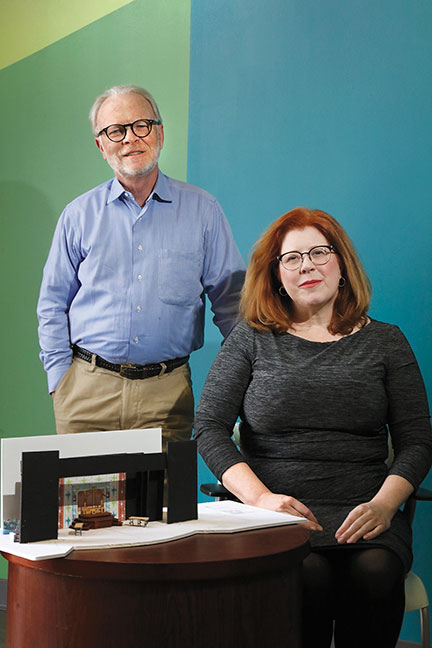
William Goldsmith with Susan Pringle who was hired as CCT’s executive director in 2017.
Photo © Larry Hamill.From Ft. Hayes, Pringle went on to Wright State University where she did her undergraduate work in theater design and technology. “I would have gone into stage management, but at that time, stage management was structured in a program that included acting,” she says. Pringle wasn’t interested in performing, so she began the process of restructuring (with the school) her own theater program that, while deeply rooted in the design and technology departments, became more balanced overall – including courses in stage management and directing.
Following graduation, Pringle worked as a professional stage manager for three years with various companies, then went on to work with the Muse Machine, a children’s arts program in the Dayton area. She served initially as an assistant program director then took on the role of their executive director. “I was there for 15 years,” she says. “It’s a great organization with strong community support, and I loved my time there.” But after 15 years, she realized it was time for new challenges.
And there were plenty of challenges awaiting her in the time between leaving Dayton and arriving in Columbus. There was a time, for example, when she managed fund-raising for the Merton Institute in Louisville, and when she formed her own business, working, in essence, as a crisis manager for small to medium-sized companies, most of which had fallen into financial distress. She took time out, in that interim, to pursue her master’s degree in human resource development. “No matter what the crisis, we were always getting tapped for information dealing with human resources,” says Pringle. The master’s degree seemed the right course to take at the time, and one that would serve her no matter what lay ahead.
And what lay ahead was Columbus.
She contacted the Benefactor Group (a recruiting firm that searches for non-profit CEOs) to look at a position with the Pizzuti Collection. The position didn’t seem a good fit, but the recruiters told her that the Columbus Children’s Theatre was looking to hire an executive director. Pringle applied and as the saying goes, the rest is history.The job:
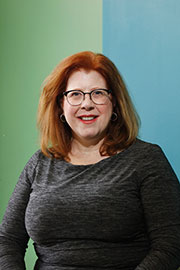
Susan Pringle . Photo © Larry Hamill. For years, Bill Goldsmith was Columbus Children’s Theatre. He came into the organization, known then as Columbus Junior Theatre, in 1989 as its executive director and formed the Children’s Theatre Series shortly thereafter. “It was more of an academy at the time. I thought they should be performing plays,” he says – even if that meant creating a theater space for the theater series. Goldsmith did just that, nearly single-handedly. At that time, there was no artistic director, only Goldsmith, an assistant, and a part-time janitor. Then, “sometime in the ‘90s, my title changed to executive director/artistic director. As we grew and added staff, my title became artistic director,” he says.
His vision at the time was to move CCT toward becoming a professional theater company, but with a budget of only $110,000 (it’s now over a million), there were limitations. If there is one thing he regrets during those early days, it’s not hiring more artistic staff – although the budget wasn’t necessarily there. Still, even with a small staff and small budget, CCT put on four shows a year – even if the stage “lights” were coffee cans painted black and the ”light system” consisted of rigging sticks together so the “lighting technician” could dim three switches at once. CCT has come a long way.
“My vision was to use children in children’s roles, adults in adult roles,” he says. He was one of the first pioneers to try that particular model. “Most theater companies use adults in children’s roles because a lot of school performances are done during the day, so adults are needed. I’ve always felt, however, that children feel more empowered when they see someone like themselves in the role.”
That model may change now, Goldsmith says, as CCT works toward more daytime performances and a greater presence in the schools. There are likely to be even more changes ahead with Pringle now at the helm. Goldsmith, 68, will retire in June on his 30th anniversary. “Susan is intelligent and eloquent. She’s a great person to represent CCT as it moves forward,” says Goldsmith.
***
“As executive director,” says Pringle, “my job is to carry out the institutional vision of Columbus Children’s Theatre and to serve as the face of the organization in terms of the business community.”
As executive director, she has oversight of all the organization’s finances; she is in charge of all hiring, board communications, professional development for staff and artists, and all of the theater company’s business functions, which range from arranging for royalties to approving contracts.
With all that having been said, however, Pringle is quick to note that “The creative process is at the heart of CCT,” and she hopes to make in-roads by looking at what’s trending in terms of education and to help the organization adapt to the needs of schools and the community.
“I know from having worked with children before that they are capable of doing so much more than even they think possible,” she says.
It’s the theater’s job – and hers as well, she believes – to encourage that ability to stretch and do the impossible. She’s realistic, however. “Most of the kids who come here aren’t going on to professional acting or theater careers,” she says. “Some will. But the majority of them will become audience members and arts patrons in the future,” and that may be the biggest benefit of a children’s theater company, it’s greatest strength, she says.
“Theater interrupts the daily cycle of a child’s life. It takes them away from school and video games, it disrupts habits and patterns and brings them into an environment where they’re presented with opportunities and challenges. They come watch a play and think about what they’ve seen. It’s a shared experience, with family and friends, and dialogue often follows,” she says.The future:
CCT is currently looking at its educational programming, says Pringle. “The program must evolve to fill the needs of the schools as they exist right now,” she says. That’s especially true when it comes to schools of the surrounding community. “We pull a lot of our audience from the suburbs, but we have an opportunity to improve on that.” Working with the schools is one way to do that. “I sat in on a performance of Rent last year that was presented at Eastmoor Academy. I was wowed. Those kids did an amazing job. So when we stage Bring It On this summer, we’ll do what the Broadway shows often do, and that’s to preview it first at another location. So we’ll present Bring It On for a weekend (three performances) at Eastmoor before we move it onto our stage.”
She also hopes to bring more middle-school children into theater by expanding the season and presenting plays that children that age will enjoy. “Last year, we staged Dracula,” she says. It wasn’t terribly dark, but it was tough – not the kind of performance you would bring your six or even eight-year old to. “We also staged Tuck Everlasting” – a classic children’s book that deals with the topic of death and immortality. “When I asked my (tweener) son what were his favorite productions last year, these are the two he named, so I know we’re doing something right.”
Pringle says she also hopes for more partnerships along the way – along the lines of shared productions, like the one with Eastmoor, and the upcoming production of West Side Story that will be presented with the Short North Stage in October. “Partnerships benefit the arts community as a whole,” says Pringle.
Organizations that have been stymied by a lack of resources, or staffing or talent learn that by pooling their efforts, they can provide the kind of entertainment they have been longing to do – and their audiences to see.
But it’s CCT’s partnership with the kids themselves that Pringle is most looking forward to. “The kids can start here as young as three, attending classes and seeing plays. To audition for a mainstage show, they must be 10 years old, so if they continue theater in school, they may become partners with us in future productions.”
The same is true if they pursue theater majors in college. “They can work for us as interns,” and eventually become members of CCT staff. Or, if they go to New York for a few years to try their craft there and then return to Columbus, “We’ll hire them as teaching professionals.”
The partnership is an evolution, but one that never takes its eye off theater, the arts, and its contribution to the community.
That’s what Pringle is keeping her eye on. “It’s an exciting time,” she says, “and I want to be there during this. I want to be in the thick of things.”Visit www.columbuschildrenstheatre.org and www.shortnorthstage.org to learn more about programs and performances
© 2019 Short North Gazette, Columbus, Ohio. All rights reserved.
Return to Homepage www.shortnorth.com